★
테스트를 통해 어휘력 다지기!
☞ 어휘력 [wish - (28)] - Ⅰ → [단어/숙어 18]
★
"asteroid"의 동의어 (3).
1.
While the general public often uses
the colloquial term ________
to describe any rocky debris entering the atmosphere,
researchers prefer more precise classifications
based on the object's chemical composition and orbital trajectory.
A) space rock
B) minor planet
C) astronomical object
D) planetoid
Answer: A
Explanation:
"Space rock" is an informal,
non-scientific term used by the general public
to describe rocky bodies in space,
contrasting with the precise language used by researchers.
2.
In the 19th century,
the term ________ was frequently employed
to describe moons or smaller satellites
that were considered subordinate to the major planets
they orbited,
reflecting an early hierarchical view of our solar system.
A) celestial body
B) secondary planet
C) heavenly body
D) asteroid
Answer: B
Explanation:
"Secondary planet" is a historical and specific term
used for subordinate bodies (like moons)
that are smaller than major planets.
3.
The discovery of Ceres initially sparked a debate
among astronomers,
leading to its eventual classification as a ________
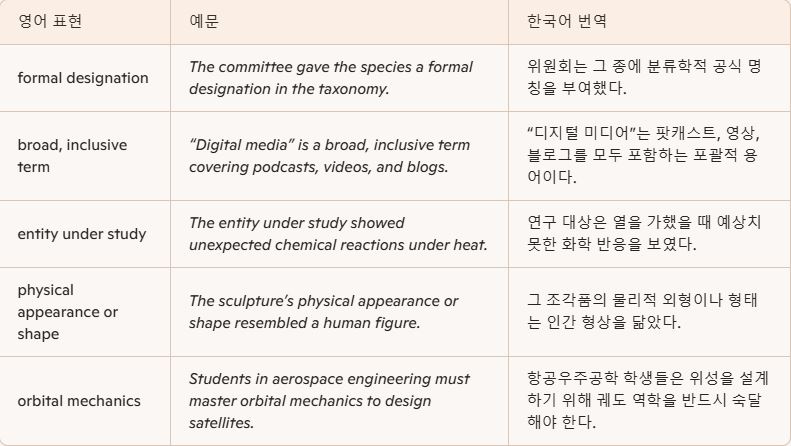
—a formal designation for any object orbiting the Sun
that is neither a major planet nor a comet.
A) space rock
B) planetoid
C) minor planet
D) heavenly body
Answer: C
Explanation:
"Minor planet" is the official scientific category
for small solar system bodies
(like asteroids and dwarf planets) that orbit the Sun.
4.
Deep-space telescopes like James Webb
allow us to observe a distant ________
that may include not only stars and nebulae
but also complex dark matter structures
that remain invisible to the naked eye.
A) space rock
B) secondary planet
C) planetoid
D) astronomical object
Answer: D
Explanation:
"Astronomical object" is a broad, inclusive term
used in professional research to cover any entity under study,
from nebulae to dark matter.
5.
Some astronomers use the term ________
to describe larger, spherical asteroids
that possess enough mass to resemble a small planet,
though they still fail to clear their own orbital path.
A) planetoid
B) celestial body
C) secondary planet
D) space rock
Answer: A
Explanation:
"Planetoid" (meaning planet-like) is often used
for larger asteroids
that have the physical appearance or shape
of a small planet.
6.
Throughout human history,
any ________ seen moving across the night sky,
whether it be a planet, a star, or a comet,
was often interpreted as a divine omen or a mystical sign
from the gods.
A) astronomical object
B) heavenly body
C) minor planet
D) secondary planet
Answer: B
Explanation:
"Heavenly body" is a literary and traditional term
used to describe objects in the sky with a sense of wonder,
often in historical or religious contexts.
7.
Gravitational microlensing has become a vital tool
for detecting a ________
—an all-encompassing term
for any natural physical entity in the observable universe—
located millions of light-years away.
A) minor planet
B) space rock
C) celestial body
D) asteroid
Answer: C
Explanation:
"Celestial body" is a formal,
broad term for any natural object in space (stars, planets, etc.),
making it suitable for a discussion on everything
in the observable universe.
8.
When a rogue ________ enters a stable planetary system,
its gravitational pull can destabilize
the orbits of surrounding debris,
potentially leading to catastrophic collisions over millions of years.
A) heavenly body
B) astronomical object
C) secondary planet
D) asteroid
Answer: D
Explanation:
"Asteroid" is the specific and most common term
for the rocky,
airless bodies found in space,
particularly when discussing
physical collisions and orbital mechanics.
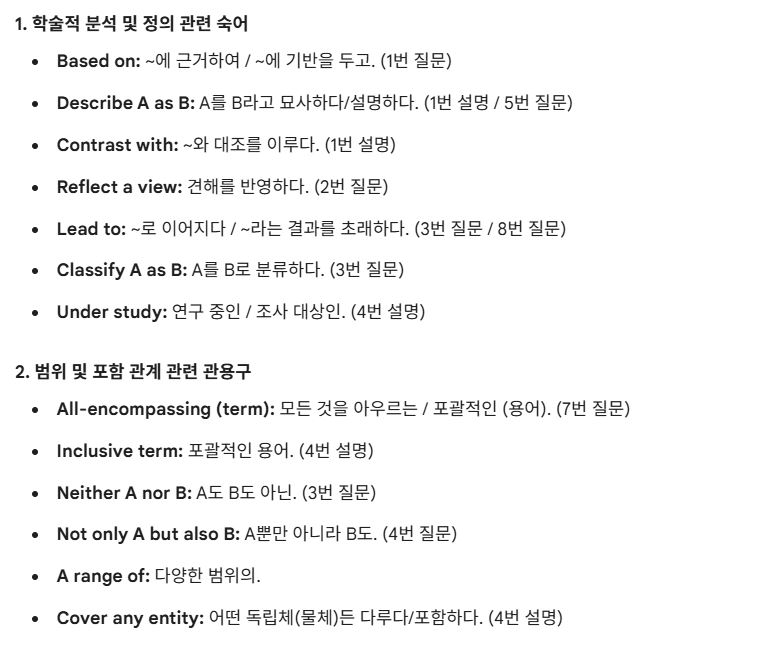
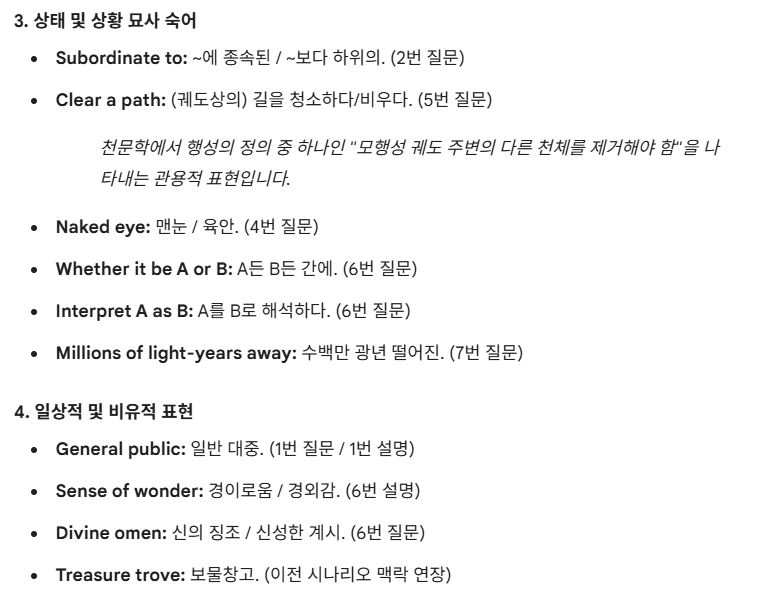
☞ [숙어 / 관용구]

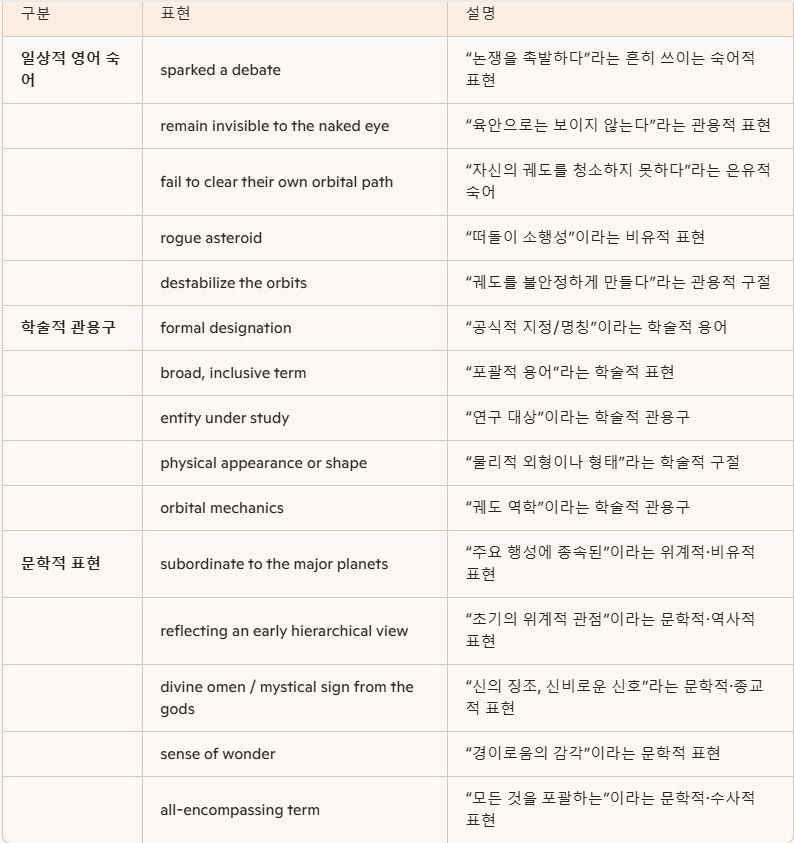
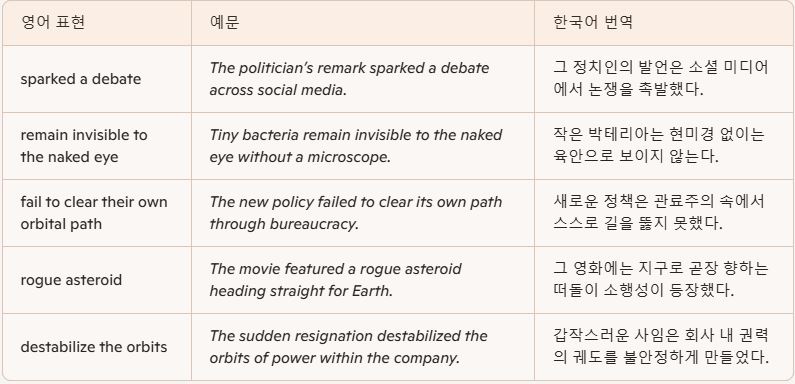
☞ [숙어 / 관용적 표현 보충과 예문]

'영어 어휘력 기르기' 카테고리의 다른 글
| 어휘력 [wish - (28)] - Ⅰ → [단어/숙어 18] → [테스트 2] (1) | 2026.04.25 |
|---|---|
| 어휘력 [wish - (28)] - Ⅰ → [단어/숙어 18] → [테스트 1] (1) | 2026.04.25 |
| 어휘력 [wish - (28)] - Ⅰ → [단어/숙어 17] → [테스트 3] (0) | 2026.04.23 |
| 어휘력 [wish - (28)] - Ⅰ → [단어/숙어 17] → [테스트 2] (0) | 2026.04.23 |
| 어휘력 [wish - (28)] - Ⅰ → [단어/숙어 17] → [테스트 1] (0) | 2026.04.23 |