★
테스트를 통해 어휘력 다지기!
☞ 어휘력 [wish - (28)] - Ⅰ → [단어/숙어 17]
★
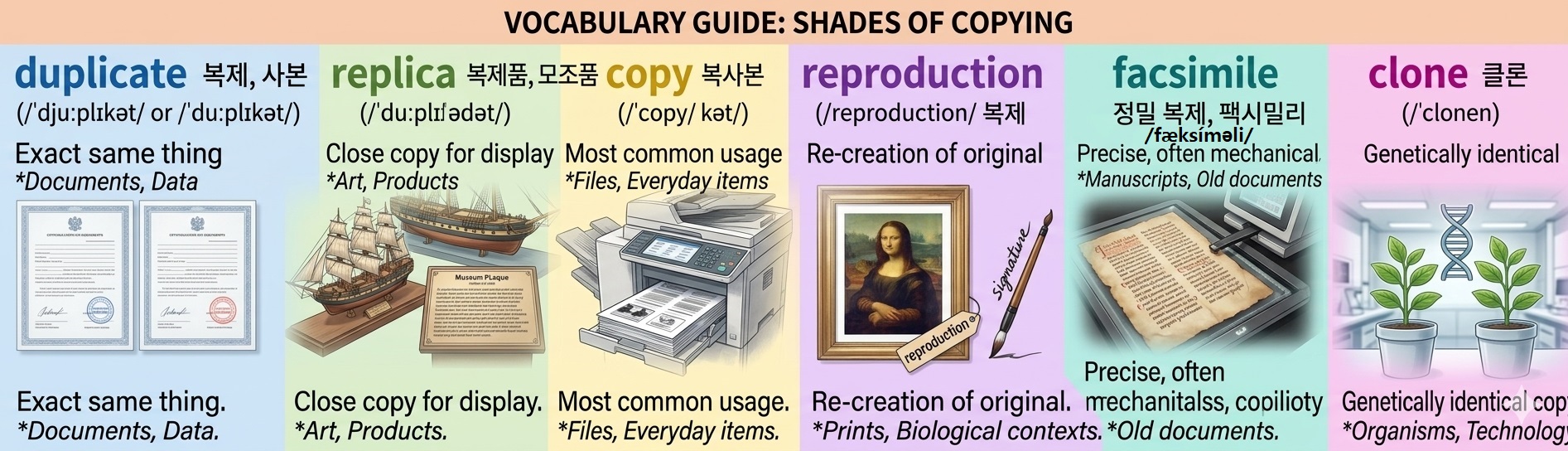
"clone"의 동의어 (1).
1.
The Art Gallery Scenario:
A world-renowned museum
wants to display
a perfect, full-scale physical model
of a fragile ancient statue
so that the public can appreciate its beauty
without risking damage to the original artifact.
What is this professional reconstruction called?
A) Xerox
B) Replica
C) Copycat
D) Imitator
Answer: B
Explanation:
A replica refers to
an exact, high-quality reproduction
of an object,
often used for artworks or historical artifacts
to maintain the aesthetic value of the original.
2.
The Tech Startup Conflict:
A new smartphone app has just been released,
and it looks almost identical
to a famous social media platform.
The public criticizes the developers
for simply stealing the idea and UI design
without any innovation.
In a casual, slightly negative context,
how would you describe this entity?
A) Facsimile
B) Clone
C) Copycat
D) Duplicate
Answer: C
Explanation:
Copycat is an informal term
used to describe someone or something
that mimics another's work or style,
often implying a lack of original thought or creativity.
3.
The Science Fiction Dilemma:
In a futuristic society,
a laboratory has successfully created
a genetically identical human being
through advanced bio-engineering.
This "person" possesses the same DNA
as the donor but is treated as a manufactured entity.
What term is specifically used
for this bio-engineered being?
(명사로서의 being은 "생물", "인간", "존재" 그 자체.)
A) Replicant
B) Lookalike
C) Xerox
D) Facsimile
Answer: A
Explanation:
Replicant is a specialized term,
primarily found in sci-fi (like Blade Runner),
to describe a bio-engineered or synthetic being
that is a "copy" of a human.
4.
The Administrative Error:
A lawyer realizes
that the original contract was lost in a fire.
Fortunately,
he finds an extra, identical legal document
that was printed at the exact same time
as the original to serve as a backup.
What is this functional, identical document called?
A) Reproduction
B) Imitator
C) Duplicate
D) Lookalike
Answer: C
Explanation:
A duplicate is an exact copy
of an original (documents, keys, or data)
meant to function in the same way as the original.
5.
The Biology Experiment:
A researcher takes a single cell from a rare plant
and uses it to grow an entirely new organism
that is genetically 100% identical to the parent.
This process is used
to preserve the species' exact genetic code.
What is this organism called?
A) Clone
B) Copycat
C) Xerox
D) Facsimile
Answer: A
Explanation:
A clone is a biological entity
that is genetically identical to the original organism,
produced through asexual reproduction
or laboratory techniques.
6.
The Rare Book Preservation:
A historian wants to publish
a printed version of a 15th-century manuscript.
He ensures
that every stain, handwriting quirk, and page texture
is captured exactly
as it appears in the original book
to provide an authentic experience for researchers.
What is this precise reproduction called?
A) Duplicate
B) Facsimile
C) Imitator
D) Copycat
Answer: B
Explanation:
A facsimile is
a very precise, faithful reproduction
of a document, book, or map
that aims to be as close to the original as possible
in every detail.
7.
The Street Performer:
At a tourist spot,
you see a man
who happens to have
the exact same facial structure, hair, and height
as a famous Hollywood actor.
He isn't related to the actor and isn't a robot;
he just happens to look exactly like him.
What do you call this person?
A) Replicant
B) Reproduction
C) Replica
D) Lookalike
Answer: D
Explanation:
A lookalike is a person or thing
that has a very strong physical resemblance
to someone or something else,
purely in terms of appearance.
8.
The Office Task:
An employee is asked to quickly produce
ten paper versions of a memo
to distribute during a meeting.
He goes to the large machine in the hallway
to get the job done.
Which term is often used
as a verb or a noun
derived from a famous brand name for this task?
A) Xerox
B) Clone
C) Replicant
D) Facsimile
Answer: A
Explanation:
Xerox is a trademark name
that became a common term
for making photocopies of documents
in an office setting.
9.
The Fine Art Print:
A photographer decides to print
50 copies of his award-winning sunset photo
to sell to collectors.
While they are not the "original" digital file,
they are high-quality versions
made by the creator for the purpose of distribution.
What is the best term for these?
A) Copycat
B) Lookalike
C) Reproduction
D) Replica
Answer: C
Explanation:
Reproduction is
the act or process
of recreating an original work,
especially in the context
of art, photography, or biological processes
where a new version is "produced" again.
10.
The Everyday Generic Term:
A student asks his friend
for a digital file of the lecture notes.
He doesn't need
a high-quality art print or a biological twin;
he just needs
the most common, general version
of that information.
Which term is the most universal?
A) Replicant
B) Imitator
C) Facsimile
D) Copy
Answer: D
Explanation:
Copy is the most general and widely used term
for any version of an original
(files, documents, or objects).
11.
The Talent Show Critic:
A judge at a music competition tells a contestant,
"You sound exactly like Michael Jackson,
but you lack your own soul.
You are just mimicking his every move."
In this context,
the judge is referring to the person
as a person who copies others.
Which term fits?
A) Duplicate
B) Imitator
C) Xerox
D) Replica
Answer: B
Explanation:
An imitator is a person
who copies
the behavior, voice, or style
of another,
often used in performance or sometimes
with a negative connotation of lacking originality.
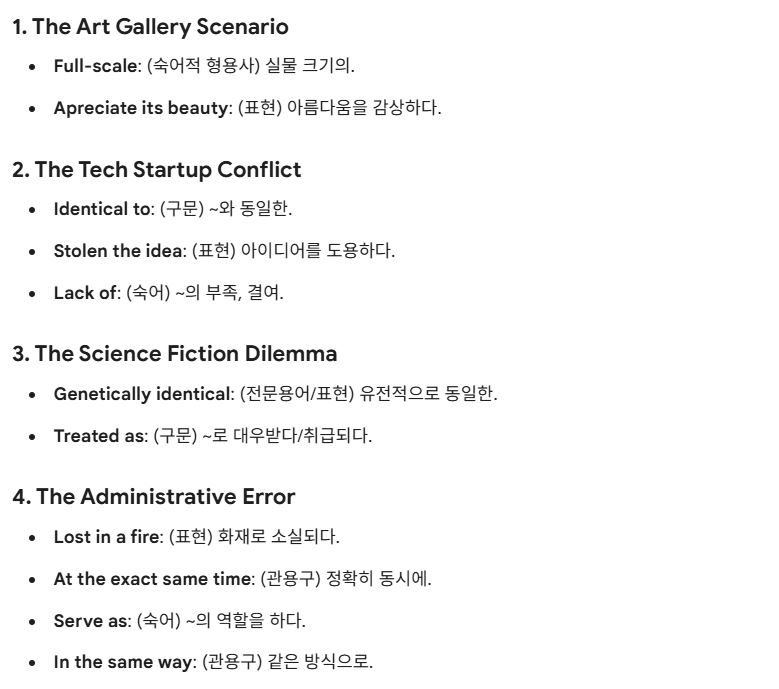
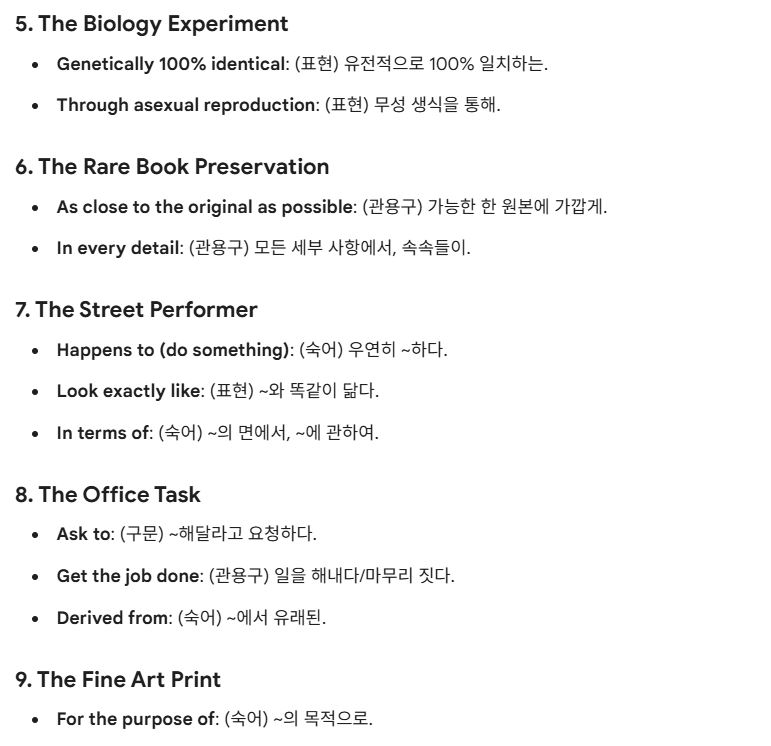
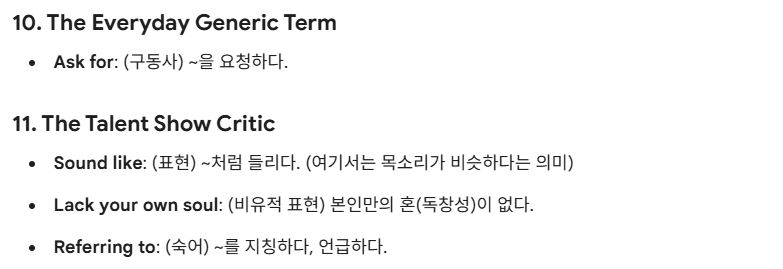
☞ [숙어 / 관용구]
→ [수정]
목록 1번: Apreciate → Appreciate
☞ [학습용 단어장]

'영어 어휘력 기르기' 카테고리의 다른 글
| 어휘력 [wish - (28)] - Ⅰ → [단어/숙어 17] → [테스트 3] (0) | 2026.04.23 |
|---|---|
| 어휘력 [wish - (28)] - Ⅰ → [단어/숙어 17] → [테스트 2] (0) | 2026.04.23 |
| 어휘력 [wish - (28)] - Ⅰ → [단어/숙어 16] → [테스트 3] (0) | 2026.04.21 |
| 어휘력 [wish - (28)] - Ⅰ → [단어/숙어 16] → [테스트 2] (0) | 2026.04.21 |
| 어휘력 [wish - (28)] - Ⅰ → [단어/숙어 16] → [테스트 1] (1) | 2026.04.21 |