★
테스트를 통해 어휘력 다지기!
☞ 어휘력 [wish - (28)] - Ⅰ → [단어/숙어 17]
★
"clone"의 동의어 (2).
1.
How would you distinguish a "duplicate"
from a "copy" in a legal context?
A) A duplicate is always hand-written,
whereas a copy is always digital.
B) A duplicate refers to people,
while a copy refers to objects.
C) There is no difference;
they are used interchangeably in all situations.
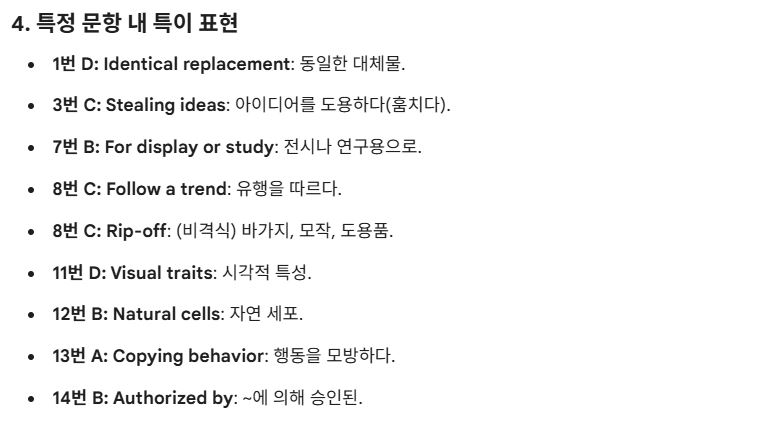
D) A duplicate is a functional identical replacement,
while a copy is just a reproduction.
Answer: D
Explanation:
A duplicate is an exact counterpart of an original
(like a second original) often used for legal validity,
while copy is a general term for any reproduction.
2.
What is the primary difference
between a "replica" and a "lookalike"?
A) A replica is a living organism,
while a lookalike is a machine.
B) A replica is a high-quality reconstruction of an object,
while a lookalike refers to visual resemblance,
often in people.
C) A replica is always smaller than the original,
whereas a lookalike is larger.
D) A replica is used in sci-fi,
while a lookalike is used in biology.
Answer: B
Explanation:
Replica refers to a faithful reproduction of an object
(like a statue),
while lookalike focuses on a person or thing
that happens to look very similar to another.
3.
In terms of connotation,
how do you distinguish an "imitator" from a "copycat"?
A) An imitator is always a robot,
while a copycat is always a human.
B) An imitator is a formal term for biology,
while a copycat is a formal term for law.
C) An imitator often refers to a performer mimicking someone,
while copycat is an informal,
often negative term for someone stealing ideas.
D) There is no difference in tone;
both are strictly professional terms.
Answer: C
Explanation:
Imitator is neutral and often used for performers/actors;
copycat is informal and carries a negative nuance
of lacking originality.
4.
What is the main difference
between "reproduction" and "facsimile"?
A) Reproduction is a type of music,
while facsimile is a type of dance.
B) Reproduction only applies to plants,
while facsimile only applies to animals.
C) Reproduction is always digital,
while facsimile is always a physical 3D model.
D) Reproduction is a broad term for making more of something,
while facsimile is
an extremely precise, detailed copy of a document.
Answer: D
Explanation:
Reproduction is broad (art, photos, biology);
facsimile is a specialized term for an exact,
"true-to-original" copy of a book or manuscript.
5.
How would you distinguish a "clone"
from a "replicant" in modern English?
A) A clone is a biological organism with identical DNA,
while a replicant is a fictional synthetic being from sci-fi.
B) A clone is a machine, while a replicant is a natural birth.
C) A clone is a copy of a document,
while a replicant is a copy of a key.
D) A clone is a negative term,
while a replicant is a scientific term.
Answer: A
Explanation:
Clone is a real scientific term for genetic identity;
replicant is a literary/SF term for manufactured beings.
6.
What is the difference
between "Xerox" and "copy" in an office setting?
A) Xerox is a term for hand-drawing,
while copy is for printing.
B) Xerox specifically implies the use of a photocopier
(derived from the brand),
while copy is the universal term.
C) Xerox is used only for color images,
while copy is for black and white.
D) Xerox is a formal scientific process,
while copy is an informal slang.
Answer: B
Explanation:
Xerox is a proprietary eponym
used as a verb or noun for photocopying,
whereas copy is the general action.
7.
How do you distinguish a "duplicate" key
from a "replica" statue?
A) A duplicate is a negative imitation,
while a replica is a legal document.
B) A duplicate is meant to perform the same function,
while a replica is often for display or study.
C) A duplicate must be larger than the original,
but a replica must be smaller.
D) A duplicate is made of plastic,
while a replica is made of metal.
Answer: B
Explanation:
Duplicate emphasizes functional equivalence
(opening the same lock),
while replica emphasizes aesthetic or historical recreation.
8.
What is the difference
between "copycat" and "imitator" in business?
A) A copycat is a person, while an imitator is a corporation.
B) A copycat is a legal term, while an imitator is a slang term.
C) A copycat steals a business model or product design,
while an imitator might just follow a trend respectfully.
D) A copycat refers to genetic engineering,
while an imitator refers to art.
Answer: C
Explanation:
In business,
a copycat product is a derogatory term for a rip-off,
whereas imitator can be a more neutral description
of a market follower.
9.
How would you distinguish "reproduction"
from "clone" in a biological context?
A) Reproduction is the general process of creating offspring,
while a clone is an offspring
with 100% identical DNA to one parent.
B) Reproduction is artificial, while a clone is always natural.
C) Reproduction is for computers, while a clone is for documents.
D) There is no difference; they mean the exact same thing in biology.
Answer: A
Explanation:
Reproduction is the broad biological category;
clone is the specific result of asexual or laboratory genetic copying.
10.
What is the difference between "facsimile" and "Xerox"?
A) A facsimile is a living person, while a Xerox is a dead object.
B) A facsimile is always a digital scan,
while a Xerox is always a hand-written note.
C) A facsimile is a high-quality reproduction of rare books/docs,
while a Xerox is a common office photocopy.
D) A facsimile is an informal slang,
while a Xerox is a scientific breakthrough.
Answer: C
Explanation:
Facsimile implies a high degree of fidelity for archival purposes;
Xerox is a quick, everyday reproduction for administrative use.
11.
How do you distinguish a "lookalike" from a "duplicate"?
A) A lookalike is a machine, while a duplicate is a human.
B) A lookalike is a functional replacement,
while a duplicate is just for show.
C) A lookalike is for documents,
while a duplicate is for celebrities.
D) A lookalike shares visual traits,
while a duplicate is an exact functional and structural copy.
Answer: D
Explanation:
Lookalike is about appearance (e.g., an Elvis lookalike);
duplicate is about being an exact second version
of the original entity.
12.
What is the difference
between "replicant" and "clone" in literature?
A) Replicants are animals, while clones are only plants.
B) Replicants are often biorobotic or synthetic,
while clones are usually born from natural cells.
C) Replicants are only found in historical fiction,
while clones are in romance.
D) Replicants are the "original" and clones are the "copies."
Answer: B
Explanation:
In SF contexts,
replicants are typically manufactured/assembled (synthetic),
whereas clones are grown
from the genetic material of an existing donor.
13.
How do you distinguish an "imitator" from a "lookalike"?
A) An imitator focuses on copying behavior/voice,
while a lookalike focuses on physical appearance.
B) An imitator is a statue, while a lookalike is a painting.
C) An imitator is a biological term,
while a lookalike is a legal term.
D) There is no way to distinguish them;
they are synonyms in every case.
Answer: A
Explanation:
Imitator is an active role (mimicking actions/speech);
lookalike is a passive state of looking like someone else.
14.
What is the difference
between "copy" and "reproduction" in the art world?
A) A copy is a negative fake,
while a reproduction is a government document.
B) A copy is a general term,
while a reproduction often refers to a professional print
authorized by the artist or gallery.
C) A copy is always a sculpture,
while a reproduction is always a poem.
D) A copy is made by a machine,
while a reproduction is made by a cat.
Answer: B
Explanation:
While similar,
reproduction is the formal term
used by galleries for high-quality prints of an original work.
15.
How would you distinguish a "facsimile" from a "replica"?
A) Facsimile usually refers to two-dimensional items (documents),
while replica often refers to three-dimensional objects (statues).
B) Facsimile is a biological term, while replica is a computer term.
C) Facsimile is an informal slang, while replica is a trademark.
D) Facsimile means "fake," while replica means "genuine."
Answer: A
Explanation:
Facsimile is historically used for manuscripts/books;
replica is more common for 3D objects like artifacts or cars.
16.
What is the difference between "Xerox" and "duplicate"?
A) Xerox refers to people, while duplicate refers to feelings.
B) Xerox is a type of food, while duplicate is a type of clothing.
C) Xerox is always a failure, while duplicate is always a success.
D) Xerox is a brand-related term for copying,
while duplicate implies the creation
of a formal, identical second version.
Answer: D
Explanation:
Xerox describes the method (photocopying);
duplicate describes the status of the resulting object
as an identical second original.
17.
How do you distinguish a "copycat" from a "replica"?
A) A copycat is a person who mimics others (often negatively),
while a replica is a physical recreation of an object.
B) A copycat is an exact statue,
while a replica is a person who steals ideas.
C) A copycat is used in science, while a replica is used in slang.
D) They are both used only for digital files.
Answer: A
Explanation:
Copycat is person-oriented or idea-oriented (behavioral);
replica is object-oriented (physical).
18.
What is the difference between "clone" and "copy"?
A) A clone is a type of fruit, while a copy is a type of vegetable.
B) A clone is an old term, while a copy is a futuristic term.
C) A clone implies genetic or structural identity
at the most fundamental level,
while copy is a broad term for any likeness.
D) A clone is always a paper document, while a copy is always a person.
Answer: C
Explanation:
Clone is specific to exact biological or technical replication
(like "disk cloning"),
whereas copy is the most general term available.
19.
How would you distinguish a "replicant" from an "imitator"?
A) A replicant is a person who acts like a celebrity.
B) A replicant is an artificial being in fiction,
while an imitator is a real person who mimics someone's style.
C) A replicant is a photocopier, while an imitator is a DNA strand.
D) They are the same; both refer to people who like to draw.
Answer: B
Explanation:
Replicant belongs to the world of science fiction;
imitator belongs to the real world of performance and behavior.
20.
What is the difference between "lookalike" and "facsimile"?
A) A lookalike is a genetic twin,
while a facsimile is a fake diamond.
B) A lookalike is a verb, while a facsimile is an adjective.
C) A lookalike is a legal document, while a facsimile is a movie star.
D) A lookalike is usually a person who resembles another,
while a facsimile is an exact copy of a document or book.
Answer: D
Explanation:
Lookalike is about visual resemblance in people/things;
facsimile is about the high-fidelity reproduction
of graphic/textual information.
☞ [숙어 / 관용구]


'영어 어휘력 기르기' 카테고리의 다른 글
| 어휘력 [wish - (28)] - Ⅰ → [단어/숙어 18] → [테스트 1] (1) | 2026.04.25 |
|---|---|
| 어휘력 [wish - (28)] - Ⅰ → [단어/숙어 17] → [테스트 3] (0) | 2026.04.23 |
| 어휘력 [wish - (28)] - Ⅰ → [단어/숙어 17] → [테스트 1] (0) | 2026.04.23 |
| 어휘력 [wish - (28)] - Ⅰ → [단어/숙어 16] → [테스트 3] (0) | 2026.04.21 |
| 어휘력 [wish - (28)] - Ⅰ → [단어/숙어 16] → [테스트 2] (0) | 2026.04.21 |