★
테스트를 통해 어휘력 다지기!
☞ 어휘력 [wish - (28)] - Ⅰ → [단어/숙어 18]
★
"asteroid"의 동의어 (1).
1.
A scientist at NASA
is writing a formal research paper
for the International Astronomical Union (IAU)
about an object orbiting the Sun
that is neither a planet nor a comet.
Which official term is most appropriate
for this academic context?
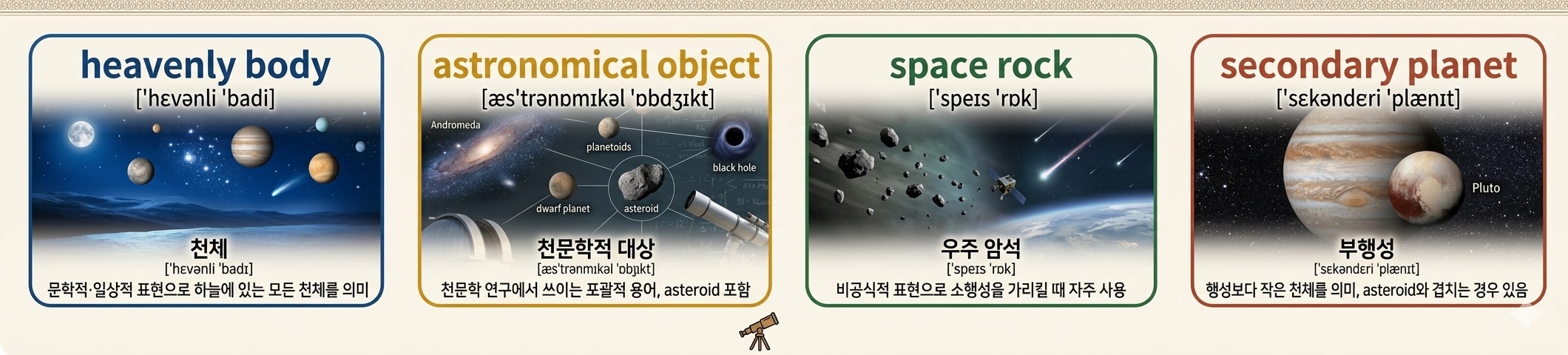
A) Space rock
B) Minor planet
C) Heavenly body
D) Secondary planet
Answer: B
Explanation:
"Minor planet" is the official astronomical term
used by organizations
like the IAU to categorize objects
like asteroids
that orbit the Sun
but do not meet the criteria of a major planet.
2.
While watching a meteor shower in the backyard,
a child points to the sky
and asks their parent about the glowing streaks of light.
The parent wants to explain
that even though they look like "shooting stars,"
they are actually small chunks of stone or metal
traveling through space.
Which informal term would the parent likely use?
A) Space rock
B) Astronomical object
C) Celestial body
D) Minor planet
Answer: A
Explanation:
"Space rock" is an informal,
non-scientific term frequently
used in daily conversation or popular media
to describe asteroids or meteoroids
in a way that is easy to visualize.
3.
A poet is writing a beautiful piece
about the vastness of the night sky,
describing the planets, stars, and moons
as majestic entities watching over the Earth.
Which term best fits this lyrical and emotional context?
A) Minor planet
B) Planetoid
C) Heavenly body
D) Astronomical object
Answer: C
Explanation:
"Heavenly body" carries a literary and traditional nuance,
often used in poetry or everyday language
to describe anything seen in the sky
with a sense of wonder.
4.
An astronomer is giving a lecture
on the broad classification of everything
in the universe.
They need a term
that serves as an "umbrella" to include
stars, galaxies, nebulae, and asteroids alike.
Which term is the most inclusive
for any physical entity in space?
A) Secondary planet
B) Space rock
C) Planetoid
D) Celestial body
Answer: D
Explanation:
"Celestial body" is a comprehensive term
that encompasses all natural objects found
in the universe,
regardless of their specific size or type.
5.
During a sci-fi movie,
the captain of a starship detects a large, rocky object
that is roughly the size of a small moon
but lacks a clear atmosphere.
The crew refers to it as a "little planet"
because of its shape.
Which term is almost synonymous with "asteroid"
but emphasizes its planet-like appearance?
A) Heavenly body
B) Planetoid
C) Minor planet
D) Celestial body
Answer: B
Explanation:
"Planetoid" literally means "planet-like."
It is often used interchangeably with asteroid,
especially when emphasizing
that the object is a small, rocky body
resembling a tiny planet.
6.
A news reporter is interviewing a professor
about a new discovery.
The professor wants to use a broad, scientific term
that refers to the object specifically
as a target of professional study and observation,
including its physical properties.
Which term would they choose?
A) Space rock
B) Heavenly body
C) Astronomical object
D) Planetoid
Answer: C
Explanation:
"Astronomical object" is a professional and inclusive term
used in the context of scientific research
to refer to any entity under astronomical study.
7.
In an older astronomy textbook,
a researcher is discussing a moon
that orbits a larger planet.
Instead of calling it a "satellite,"
they use a term
that suggests
it is a smaller, subordinate planetary body.
Which term might they use?
A) Secondary planet
B) Space rock
C) Minor planet
D) Celestial body
Answer: A
Explanation:
"Secondary planet" is an older or more specific term
used to describe bodies smaller than major planets,
sometimes referring to moons or objects
whose orbits are influenced by larger planets.
8.
A space agency releases a warning
about a rocky object
between Mars and Jupiter
that might collide with a satellite.
They use the most common, specific name
for these rocky bodies found primarily
in the belt between those two planets.
What is this term?
A) Heavenly body
B) Celestial body
C) Minor planet
D) Asteroid
Answer: D
Explanation:
"Asteroid" is
the primary and most common term
for the rocky,
airless remnants left over
from the early formation of our solar system,
typically found in the asteroid belt.
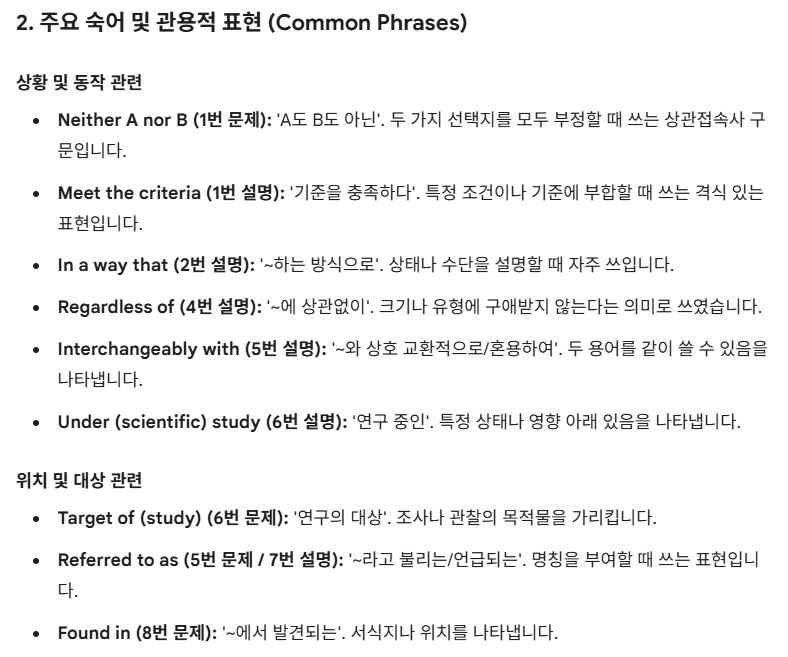
☞ [숙어 / 관용구]

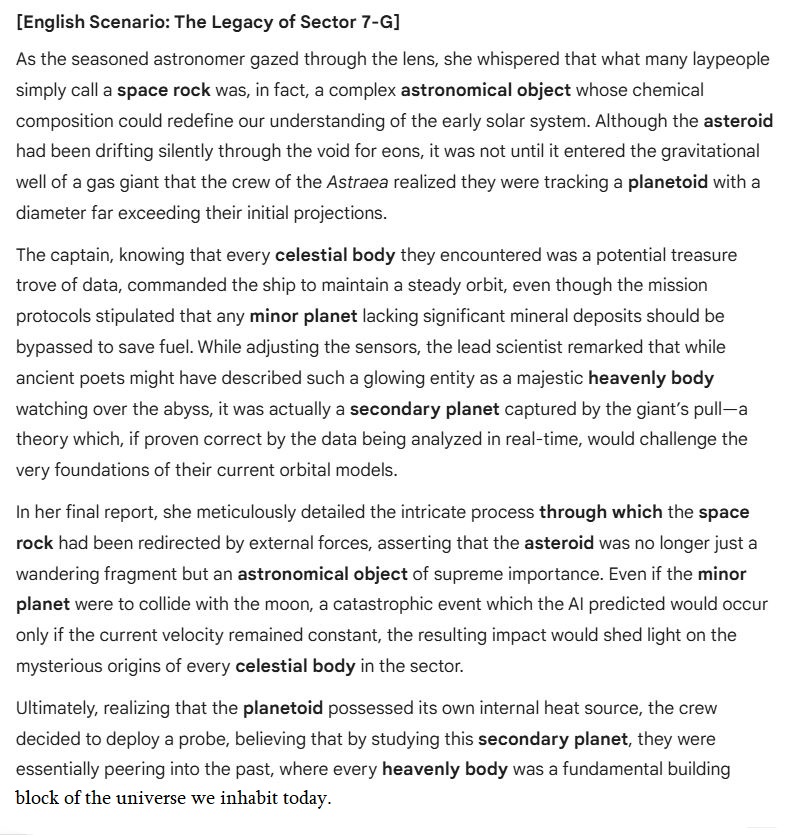
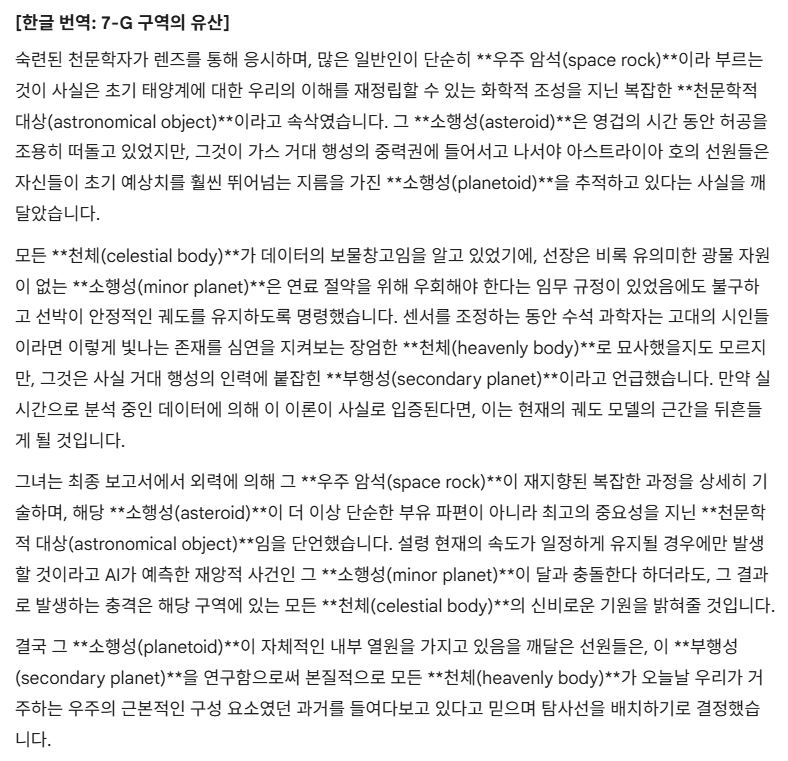
☞ [8개 단어를 활용한 하나의 유기적 스토리 예문]
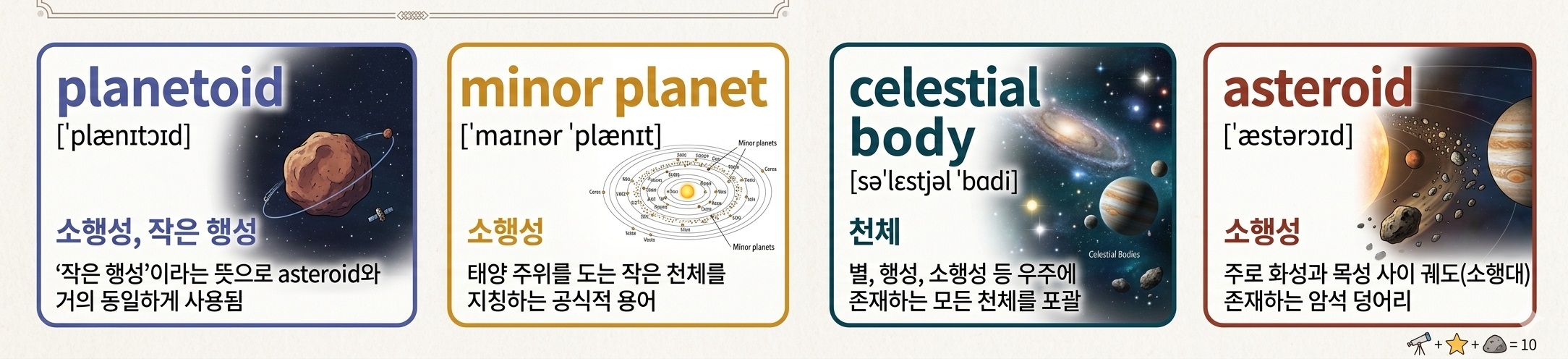
☞ [학습용 단어장]
'영어 어휘력 기르기' 카테고리의 다른 글
| 어휘력 [wish - (28)] - Ⅰ → [단어/숙어 18] → [테스트 3] (1) | 2026.04.25 |
|---|---|
| 어휘력 [wish - (28)] - Ⅰ → [단어/숙어 18] → [테스트 2] (1) | 2026.04.25 |
| 어휘력 [wish - (28)] - Ⅰ → [단어/숙어 17] → [테스트 3] (0) | 2026.04.23 |
| 어휘력 [wish - (28)] - Ⅰ → [단어/숙어 17] → [테스트 2] (0) | 2026.04.23 |
| 어휘력 [wish - (28)] - Ⅰ → [단어/숙어 17] → [테스트 1] (0) | 2026.04.23 |