★
테스트를 통해 어휘력 다지기!
☞ 어휘력 [wish - (28)] - Ⅰ → [단어/숙어 18]
★
"asteroid"의 동의어 (2).
1.
How would a scientist distinguish a 'minor planet'
from a 'secondary planet' in a formal academic report?
A) By defining a minor planet as an official category
for objects orbiting the Sun,
while a secondary planet often refers to
smaller or subordinate bodies.
B) By claiming that minor planets are larger than major planets,
unlike secondary planets.
C) By stating that secondary planets are the only objects
that can orbit the Sun directly.
D) By identifying minor planets as gaseous bodies
and secondary planets as strictly icy bodies.
Answer: A
Explanation:
'Minor planet' is the official scientific term
for small solar system bodies,
whereas 'secondary planet' is a less common term
for smaller or subordinate entities.
2.
What is the primary difference
between a 'celestial body' and a 'space rock'
in terms of usage context?
A) A celestial body is a small fragment of a planet,
while a space rock is a galaxy.
B) A celestial body is an all-encompassing scientific term
for any entity in space,
whereas 'space rock' is an informal, casual expression.
C) There is no difference;
both are used exclusively in high-level physics papers.
D) 'Space rock' refers to stars,
while 'celestial body' refers only to asteroids.
Answer: B
Explanation:
'Celestial body' is a formal, broad term,
while 'space rock' is the informal,
everyday way to refer to asteroids or meteoroids.
3.
When trying to distinguish an 'asteroid' from a 'planetoid',
what should one keep in mind?
A) Planetoids are always made of gas,
while asteroids are always made of ice.
B) Asteroids are found only outside our galaxy,
while planetoids are inside.
C) Planetoids are usually much larger than galaxies.
D) They are often used almost synonymously,
but 'planetoid' specifically suggests a "planet-like" nature
due to its size or shape.
Answer: D
Explanation:
'Planetoid' literally means "planet-like"
and is frequently used as a synonym for larger asteroids.
4.
What is the main difference
between a 'heavenly body' and an 'astronomical object'?
A) 'Heavenly body' is used in literary or poetic contexts,
while 'astronomical object' is a broad term
used in scientific research.
B) 'Astronomical object' refers only to man-made satellites.
C) 'Heavenly body' refers only to dark matter.
D) 'Astronomical object' is an informal slang used by children.
Answer: A
Explanation:
'Heavenly body' has a more aesthetic/literary nuance,
whereas 'astronomical object'
is the standard inclusive term for research.
5.
How do researchers distinguish an 'asteroid'
from an 'astronomical object'?
A) Asteroids are the only things in space,
while astronomical objects do not exist.
B) An asteroid is a specific type of rocky body,
while 'astronomical object' is a general category
that includes asteroids, stars, and galaxies.
C) Astronomical objects are always smaller than asteroids.
D) Asteroids are found on Earth,
while astronomical objects are found in space.
Answer: B
Explanation:
'Astronomical object' is the "umbrella" term,
and an asteroid is one specific type of object under that umbrella.
6.
What is the difference
between a 'minor planet' and an 'asteroid' in official terminology?
A) There is no difference;
'asteroid' is the only official term allowed in science.
B) 'Minor planet' is the broader official classification
that includes asteroids as well as dwarf planets.
C) Minor planets are located on Earth, while asteroids are in space.
D) Asteroids are made of fire, while minor planets are made of water.
Answer: B
Explanation:
In official IAU terminology,
'minor planet' is the formal category that encompasses asteroids.
7.
In a poem,
how might one distinguish a 'heavenly body' from a 'space rock'?
A) By describing the heavenly body with wonder and beauty,
whereas a 'space rock' sounds more physical and mundane.
B) By saying that space rocks are the source of all light in the universe.
C) By defining a space rock as a living creature.
D) By claiming heavenly bodies are only found in science fiction novels.
Answer: A
Explanation:
The choice between these two depends on the tone;
'heavenly body' is poetic,
while 'space rock' is literal and informal.
8.
What is the key difference between 'planetoid' and 'celestial body'?
A) A planetoid is a specific small, planet-like body,
whereas 'celestial body' is a general term
for any natural object in space.
B) Celestial bodies are always smaller than planetoids.
C) Planetoids are found in the ocean,
and celestial bodies are in the sky.
D) A celestial body is an informal term for a comet only.
Answer: A
Explanation:
'Celestial body' covers everything (stars, moons, etc.),
while 'planetoid' is specific to small, rocky, planet-like objects.
9.
How would you distinguish a 'secondary planet'
from a 'heavenly body'?
A) A secondary planet is a specific classification for smaller bodies,
while 'heavenly body' is a non-specific, descriptive term
for anything in the sky.
B) They are exactly the same and used only in chemistry.
C) Secondary planets are stars, and heavenly bodies are black holes.
D) Heavenly bodies are fake, while secondary planets are real.
Answer: A
Explanation:
'Secondary planet' refers to a specific type of subordinate body,
while 'heavenly body' is a general, often poetic, descriptor.
10.
What is the difference
between an 'asteroid' and a 'space rock' in a news headline?
A) 'Asteroid' is the more technical term,
while 'space rock' is used to make
the story more accessible to the general public.
B) 'Space rock' refers to a new planet,
while 'asteroid' refers to a dead star.
C) 'Asteroid' is only used for objects hitting the Sun.
D) 'Space rock' is a term used only by astronauts
while they are walking on the moon.
Answer: A
Explanation:
Headlines often use 'space rock' for simplicity
and 'asteroid' for technical accuracy.
11.
Which statement best helps distinguish 'astronomical object'
from 'minor planet'?
A) Minor planets are only found in other galaxies.
B) An astronomical object can be a galaxy or a star,
whereas a minor planet specifically refers to
smaller bodies orbiting the Sun.
C) Astronomical objects are always made of liquid.
D) Minor planets are the only objects that astronomers study.
Answer: B
Explanation:
'Astronomical object' is much broader,
covering even the largest structures in the universe.
12.
What is the difference between 'planetoid' and 'minor planet'?
A) Planetoid is a casual slang, while minor planet is a type of food.
B) 'Planetoid' is often used to emphasize
the physical appearance of an asteroid,
while 'minor planet' is the official technical designation.
C) Minor planets are always bigger than the Sun.
D) Planetoids are only found in comic books.
Answer: B
Explanation:
While they overlap,
'minor planet' is the "official" name,
and 'planetoid' is a more descriptive synonym.
13.
How can we distinguish a 'celestial body' from an 'asteroid'?
A) An asteroid is a specific type of rocky celestial body;
therefore, all asteroids are celestial bodies,
but not all celestial bodies are asteroids.
B) Celestial bodies are made of gas, and asteroids are made of light.
C) Asteroids are much larger than the entire universe.
D) They cannot be distinguished
because they mean the exact same thing in every context.
Answer: A
Explanation:
'Celestial body' is the category (set),
and 'asteroid' is a member of that category (subset).
14.
What is the difference between a 'secondary planet' and an 'asteroid'?
A) Secondary planets are always larger than the Earth.
B) 'Secondary planet' is a term for bodies smaller than major planets
that may overlap with the definition of an asteroid.
C) Asteroids only orbit moons, while secondary planets orbit nothing.
D) There is no difference; they are both informal slang for the moon.
Answer: B
Explanation:
'Secondary planet' is a categorization
for bodies smaller than the main planets,
which sometimes includes asteroids.
15.
To distinguish 'heavenly body' from 'minor planet',
one should look at:
A) The temperature of the object.
B) Whether the term is being used
in a formal scientific classification or a general descriptive sense.
C) The color of the object through a telescope.
D) Whether the object is located inside a black hole.
Answer: B
Explanation:
'Minor planet' is a formal classification;
'heavenly body' is a general description.
16.
What is the difference between 'space rock' and 'planetoid'?
A) 'Space rock' is very informal,
while 'planetoid' sounds more technical
and suggests a planet-like shape.
B) 'Space rock' refers only to the Sun.
C) 'Planetoid' is a term for a collection of many galaxies.
D) They are different because 'space rock' is used only in biology.
Answer: A
Explanation:
'Space rock' is casual;
'planetoid' is a more formal descriptive term
for a small planetary body.
17.
How would an astronomer distinguish an 'astronomical object'
from a 'celestial body'?
A) They are largely interchangeable,
but 'astronomical object' is more common
in the context of research and data analysis.
B) 'Celestial body' refers only to objects with oxygen.
C) 'Astronomical object' refers only to telescopes.
D) Celestial bodies are only visible during the day.
Answer: A
Explanation:
Both are broad,
but 'astronomical object' is the preferred term
in modern scientific literature.
18.
What is the difference between 'asteroid' and 'heavenly body'?
A) An asteroid is a specific rocky body,
while 'heavenly body' is a general term
for any natural object in the sky.
B) Heavenly bodies are always closer to Earth than asteroids.
C) Asteroids are only found in books, while heavenly bodies are real.
D) A heavenly body is a type of cloud, not a space object.
Answer: A
Explanation:
Similar to the relationship with 'celestial body',
'heavenly body' is the broad category.
19.
To distinguish 'minor planet' from 'space rock',
you should consider:
A) The weight of the object in kilograms.
B) The distance from the object to the North Pole.
C) Whether you are speaking to a scientist
in a lab or a friend at a park.
D) If the object has a name like "Mars" or "Venus."
Answer: C
Explanation:
Context is key—'minor planet'
is for professional/scientific settings,
'space rock' is for casual conversation.
20.
What is the key difference
between 'secondary planet' and 'astronomical object'?
A) Secondary planets are much hotter than astronomical objects.
B) 'Secondary planet' is a specific sub-type of object,
while 'astronomical object' includes everything
from black holes to asteroids.
C) Astronomical objects are only found on the moon.
D) Secondary planets are only visible with the naked eye.
Answer: B
Explanation:
'Astronomical object' is the most inclusive term available in the list.
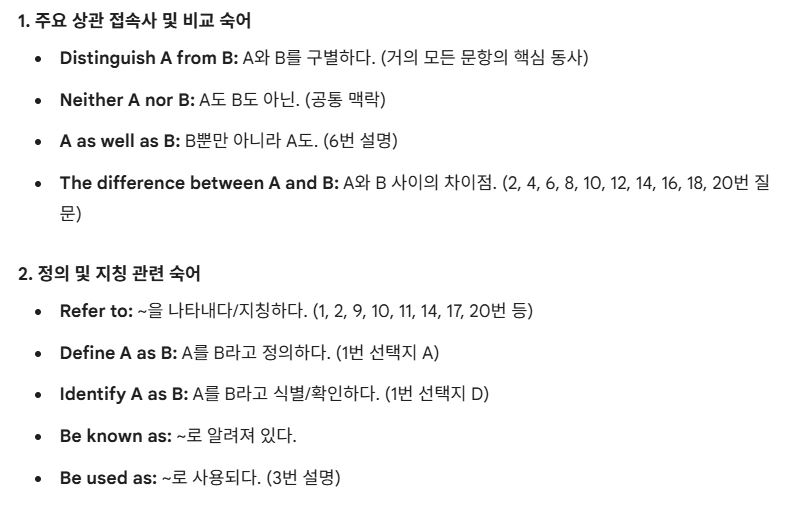
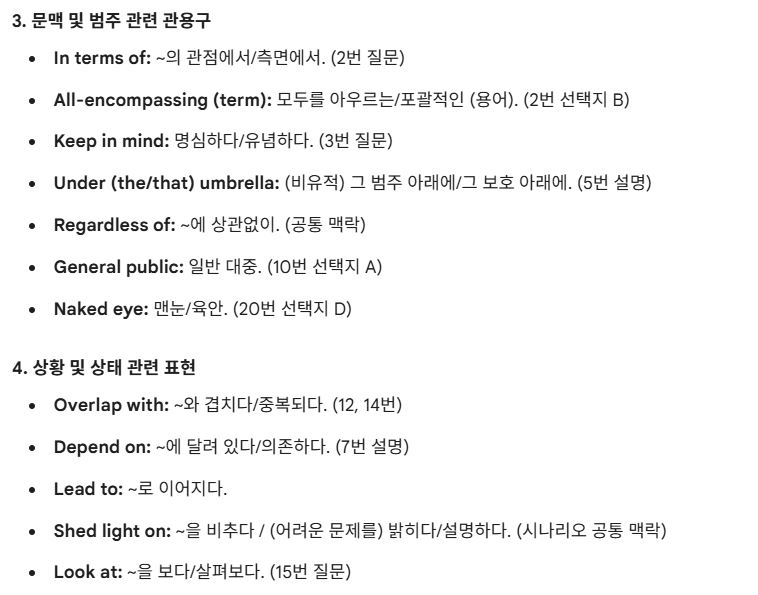
☞ [숙어 / 관용구]

'영어 어휘력 기르기' 카테고리의 다른 글
| 어휘력 [wish - (28)] - Ⅰ → [단어/숙어 18] → [테스트 3] (1) | 2026.04.25 |
|---|---|
| 어휘력 [wish - (28)] - Ⅰ → [단어/숙어 18] → [테스트 1] (1) | 2026.04.25 |
| 어휘력 [wish - (28)] - Ⅰ → [단어/숙어 17] → [테스트 3] (0) | 2026.04.23 |
| 어휘력 [wish - (28)] - Ⅰ → [단어/숙어 17] → [테스트 2] (0) | 2026.04.23 |
| 어휘력 [wish - (28)] - Ⅰ → [단어/숙어 17] → [테스트 1] (0) | 2026.04.23 |