★
테스트를 통해 어휘력 다지기!
☞ 어휘력 [wish - (28)] - Ⅰ → [단어/숙어 16]
★
"secrecy"의 동의어 (2).
1.
How would you distinguish confidentiality from secretiveness?
A) Confidentiality refers to a personal habit of hiding things,
while secretiveness is a legal requirement.
B) Confidentiality is a professional duty in formal contexts
like law or medicine,
while secretiveness is a general tendency
of an individual or group to hide information.
C) Confidentiality involves physical hiding,
whereas secretiveness refers to being quiet.
D) There is no difference;
both terms are used exclusively in military operations.
Answer: B
Explanation:
Confidentiality is used in official/professional settings,
while secretiveness describes
a personality or group trait of being inclined to hide info.
2.
What is the main difference between privacy and anonymity?
A) Privacy is about protecting one's personal space and sphere,
while anonymity is specifically
about keeping one's identity or name unknown.
B) Privacy is used only for illegal acts,
while anonymity is used for medical records.
C) Privacy means being silent,
while anonymity means using a trick to deceive others.
D) Privacy refers to military stealth,
while anonymity refers to a shy personality.
Answer: A
Explanation:
Privacy focuses on the "personal domain,"
whereas anonymity focuses on the "hidden identity."
3.
In terms of behavior,
how can you distinguish reticence from taciturnity?
A) Reticence is a physical act of hiding objects,
while taciturnity is a legal protection.
B) Reticence is being mysterious,
while taciturnity is about being underhanded.
C) Reticence is a cautious or silent temperament
regarding certain topics,
while taciturnity is a habitual tendency
to say almost nothing at all.
D) Reticence is always negative,
while taciturnity is always positive.
Answer: C
Explanation:
Reticence relates to being reserved in attitude/speech,
while taciturnity describes someone
who is habitually extremely untalkative.
4.
What is the difference between concealment and stealth?
A) Concealment is about professional ethics,
while stealth is about public obscurity.
B) Concealment is
the act of intentionally hiding something from view,
while stealth refers to
the quality of moving or acting in a way that avoids detection.
C) Concealment refers to a shy personality,
while stealth refers to a mysterious atmosphere.
D) Concealment is a legal term for privacy,
while stealth is a synonym for honesty.
Answer: B
Explanation:
Concealment is the act of hiding (the "what"),
while stealth is the manner of movement (the "how").
5.
How do you distinguish underhandedness from discretion?
A) Underhandedness involves deceptive and dishonest methods,
whereas discretion is
the wise and cautious management of information
to avoid trouble.
B) Underhandedness is a military tactic,
while discretion is a form of illegal subterfuge.
C) Underhandedness is a positive trait,
while discretion is a negative trait.
D) Both terms refer to
the physical act of being silent in a courtroom.
Answer: A
Explanation:
Underhandedness has a negative, dishonest connotation;
discretion is a positive, careful quality.
6.
What is the difference between covertness and furtiveness?
A) Covertness is used for medical privacy,
while furtiveness is for public fame.
B) Covertness refers to personal shyness,
while furtiveness refers to a mysterious puzzle.
C) Covertness is often used
for official or military "hidden" operations,
while furtiveness implies a sneaky, guilty vibe
as if someone is doing something wrong.
D) Covertness means being quiet,
while furtiveness means being legally protected.
Answer: C
Explanation:
Covertness is more formal/tactical;
furtiveness suggests a "guilty" or "sneaky" behavior.
7.
How would you distinguish reserve from closeness?
A) Reserve is a formal legal term,
while closeness is a military strategy.
B) Reserve is a personality trait of keeping feelings to oneself,
while closeness (in this context) is
an uncooperative attitude of not sharing info with others.
C) Reserve is about hiding illegal goods,
while closeness is about being famous.
D) Reserve means having a secret name,
while closeness means being very loud.
Answer: B
Explanation:
Reserve is a social/personal temperament;
closeness refers to a "closed" or "siloed" lack of sharing.
8.
What is the difference between mystery and obscurity?
A) Mystery refers to an unexplainable or secret state,
while obscurity refers to
the state of being unknown, unclear, or not famous.
B) Mystery is a dishonest trick,
while obscurity is a professional requirement.
C) Mystery is about military movement,
while obscurity is about a shy personality.
D) Mystery means being silent,
while obscurity means being legally bound.
Answer: A
Explanation:
Mystery involves the "unknown/unexplainable,"
whereas obscurity is about "not being prominent/clear."
9.
In a situation involving a trick,
how do you distinguish subterfuge from secrecy?
A) Subterfuge is a specific deceptive device or plan
used to hide something,
while secrecy is the general practice of keeping things hidden.
B) Subterfuge is a medical term, while secrecy is a military term.
C) Subterfuge is always legal, while secrecy is always illegal.
D) Subterfuge refers to being quiet,
while secrecy refers to being famous.
Answer: A
Explanation:
Subterfuge is a "deceptive scheme,"
while secrecy is the "state" or "habit" of hiding.
10.
What is the difference
between clandestineness and confidentiality?
A) Clandestineness usually refers to
illicit or illegal secret operations,
while confidentiality is the authorized protection of data
in a professional context.
B) Clandestineness is about personal shyness,
while confidentiality is about a mysterious state.
C) Clandestineness is a positive social trait,
while confidentiality is a negative personality flaw.
D) Both terms refer to
the act of moving quietly through a forest.
Answer: A
Explanation:
Clandestine implies "illicit/secret,"
whereas confidential implies "official/trusted."
11.
How do you distinguish silence from reticence?
A) Silence is the physical state of not speaking,
while reticence is the underlying personality trait or attitude
of being disinclined to speak.
B) Silence is a dishonest trick,
while reticence is a legal requirement.
C) Silence is used only by soldiers,
while reticence is used only by doctors.
D) Silence is about keeping an identity secret,
while reticence is about being unknown.
Answer: A
Explanation:
Silence is the "condition,"
while reticence is the "disposition."
12.
What is the difference
between underhandedness and furtiveness?
A) Underhandedness focuses on
the deceptive and dishonest methods used,
while furtiveness focuses on
the "sneaky" and "guilty" appearance of the person.
B) Underhandedness is a professional duty,
while furtiveness is a state of not being famous.
C) Underhandedness is about moving quietly,
while furtiveness is about legal records.
D) Both terms are synonyms for being very helpful and open.
Answer: A
Explanation:
Underhandedness relates to "crooked methods";
furtiveness relates to "guilty looks/actions."
13.
How would you distinguish stealth from covertness?
A) Stealth is primarily about the manner of movement
to avoid detection,
while covertness refers more broadly to
the hidden nature of an operation or status.
B) Stealth is about legal protection,
while covertness is about a shy personality.
C) Stealth is a deceptive trick,
while covertness is a state of being unknown.
D) Stealth is used in hospitals,
while covertness is used in classrooms.
Answer: A
Explanation:
Stealth is "undetectable action/movement";
covertness is the "quality of being hidden/disguised."
14.
What is the difference between secrecy and privacy?
A) Secrecy is the active hiding of information,
while privacy is the right
to keep one's personal life free from intrusion.
B) Secrecy is only for criminals,
while privacy is only for doctors.
C) Secrecy refers to a quiet person,
while privacy refers to a sneaky person.
D) Secrecy means having no name,
while privacy means being very famous.
Answer: A
Explanation:
Secrecy is about "concealing facts";
privacy is about "personal boundaries."
15.
How do you distinguish obscurity from anonymity?
A) Obscurity means being unknown or not prominent,
while anonymity specifically means
the identity or name is withheld.
B) Obscurity is a military tactic,
while anonymity is a form of medical insurance.
C) Obscurity is a deceptive trick,
while anonymity is a type of shy behavior.
D) Both terms mean
that a person is acting in a very sneaky and guilty way.
Answer: A
Explanation:
Obscurity is "lack of fame/clarity";
anonymity is "namelessness."
16.
What is the difference between discretion and reticence?
A) Discretion is the intentional choice
to be careful with information to be responsible,
while reticence is a natural tendency
to be quiet or uncommunicative.
B) Discretion is an illegal act,
while reticence is a legal requirement.
C) Discretion is about moving silently,
while reticence is about hiding objects.
D) Discretion is a negative trait,
while reticence is a professional rank.
Answer: A
Explanation:
Discretion is "prudence/judgment";
reticence is "habitual silence/reserve."
17.
How can you distinguish clandestineness from subterfuge?
A) Clandestineness is the state
of an operation being secret/illicit,
while subterfuge is the actual trick or deception
used to achieve that secrecy.
B) Clandestineness is a personality trait,
while subterfuge is a medical condition.
C) Clandestineness means being quiet,
while subterfuge means being famous.
D) Both terms refer to the legal protection of a patient's records.
Answer: A
Explanation:
Clandestineness is the "attribute of the activity";
subterfuge is the "method of deception."
18.
What is the difference between reserve and taciturnity?
A) Reserve is a social aloofness or keeping feelings inside,
while taciturnity is a more extreme, specific habit
of barely speaking at all.
B) Reserve is used in military radar,
while taciturnity is used in law firms.
C) Reserve is a sneaky behavior,
while taciturnity is a mysterious puzzle.
D) Reserve means being hidden,
while taciturnity means being very famous.
Answer: A
Explanation:
Reserve is "emotional restraint";
taciturnity is "verbal minimalism."
19.
How do you distinguish concealment
from underhandedness?
A) Concealment is the physical act of hiding something,
while underhandedness refers to
the dishonest or deceptive character of an action.
B) Concealment is a professional ethic,
while underhandedness is a personality trait of being shy.
C) Concealment is about being unknown,
while underhandedness is about being quiet.
D) Both terms describe
the legal way a doctor handles a patient's file.
Answer: A
Explanation:
Concealment is the "physical act";
underhandedness is the "moral quality (dishonesty)."
20.
What is the difference between secretiveness and closeness?
A) Secretiveness is a general disposition to hide information,
while closeness is a specific social or organizational refusal
to share or be open with others.
B) Secretiveness is a military movement,
while closeness is a medical record.
C) Secretiveness is a positive trait,
while closeness is a deceptive trick.
D) Secretiveness means being nameless,
while closeness means being loud.
Answer: A
Explanation:
Secretiveness is an "inclination to hide";
closeness is "lack of openness/integration."
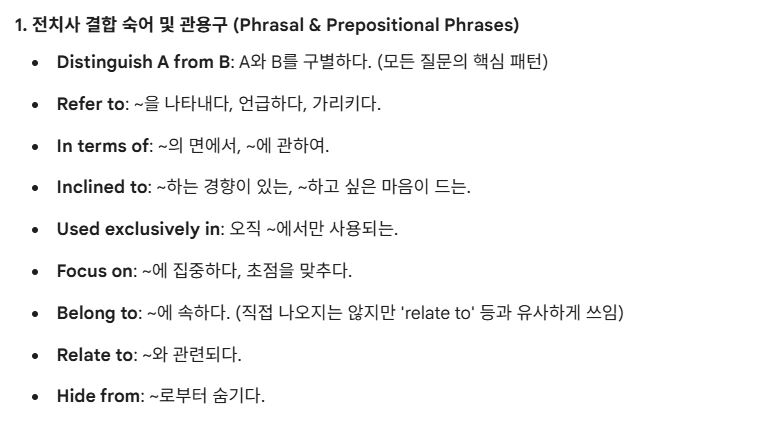
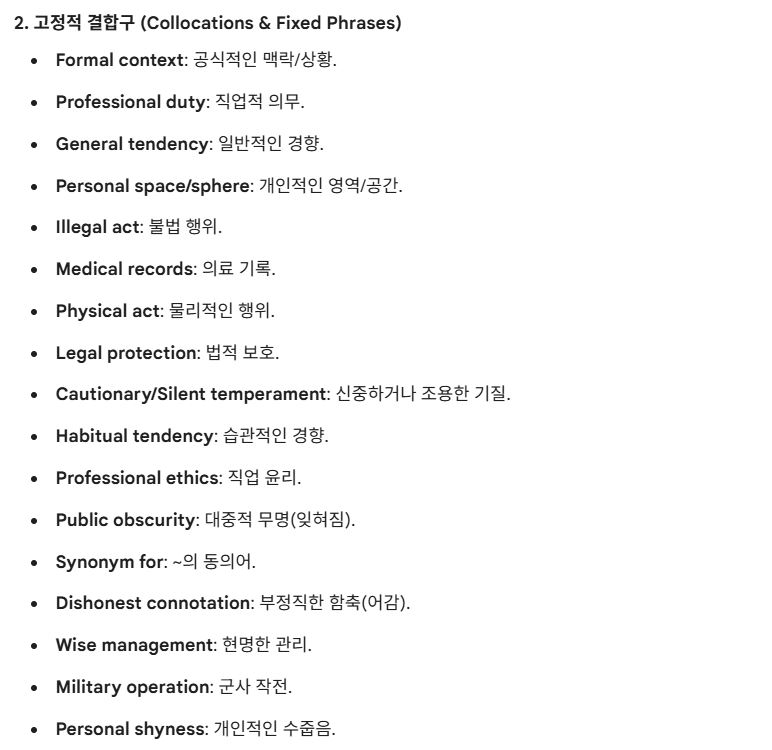
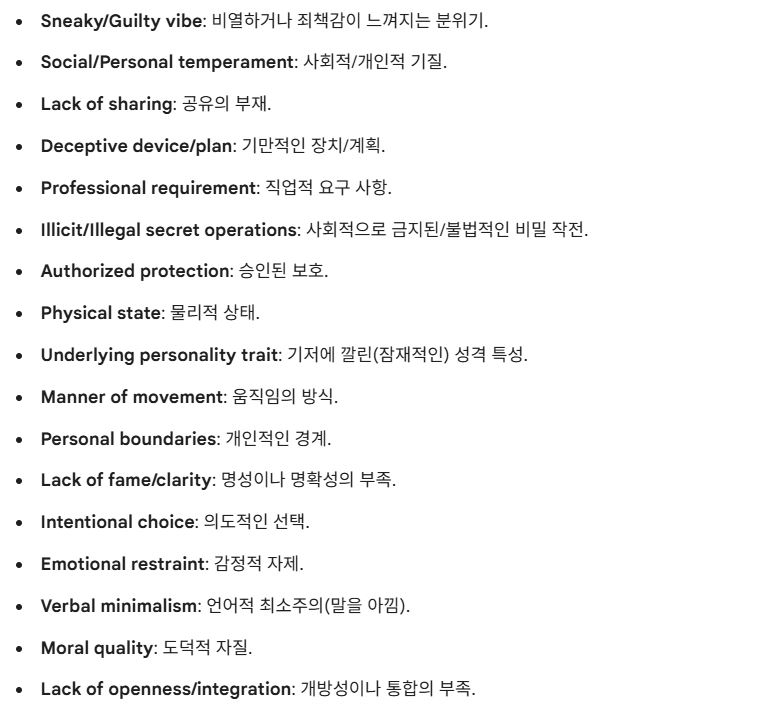
☞ [숙어 / 관용구]

'영어 어휘력 기르기' 카테고리의 다른 글
| 어휘력 [wish - (28)] - Ⅰ → [단어/숙어 17] → [테스트 1] (0) | 2026.04.23 |
|---|---|
| 어휘력 [wish - (28)] - Ⅰ → [단어/숙어 16] → [테스트 3] (0) | 2026.04.21 |
| 어휘력 [wish - (28)] - Ⅰ → [단어/숙어 16] → [테스트 1] (1) | 2026.04.21 |
| 어휘력 [wish - (28)] - Ⅰ → [단어/숙어 15] → [테스트 3] (0) | 2026.04.19 |
| 어휘력 [wish - (28)] - Ⅰ → [단어/숙어 15] → [테스트 2] (1) | 2026.04.19 |