★
테스트를 통해 어휘력 다지기!
☞ 어휘력 [wish - (28)] - Ⅰ → [단어/숙어 16]
★
"secrecy"의 동의어 (3).
1.
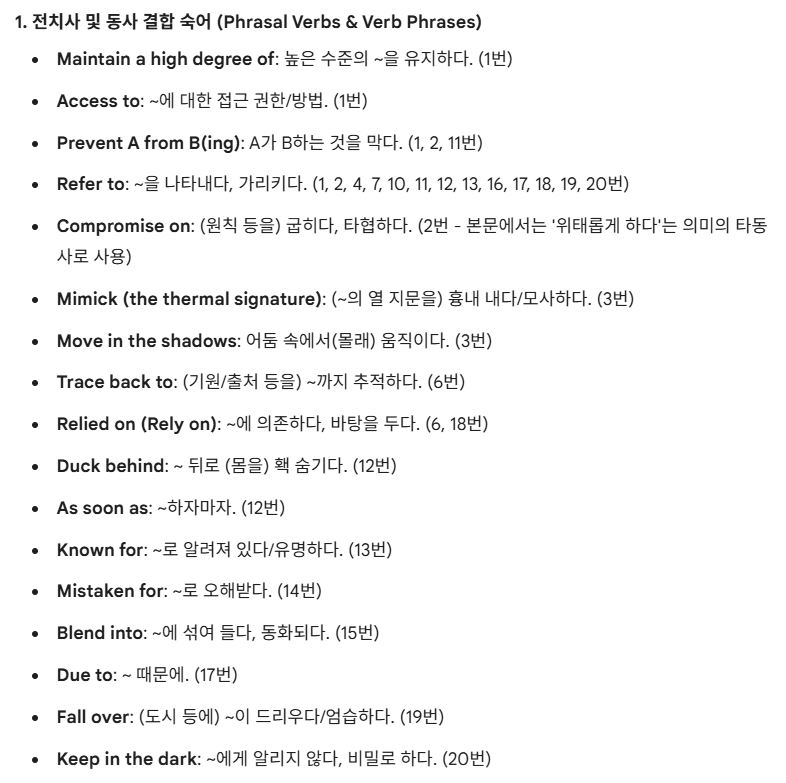
The pharmaceutical giant maintained
a high degree of ________
regarding the new formula,
ensuring that even internal researchers only had access
to fragmented data to prevent industrial espionage.
A) stealth
B) secrecy
C) anonymity
D) reserve
Answer: B
Explanation:
Secrecy refers to the general habit or systematic practice
of keeping information hidden from others,
which fits the context of a company
protecting its intellectual property.
2.
Despite the intense interrogation by the press,
the diplomat’s natural ________
prevented him from revealing any details
that might compromise the ongoing peace negotiations.
A) clandestineness
B) underhandedness
C) reticence
D) mystery
Answer: C
Explanation:
Reticence describes
a personality trait or a temporary inclination
to be silent or uncommunicative,
especially regarding specific sensitive topics.
3.
The spy’s ________ allowed him to infiltrate
the high-security facility
by mimicking the thermal signature of a janitor
and moving in the shadows of the security cameras' blind spots.
A) privacy
B) concealment
C) stealth
D) silence
Answer: C
Explanation:
Stealth is the specific quality
of moving or acting in a cautious, quiet,
and undetectable manner to avoid being seen or heard.
4.
The legal team reminded the witnesses
that the ________ of the deposition was protected
by a non-disclosure agreement,
and any leak would result in severe litigation.
A) secretiveness
B) confidentiality
C) closeness
D) obscurity
Answer: B
Explanation:
Confidentiality is the formal, professional, or legal obligation
to keep sensitive information private
within a specific relationship (law, medicine, business).
5.
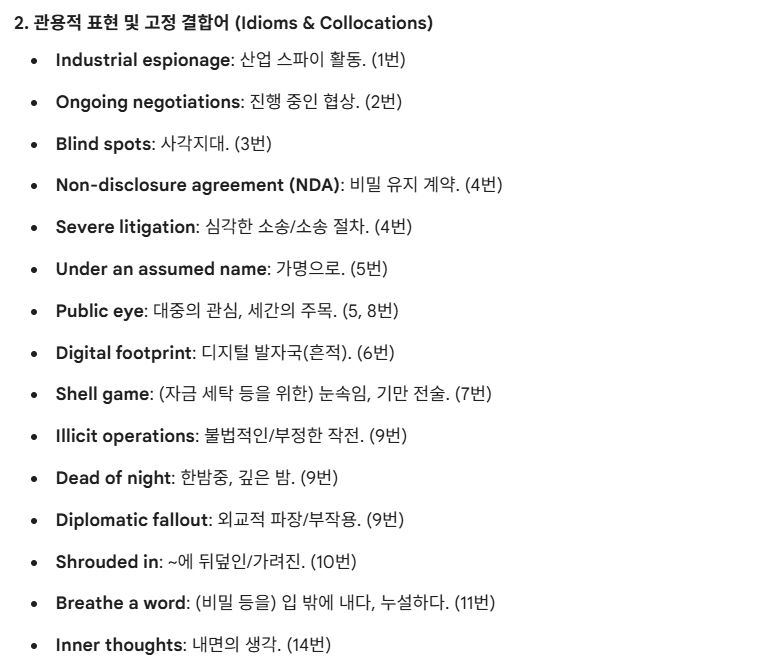
After the scandal broke,
the disgraced politician withdrew into a life of total ________,
living in a remote cabin under an assumed name
where the public eye could no longer reach him.
A) obscurity
B) underhandedness
C) covertness
D) taciturnity
Answer: A
Explanation:
Obscurity is the state
of being unknown, inconspicuous, or unimportant,
often following a period of fame or prominence.
6.
The hacker relied on total ________
to bypass the server’s firewalls,
using multiple proxy servers
to ensure that his digital footprint could never be traced back
to his real identity.
A) reserve
B) discretion
C) concealment
D) anonymity
Answer: D
Explanation:
Anonymity is the condition of being anonymous,
specifically focusing on keeping one's identity or name hidden.
7.
The investigator suspected ________
when he noticed
that the financial records had been meticulously altered
using a complex "shell game" of transfers to hide the missing funds.
A) underhandedness
B) silence
C) reticence
D) privacy
Answer: A
Explanation:
Underhandedness refers to
deceptive, dishonest, or crooked methods
used to achieve a goal, often involving a moral breach.
8.
For many celebrities,
the greatest luxury is not wealth but ________
—the ability to walk down a street
without being photographed or interrupted by fans.
A) mystery
B) secrecy
C) privacy
D) stealth
Answer: C
Explanation:
Privacy is the state
of being free from public attention or intrusion
into one's personal life and individual domain.
9.
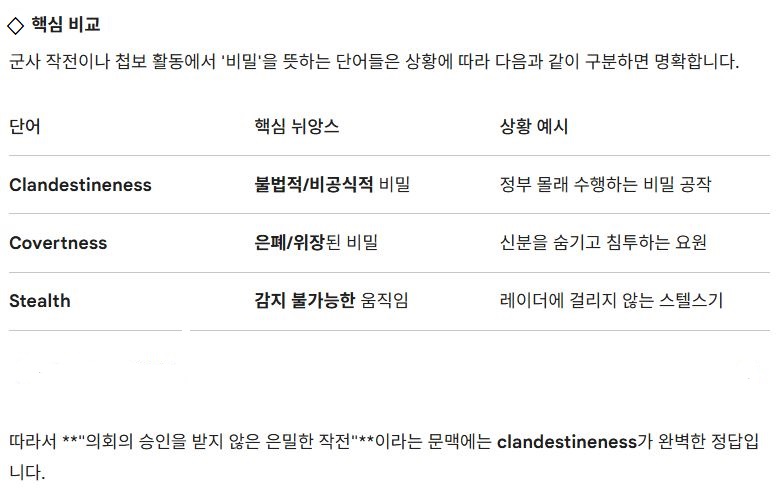
The military operation was characterized by extreme ________;
it was unauthorized by the senate and carried out
in the dead of night
to avoid international diplomatic fallout.
(아래 참조)
A) discretion
B) clandestineness
C) taciturnity
D) reserve
Answer: B
Explanation:
Clandestineness refers to
the quality of being secret or illicit,
specifically used for unauthorized or "underground" operations.
10.
The ancient ruins are shrouded in ________,
as no historical records exist
to explain why the civilization suddenly abandoned
such a prosperous city.
A) secretiveness
B) furtiveness
C) confidentiality
D) mystery
Answer: D
Explanation:
Mystery refers to something
that is difficult or impossible to understand or explain,
often involving a sense of wonder or confusion.
11.
The butler was valued for his ________;
he observed many scandalous events in the household
but never breathed a word to the tabloid journalists.
A) discretion
B) obscurity
C) closeness
D) stealth
Answer: A
Explanation:
Discretion is the quality of behaving or speaking
in such a way as to avoid
revealing private information or causing offense;
it implies wise judgment.
12.
The suspect’s ________ was evident
when he was caught peeking through the office window
and quickly ducked behind a bush
as soon as he saw the security guard.
A) reserve
B) secrecy
C) furtiveness
D) anonymity
Answer: C
Explanation:
Furtiveness suggests a guilty, sneaky, or shifty manner,
as if one is trying to avoid being caught doing something wrong.
13.
The CEO was known for his ________;
even in board meetings,
he rarely spoke more than three sentences,
leaving his subordinates to guess his true intentions.
A) concealment
B) clandestineness
C) underhandedness
D) taciturnity
Answer: D
Explanation:
Taciturnity is a habitual tendency to say very little;
it describes a person who is naturally untalkative or dour.
14.
The artist’s ________ was often mistaken for arrogance,
but in reality, he was simply a deeply private person
who felt uncomfortable sharing his inner thoughts with strangers.
A) reserve
B) mystery
C) covertness
D) furtiveness
Answer: A
Explanation:
Reserve is a personality trait of being self-restrained
and not showing one's feelings or thoughts readily.
15.
To escape the enemy patrol,
the soldiers utilized the thick fog
for the ________ of their movements,
blending into the grey mist
until they reached the safety of the woods.
A) privacy
B) concealment
C) confidentiality
D) reticence
Answer: B
Explanation:
Concealment is the act of hiding something
or the state of being hidden from sight,
often through physical means.
16.
The intelligence agency’s ________ was compromised
when a double agent leaked the location of several "black sites"
to the international press.
A) underhandedness
B) closeness
C) covertness
D) silence
Answer: C
Explanation:
Covertness is the quality of being concealed or disguised,
typically used in the context of official "covert" (hidden) operations.
17.
The project failed due to the ________ of the different departments;
because they refused to share their findings with one another,
critical errors went unnoticed for months.
A) mystery
B) closeness
C) obscurity
D) stealth
Answer: B
Explanation:
Closeness (in an organizational context) refers to an uncooperative,
closed-off attitude or a refusal to share information.
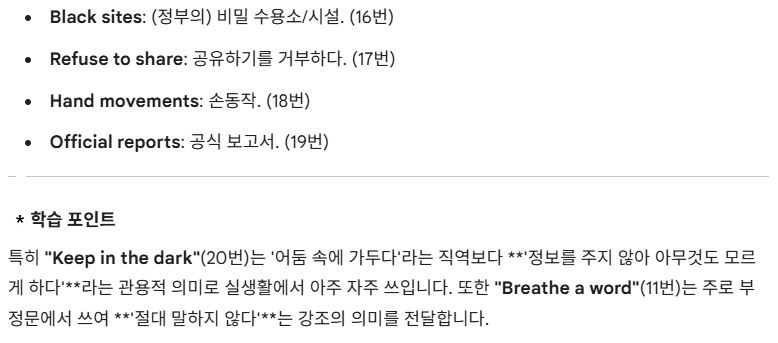
18.
The magician’s trick relied on a clever ________
—a hidden compartment in the table
that allowed the coin to "vanish"
while the audience was distracted by his hand movements.
A) subterfuge
B) secrecy
C) privacy
D) reticence
Answer: A
Explanation:
Subterfuge is a specific deceit or trick
used in order to achieve a goal or hide the truth.
19.
In the aftermath of the explosion,
a heavy ________ fell over the city
as people were too shocked to speak,
and no official reports were released for hours.
A) secretiveness
B) clandestineness
C) silence
D) anonymity
Answer: C
Explanation:
Silence is the complete absence of sound or speaking;
it can be a physical state
or a deliberate act of not revealing information.
20.
The cult was notorious for its ________;
members were forbidden from speaking to outsiders
about their rituals,
and new recruits were kept in the dark
about the group's leadership.
A) discretion
B) underhandedness
C) obscurity
D) secretiveness
Answer: D
Explanation:
Secretiveness is the trait of being fond
of keeping secrets or having a tendency
to hide information from others.
☞ 9번에서:

☞ [숙어 / 관용구]
'영어 어휘력 기르기' 카테고리의 다른 글
| 어휘력 [wish - (28)] - Ⅰ → [단어/숙어 17] → [테스트 2] (0) | 2026.04.23 |
|---|---|
| 어휘력 [wish - (28)] - Ⅰ → [단어/숙어 17] → [테스트 1] (0) | 2026.04.23 |
| 어휘력 [wish - (28)] - Ⅰ → [단어/숙어 16] → [테스트 2] (0) | 2026.04.21 |
| 어휘력 [wish - (28)] - Ⅰ → [단어/숙어 16] → [테스트 1] (1) | 2026.04.21 |
| 어휘력 [wish - (28)] - Ⅰ → [단어/숙어 15] → [테스트 3] (0) | 2026.04.19 |