★
테스트를 통해 어휘력 다지기!
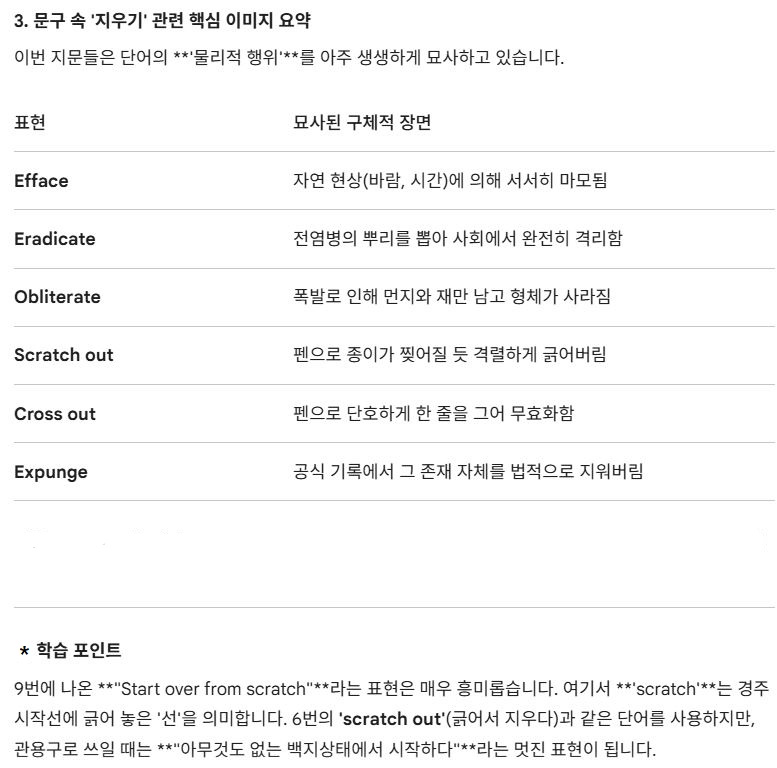
☞ 어휘력 [wish - (28)] - Ⅰ → [단어/숙어 15]
★
"erase"의 동의어 (3).
1.
The totalitarian regime
sought to __________ every mention of the rebellion
from the national archives,
ensuring that future generations would have no knowledge
of the uprising.
A) Expunge
B) Wipe
C) Cancel
D) Scratch out
Answer: A
Explanation:
"Expunge" is the most appropriate term
for the formal and complete removal of records or information
from an official source or archive.
2.
Despite the passage of centuries,
the desert winds could not completely __________ the intricate
carvings on the sandstone temple,
though the details had grown tragically faint.
A) Delete
B) Efface
C) Eradicate
D) Cross out
Answer: B
Explanation:
"Efface" is a formal term
used when surfaces or marks become indistinct or worn away,
often by natural processes or time.
3.
The scientists realized
that simply treating the symptoms was insufficient;
they needed to __________ the virus
from the population entirely to prevent a secondary outbreak.
A) Remove
B) Wipe
C) Eradicate
D) Cancel
Answer: C
Explanation:
"Eradicate" implies
pulling something out by the roots
or completely eliminating a pest, disease, or social problem.
4.
After the scandal broke,
the CEO ordered the IT department
to permanently __________ all sensitive emails
from the central server to avoid further legal scrutiny.
A) Scratch out
B) Erase
C) Efface
D) Delete
Answer: D
Explanation:
"Delete" is the technical standard
for removing digital data, files, or text
within a computer environment.
5.
The sudden explosion was so powerful
that it threatened to __________ the entire coastal village,
leaving nothing behind but a barren wasteland of ash and soot.
A) Obliterate
B) Remove
C) Cross out
D) Expunge
Answer: A
Explanation:
"Obliterate" conveys a strong nuance of total destruction,
where no trace or evidence of the original subject remains.
6.
In the heat of the argument,
the editor took a heavy black marker
and began to violently __________ the controversial paragraphs
from the manuscript,
making the ink bleed through the paper.
A) Erase
B) Scratch out
C) Efface
D) Delete
Answer: B
Explanation:
"Scratch out" refers to the physical act
of aggressively removing or gouging out written marks,
often involving physical force against the surface.
7.
Because the main speaker fell ill at the last minute,
the university had no choice but to __________ the entire seminar
and issue refunds to the disappointed attendees.
A) Remove
B) Expunge
C) Cancel
D) Wipe
Answer: C
Explanation:
"Cancel" is the standard term for voiding an agreement,
stopping a service, or calling off a planned event or record.
8.
The detective noticed
that the suspect had tried to __________ the bloodstains
from the mahogany floorboards,
but the faint chemical residue gave the attempt away.
A) Eradicate
B) Delete
C) Efface
D) Wipe
Answer: D
Explanation:
"Wipe" refers to
the physical action of rubbing a surface with a cloth
or hand to clean or remove something from it.
9.
In a fit of regret,
the artist picked up a piece of rubber
and began to __________ the charcoal sketches from the canvas,
hoping to start the portrait over from scratch.
A) Erase
B) Obliterate
C) Expunge
D) Cancel
Answer: A
Explanation:
"Erase" specifically describes the removal of marks
(pencil, charcoal, chalk)
by rubbing them with a tool like an eraser.
10.
To improve the flow of the essay,
the professor suggested
that the student __________ the redundant third chapter entirely,
rather than just editing the sentences.
A) Erase
B) Remove
C) Scratch out
D) Efface
Answer: B
Explanation:
"Remove" is the most general and versatile term
for taking something away from its place,
whether the object is physical or abstract.
11.
During the messy brainstorming session,
the architect would frequently __________ the rejected dimensions
on the blueprint with a single, firm stroke of his pen.
A) Obliterate
B) Expunge
C) Delete
D) Cross out
Answer: D
Explanation:
"Cross out" is the specific act of drawing a line
through written or printed text
to indicate it is no longer valid or correct.
☞ [숙어 / 관용구]


'영어 어휘력 기르기' 카테고리의 다른 글
| 어휘력 [wish - (28)] - Ⅰ → [단어/숙어 16] → [테스트 2] (0) | 2026.04.21 |
|---|---|
| 어휘력 [wish - (28)] - Ⅰ → [단어/숙어 16] → [테스트 1] (1) | 2026.04.21 |
| 어휘력 [wish - (28)] - Ⅰ → [단어/숙어 15] → [테스트 2] (1) | 2026.04.19 |
| 어휘력 [wish - (28)] - Ⅰ → [단어/숙어 15] → [테스트 1] (1) | 2026.04.19 |
| 어휘력 [wish - (28)] - Ⅰ → [단어/숙어 14] → [테스트 3] (1) | 2026.04.17 |