★
테스트를 통해 어휘력 다지기!
☞ 어휘력 [wish - (28)] - Ⅰ → [단어/숙어 15]
★
"erase"의 동의어 (2).
1.
How do you distinguish "erase"
from "efface" in a historical context?
A) "Erase" refers to rubbing out pencil marks,
while "efface" describes time or nature
making inscriptions faint.
B) "Erase" is used for legal records,
while "efface" is only for digital files.
C) "Erase" implies total destruction of a city,
while "efface" implies a quick physical wipe.
D) There is no difference;
both are used exclusively for computer data.
Answer: A
Explanation:
"Erase" usually involves a physical tool like an eraser,
whereas "efface" is a formal term
often used when images or memories become faint over time.
2.
What is the difference between "delete"
and "expunge" regarding official documentation?
A) "Delete" is for removing a physical object,
while "expunge" is for drawing a line through text.
B) "Delete" means to pull out by the roots,
while "expunge" means to wipe a surface.
C) "Delete" is commonly used for digital data,
while "expunge" is a formal legal term
for striking a record permanently.
D) "Delete" is only for handwriting,
while "expunge" is for deleting emails.
Answer: C
Explanation:
"Delete" is the standard term for digital actions,
but "expunge" carries a heavy legal weight,
often meaning to treat a criminal record as if it never existed.
3.
In terms of intensity,
how can you distinguish "remove" from "obliterate"?
A) "Remove" is stronger than "obliterate."
B) "Remove" refers only to digital files,
while "obliterate" refers to cleaning a table.
C) "Remove" is a general term for taking something away,
while "obliterate" means
to destroy something so completely that no trace remains.
D) "Remove" is used for light scratching,
while "obliterate" is used for drawing a line.
Answer: C
Explanation:
"Remove" is neutral and common;
"obliterate" is extreme, suggesting total annihilation.
4.
What is the key difference between "wipe" and "scratch out"?
A) "Wipe" involves using a horizontal line,
while "scratch out" involves a digital trash can.
B) "Wipe" is a legal term, while "scratch out" is a medical term.
C) "Wipe" is for cleaning digital files,
while "scratch out" is for gardening.
D) "Wipe" involves a rubbing motion over a surface,
while "scratch out" involves
using a sharp or hard tool to gouge out text.
Answer: D
Explanation:
"Wipe" is a broad surface action (often for cleaning),
whereas "scratch out" is a more aggressive,
physical way to make writing unreadable.
5.
How do you distinguish "cross out"
from "cancel" in the context of a written list?
A) "Cross out" means drawing a line through an item,
while "cancel" means
voiding an entire arrangement or marking it as invalid.
B) "Cross out" is for deleting files,
while "cancel" is for wiping a table.
C) "Cross out" implies total destruction,
while "cancel" implies fading over time.
D) "Cross out" is for legal records,
while "cancel" is for removing weeds.
Answer: A
Explanation:
"Cross out" is the physical act of drawing a line.
"Cancel" can mean the same in some contexts,
but more often refers to ending a service or agreement.
6.
What is the difference between "eradicate" and "remove"?
A) "Eradicate" means to move something to a new place,
while "remove" means to destroy it.
B) "Eradicate" implies "rooting out" or total elimination of a problem,
while "remove" is a simple act of taking something away.
C) "Eradicate" is for digital text,
while "remove" is only for legal archives.
D) Both are identical and used only for cleaning surfaces.
Answer: B
Explanation:
"Eradicate" is much stronger
and is often used for diseases, pests, or social evils
to ensure they don't return.
7.
How would you distinguish "erase" from "delete"?
A) "Erase" is for physical marks like pencil or chalk,
while "delete" is for digital information.
B) "Erase" is for legal records,
while "delete" is for physical objects.
C) "Erase" is used for pulling up weeds,
while "delete" is for cleaning a window.
D) "Erase" is a formal literary term,
while "delete" is used for handwriting.
Answer: A
Explanation:
We erase pencil marks with an eraser,
but we delete files on a computer.
8.
What is the difference between "efface" and "obliterate"?
A) "Efface" means to add more detail,
while "obliterate" means to hide.
B) "Efface" is for computer viruses,
while "obliterate" is for pencil marks.
C) "Efface" means to draw a line,
while "obliterate" means to cancel a subscription.
D) "Efface" implies a gentle or gradual fading/rubbing out,
while "obliterate" implies a violent or total wiping out.
Answer: D
Explanation:
"Efface" is subtle and often suggests something becoming faint;
"obliterate" is forceful and suggests total disappearance.
9.
How do you distinguish "expunge" from "cross out"?
A) "Expunge" is for casual notes,
while "cross out" is for court records.
B) "Expunge" means to wipe a table,
while "cross out" means to pull weeds.
C) "Expunge" is a formal removal of a record from history/law,
while "cross out" is a simple act of drawing a line through text.
D) There is no difference; both involve using an eraser.
Answer: C
Explanation:
"Expunge" is formal and permanent;
"cross out" is informal and physical.
10.
What is the difference between "wipe" and "erase"?
A) "Wipe" is used for digital files,
while "erase" is for legal documents.
B) "Wipe" usually refers to cleaning a surface with a cloth,
while "erase" refers to removing specific marks or characters.
C) "Wipe" implies total destruction,
while "erase" implies a horizontal line.
D) "Wipe" is a synonym for "cancel,"
while "erase" is a synonym for "expunge."
Answer: B
Explanation:
You wipe a table to clean it;
you erase a mistake in your notebook.
11.
In a digital context,
how do you distinguish "delete" from "wipe"?
A) "Delete" removes a specific file,
while "wipe" often refers to
completely clearing a drive or memory.
B) "Delete" is for physical dirt, while "wipe" is for pencil marks.
C) "Delete" means to draw a line through a word,
while "wipe" is for legal archives.
D) "Delete" is a formal literary term,
while "wipe" is for pulling weeds.
Answer: A
Explanation:
In tech, "delete" is for individual items,
whereas "wipe" (like "wiping a hard drive") means
clearing everything.
12.
What is the difference between "scratch out" and "cross out"?
A) "Scratch out" uses a pen gently,
while "cross out" uses a knife.
B) "Scratch out" is used for computer data,
while "cross out" is for legal records.
C) "Scratch out" implies scraping or gouging the surface,
while "cross out" simply means drawing a line through the text.
D) Both are exactly the same and used only for gardening.
Answer: C
Explanation:
"Scratch out" is a more aggressive, physical removal;
"cross out" is a standard way to mark text as wrong.
13.
How do you distinguish "cancel" from "erase"?
A) "Cancel" is for stopping a planned event or agreement,
while "erase" is for removing a physical mark.
B) "Cancel" is for cleaning surfaces,
while "erase" is for legal records.
C) "Cancel" implies total annihilation,
while "erase" implies a horizontal line.
D) "Cancel" is for digital files, while "erase" is for weeds.
Answer: A
Explanation:
You cancel a meeting or a credit card;
you erase a drawing.
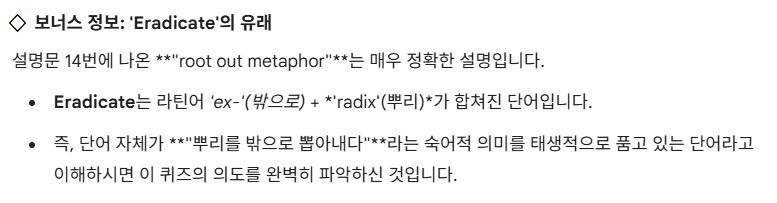
14.
What is the difference between "obliterate" and "eradicate"?
A) "Obliterate" means to draw a line,
while "eradicate" means to rub out pencil.
B) "Obliterate" is for digital files,
while "eradicate" is for court records.
C) "Obliterate" means to make faint,
while "eradicate" means to wipe a surface.
D) "Obliterate" is for physical destruction,
while "eradicate" is used
for abstract concepts like "evil" or "disease."
Answer: D
Explanation:
While both mean total removal,
"eradicate" specifically carries the "root out" metaphor,
often applied to social or biological issues.
15.
How do you distinguish "remove" from "expunge"?
A) "Remove" is for legal archives,
while "expunge" is for moving furniture.
B) "Remove" is a general term for taking something away,
while "expunge" is the formal act
of deleting information from a record.
C) "Remove" means to rub with an eraser,
while "expunge" means to draw a line.
D) "Remove" is for digital text, while "expunge" is for gardening.
Answer: B
Explanation:
"Remove" is everyday language;
"expunge" is specialized for records and documents.
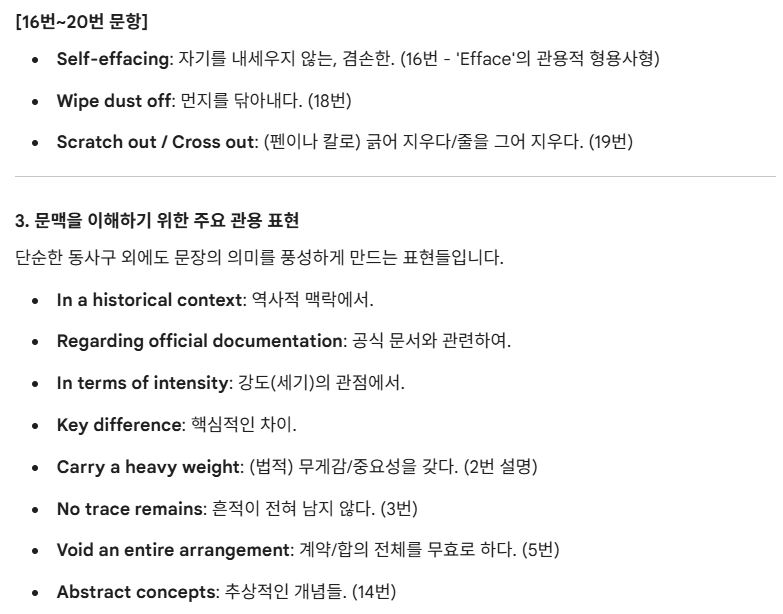
16.
What is the difference between "efface" and "erase"?
A) "Efface" is for deleting emails,
while "erase" is for historical monuments.
B) "Efface" is for physical dirt,
while "erase" is for court records.
C) "Efface" often implies
making something self-effacing or inconspicuous,
while "erase" is a direct removal of a mark.
D) "Efface" means to pull out by the roots,
while "erase" means to draw a line.
Answer: C
Explanation:
"Efface" can be used metaphorically
(like "self-effacing" behavior),
whereas "erase" is almost always a literal removal of a mark.
17.
How do you distinguish "cross out" from "delete"?
A) "Cross out" is for paper and ink,
while "delete" is for digital text.
B) "Cross out" is for court records,
while "delete" is for cleaning a table.
C) "Cross out" means to destroy completely,
while "delete" means to make faint.
D) "Cross out" is for gardening,
while "delete" is for physical marks.
Answer: A
Explanation:
"Cross out" is a manual action on paper;
"delete" is an electronic action.
18.
What is the difference between "wipe" and "obliterate"?
A) "Wipe" is a simple surface action,
while "obliterate" is total, violent destruction.
B) "Wipe" is for legal records,
while "obliterate" is for pencil marks.
C) "Wipe" means to draw a line,
while "obliterate" means to pull weeds.
D) Both are used exclusively for computer data.
Answer: A
Explanation:
You wipe dust off a shelf,
but you obliterate an enemy's fortress.
19.
How do you distinguish "scratch out" from "erase"?
A) "Scratch out" is for digital files,
while "erase" is for legal archives.
B) "Scratch out" involves scraping a surface
(often leaving a mark),
while "erase" aims to remove the mark cleanly.
C) "Scratch out" is for pulling weeds,
while "erase" is for cleaning a table.
D) "Scratch out" means to draw a single line,
while "erase" means total annihilation.
Answer: B
Explanation:
"Erase" usually leaves the surface clean;
"scratch out" involves rougher, physical scraping.
20.
What is the difference between "cancel" and "expunge"?
A) "Cancel" is for digital data,
while "expunge" is for pencil marks.
B) "Cancel" is for drawing a line,
while "expunge" is for cleaning a surface.
C) "Cancel" is commonly for voiding agreements or events,
while "expunge" is for the formal destruction of records.
D) "Cancel" means to pull out by the roots,
while "expunge" means to make faint.
Answer: C
Explanation:
You cancel a subscription or a game;
a judge expunges a criminal record.
☞ [숙어 / 관용구]


'영어 어휘력 기르기' 카테고리의 다른 글
| 어휘력 [wish - (28)] - Ⅰ → [단어/숙어 16] → [테스트 1] (1) | 2026.04.21 |
|---|---|
| 어휘력 [wish - (28)] - Ⅰ → [단어/숙어 15] → [테스트 3] (0) | 2026.04.19 |
| 어휘력 [wish - (28)] - Ⅰ → [단어/숙어 15] → [테스트 1] (1) | 2026.04.19 |
| 어휘력 [wish - (28)] - Ⅰ → [단어/숙어 14] → [테스트 3] (1) | 2026.04.17 |
| 어휘력 [wish - (28)] - Ⅰ → [단어/숙어 14] → [테스트 2] (0) | 2026.04.17 |