★
테스트를 통해 어휘력 다지기!
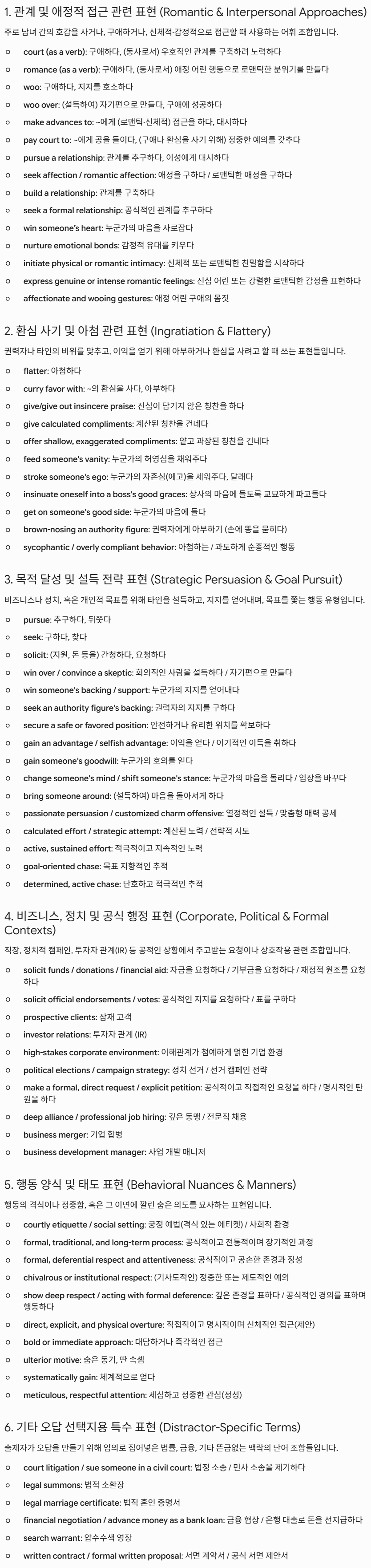
☞ 어휘력 [wish - (28)] - Ⅰ → [단어/숙어 32]
★
"court"의 '동사형' 동의어 (2).
Q1
How can a linguist best distinguish flatter from curry favor
with based on their core behavioral nuances?
A) Flatter strictly involves making physical romantic advances,
whereas curry favor with only applies to political elections.
B) Flatter focuses on the act of giving insincere praise,
while curry favor with emphasizes a broader, calculated effort
—often involving gifts or favors—
to systematically gain someone's goodwill.
C) Flatter requires a formal written proposal,
whereas curry favor with is always done anonymously.
D) There is no difference
because both terms are used
exclusively to describe romantic proposals in high society.
Correct Answer: B
Explanation:
While both involve insincerity,
flatter is specifically about giving exaggerated or false praise.
In contrast,
curry favor with is a more comprehensive,
strategic attempt to gain an authority figure's backing,
which frequently includes actions beyond mere words,
such as doing favors or giving gifts.
Q2
When trying to explain the difference between woo and woo over,
which statement accurately pinpoints
how the introduction of the particle "over" changes the meaning?
A) Woo describes a business transaction,
while woo over is used only when someone fails to achieve their goal.
B) Woo refers to the ongoing,
active process of seeking someone's affection or support,
whereas woo over focuses on the successful completion
of that process by successfully winning them
or convincing them to change their mind.
C) Woo indicates formal court litigation,
while woo over means to ignore a legal summons completely.
D) Woo signifies a physical advance,
while woo over implies that the relationship has officially ended.
Correct Answer: B
Explanation:
Woo represents the action of courting or seeking favor/support.
Adding "over" transforms it into a phrasal verb (woo over)
that emphasizes the result: successfully persuading, winning over,
or shifting someone's stance to your side.
Q3
In a high-stakes corporate environment,
how would an executive distinguish solicit from seek
when discussing investor relations?
A) Solicit implies making a formal, direct request
for a specific action or resource (like funds),
whereas seek is a broader, general term
for trying to find or obtain something
(like attention or opportunities).
B) Solicit is strictly limited to romantic dates,
while seek can only be used when looking for physical, lost objects.
C) Solicit refers to praising someone insincerely,
whereas seek implies demanding an apology by force.
D) There is no structural difference;
both require a formal written contract
before they can be used in a sentence.
Correct Answer: A
Explanation:
Solicit involves an explicit,
formal petition or request for something specific
(support, money, votes).
Seek is more open-ended and general,
meaning to search for, look for,
or try to acquire an abstract target like attention or favor.
Q4
Which of the following best describes
the core difference between make advances to
and court in modern interpersonal contexts?
A) Make advances to is a purely financial negotiation,
whereas court is used exclusively for professional job hiring.
B) Make advances to implies a general search
for a new business partner,
while court involves insincere flattery directed at a manager.
C) Make advances to denotes making a direct,
often immediate romantic or physical approach toward someone,
whereas court implies a much more formal, traditional,
and long-term process of building a relationship
with the intent of marriage or serious commitment.
D) Both terms mean exactly the same thing
and can be used interchangeably
without any shift in formality or intent.
Correct Answer: C
Explanation:
Make advances to carries a connotation of a direct,
sometimes bold or immediate romantic/physical approach.
Court (as a verb) embodies a highly respectful,
structured, traditional,
and gradual process aimed at winning a partner over
for a long-term union.
Q5
How should a writer distinguish romance (as a verb)
from flatter when describing a character's interactions
with a love interest?
A) Romance focuses on expressing genuine
or intense romantic feelings
through affectionate and wooing gestures,
whereas flatter focuses on giving calculated compliments
primarily to exploit someone or gain a selfish advantage.
B) Romance requires a legal marriage certificate,
while flatter is only used between corporate competitors.
C) Romance means to ask for financial charity,
whereas flatter implies physically pursuing a fleeing person.
D) Romance is an old-fashioned legal term for a courtroom trial,
whereas flatter means to stay completely silent.
Correct Answer: A
Explanation:
To romance someone means to woo them with loving,
affectionate, and romantic gestures to nurture emotional bonds.
To flatter means to feed someone's vanity with excessive praise,
typically driven by an ulterior motive rather than romantic affection.
Q6
What is the fundamental difference between pursue and seek
when applied to relationships or goals?
A) Pursue implies a passive waiting period,
while seek always requires immediate physical contact.
B) Pursue emphasizes actively, persistently,
and energetically following or chasing a specific target over time,
whereas seek is the initial, general act of looking for
or trying to find something desirable.
C) Pursue is used only
when someone is running away from a crime scene,
while seek is used exclusively in business marketing.
D) There is no distinction because pursue is British English
and seek is American English.
Correct Answer: B
Explanation:
Pursue carries a strong sense of continuous, active,
and determined effort directed at a specific target
(e.g., pursuing a relationship or a career).
Seek is a more general verb for searching out
or trying to obtain an objective
(e.g., seeking attention or seeking help).
Q7
How can someone accurately distinguish pay court to
from make advances to in a historical or formal social setting?
A) Pay court to involves showing formal,
deferential respect and attentiveness to win favor
(either romantically or with someone powerful),
while make advances to is a direct, explicit,
and sometimes forward romantic/physical overture.
B) Pay court to means suing someone in a civil court,
while make advances to means advancing money as a bank loan.
C) Pay court to is used exclusively for casual friendships,
whereas make advances to is strictly for a parent-child relationship.
D) There is no difference;
both terms were invented in the 21st century
to describe online social media interactions.
Correct Answer: A
Explanation:
Pay court to is an idiom rooted in courtly etiquette,
emphasizing formal attentiveness, flattery,
and deep respect to win a powerful figure's
or a love interest's favor.
Make advances to is far more direct and physical
in its romantic intent.
Q8
When examining the difference between woo and solicit,
which statement correctly identifies
their distinct operational contexts?
A) Woo is strictly an illegal financial activity,
whereas solicit is a noble act of writing poetry.
B) Woo means to hide one's true intentions completely,
while solicit means to boast about one's wealth in public.
C) Both terms involve asking for something,
but woo centers on winning romantic affection
or enthusiastic organizational support
through passionate persuasion,
while solicit centers on formally begging
or requesting specific assets, endorsements, or financial aid.
D) There is no difference
because both verbs require the preposition "against"
in a standard English sentence.
Correct Answer: C
Explanation:
Woo is characterized by persuasive, affectionate,
or passionate efforts to win someone's heart or alliance.
Solicit is a formal, practical request or petition
to obtain specific assistance, funds, or official backing.
Q9
In a scenario where an employee wants a promotion,
how would you distinguish curry favor with from pursue?
A) Curry favor with involves using calculated gestures, gifts,
or compliance to insinuate oneself into a boss's good graces,
whereas pursue would mean directly and energetically
going after the promotion itself
through performance and targeted action.
B) Curry favor with is a type of cooking technique,
whereas pursue means to write a formal resume.
C) Curry favor with is only used
when an employee dislikes the manager,
while pursue means the employee is resigning.
D) These terms cannot be distinguished
because they are exact grammatical synonyms in every context.
Correct Answer: A
Explanation:
Curry favor with targets the psychology of an authority figure
using ingratiating behavior to secure a safe or favored position.
Pursue focuses on the objective or path itself,
indicating a determined, active chase
toward achieving a goal or relationship.
Q10
What is the primary semantic difference
between court (as a verb) and flatter?
A) Court means to criticize someone publicly,
while flatter means to defend them in a court of law.
B) Court represents an extensive,
respectful process of seeking a formal relationship or alliance,
whereas flatter is simply the act of giving insincere praise
to stroke someone's ego for immediate goodwill.
C) Court is a casual term used only by teenagers,
while flatter is a highly formal word used only by monarchs.
D) Both words mean to ignore someone
deliberately to make them jealous.
Correct Answer: B
Explanation:
Court involves a deliberate, multifaceted,
and honorable attempt to win someone's long-term commitment
or favor.
Flatter is a specific verbal tool
—offering shallow, exaggerated compliments—
to gain quick favor or avoid conflict.
Q11
How can a reader distinguish woo over from solicit
when analyzing a politician's campaign strategy?
A) Woo over means the politician is withdrawing from the election,
while solicit means they are celebrating a victory.
B) Woo over describes the successful process
of changing skeptics' minds
and winning their enthusiastic support,
whereas solicit refers to the formal act of asking voters
or organizations for their donations and official endorsements.
C) Woo over is a physical physical assault,
while solicit is an anonymous online vote.
D) There is no distinction
because woo over is used for enemies
and solicit is used only for family members.
Correct Answer: B
Explanation:
Woo over highlights the triumphant outcome
of winning over or converting someone's opinion or loyalty
through persuasion.
Solicit describes the action
of reaching out to request tangible support, funds, or votes.
Q12
Which statement perfectly maps
the difference between pay court to and curry favor with?
A) Pay court to always involves paying a physical sum of money,
whereas curry favor with never involves any tangible items.
B) Pay court to is a modern internet slang phrase,
while curry favor with is an ancient Latin idiom.
C) Both involve seeking favor,
but pay court to emphasizes formal, traditional attentiveness
and chivalrous or institutional respect,
while curry favor with often carries a more negative, sycophantic,
or calculated connotation of brown-nosing an authority figure.
D) There is no difference;
they are completely interchangeable
in both romantic and corporate settings
without changing the tone.
Correct Answer: C
Explanation:
Pay court to carries an aura of formal etiquette, dignity,
and attentive devotion
(often seen in aristocratic or traditional settings).
Curry favor with often implies a scheming, overly compliant,
or sycophantic effort to get on someone's good side
for personal gain or protection.
Q13
How would you distinguish romance from make advances to
if you were analyzing a character's behavior in a dating story?
A) Romance focuses on creating an affectionate,
emotional atmosphere
and courting with loving gestures,
whereas make advances to is a much more direct, explicit,
and physical approach to signal romantic or sexual interest.
B) Romance means to break up with someone,
while make advances to means to lend them money.
C) Romance is only done via text messages,
while make advances to must be done in front of a judge.
D) Both terms imply that the characters are business partners
who have never met in person.
Correct Answer: A
Explanation:
Romance as a verb emphasizes the emotional, poetic,
and affectionate side of courting someone.
Make advances to is an overt,
direct behavioral move aimed at initiating physical
or romantic intimacy.
Q14
What is the core difference between pursue and flatter?
A) Pursue means to give up on a goal completely,
while flatter means to chase someone down the street.
B) Pursue signifies an active, sustained effort to catch, achieve,
or build a relationship with a target,
whereas flatter is merely a communicative act
of praising someone insincerely to win quick approval.
C) Pursue can only be used in legal contracts,
while flatter can only be used in art galleries.
D) There is no difference
because both terms require a written signature to be valid.
Correct Answer: B
Explanation:
Pursue denotes a continuous,
goal-oriented chase or courtship requiring time and energy.
Flatter is a behavioral tactic of using sweet,
insincere words to please an individual's vanity for personal benefit.
Q15
How can a business development manager
distinguish woo from seek when discussing prospective clients?
A) Woo means to intensely court
and passionately persuade a specific client
to choose their company,
whereas seek means to generally search the market
for any available clients or opportunities.
B) Woo means to file a lawsuit against a client,
while seek means to pay a client's debts.
C) Woo is a passive state of mind,
while seek is an aggressive physical fight.
D) There is no distinction
because woo is only used for marital ceremonies
and cannot be used in business.
Correct Answer: A
Explanation:
Woo involves an active, persuasive,
and customized charm offensive
to win over a specific target's favor or business.
Seek is a broader, foundational verb
that means to look around, explore,
or try to find potential leads or assets.
Q16
What is the fundamental difference
between court (as a verb) and solicit?
A) Court is a general term for legal defense,
while solicit means to become a politician.
B) Court means to completely ignore an authority figure,
while solicit means to give them anonymous gifts.
C) Court is an overarching process of building a respectful,
formal relationship to gain love, marriage, or a deep alliance,
while solicit is the specific act
of formally asking or petitioning someone
for a service, donation, or support.
D) Both words mean to praise someone's outfit
in a sarcastic manner.
Correct Answer: C
Explanation:
Court refers to a comprehensive,
traditional relationship-building endeavor
characterized by respect and formal attention.
Solicit is a precise action of requesting, pleading,
or applying for resources, help,
or an official endorsement from someone.
Q17
How should a student distinguish woo over from curry favor with
when evaluating social dynamics?
A) Woo over means to successfully convince or win someone over
to your side through persuasion,
whereas curry favor with describes the ongoing,
often sycophantic behavior intended to make
an authority figure like you.
B) Woo over is a type of sports strategy,
while curry favor with is used only in culinary arts.
C) Woo over implies failing to win an argument,
while curry favor with implies winning a physical race.
D) Both terms are grammatically incorrect
and should never be used in professional writing.
Correct Answer: A
Explanation:
Woo over marks a successful transition
—winning someone's support
or changing their mind via charm or persuasion.
Curry favor with emphasizes the ingratiating, calculated,
and sometimes self-serving behavior
directed at a superior to gain special standing.
Q18
When comparing
the difference between seek and pay court to,
which observation is completely accurate?
A) Seek is a broad, versatile verb
meaning to try to find or obtain something
(like help or attention),
while pay court to is a specific, formal idiom
meaning to pay meticulous, respectful attention to someone
to win their romantic or political favor.
B) Seek requires a search warrant from a police station,
whereas pay court to requires a financial down payment.
C) Seek means to tell a lie,
while pay court to means to tell the absolute truth in a public trial.
D) There is no difference;
they are exact structural synonyms
that take the same direct object in every case.
Correct Answer: A
Explanation:
Seek is an open-ended, fundamental verb
for trying to get or discover something.
Pay court to is a specialized,
culturally rich idiom
that denotes acting with formal deference, courtesy,
and tailored attentiveness
to win over a high-status individual or a romantic prospect.
Q19
How can a dramatic scriptwriter distinguish make advances to
from flatter
when writing stage directions for a character?
A) Make advances to would involve the character
making an explicit, direct romantic or physical approach,
while flatter would simply involve the character
speaking insincere compliments to please the other person's ego.
B) Make advances to means the character is leaving the stage,
while flatter means they are shouting at the audience.
C) Make advances to is strictly a financial trade,
while flatter is a physical duel with swords.
D) There is no nuance distinction;
both words are used exclusively to describe characters
who are related by blood.
Correct Answer: A
Explanation:
Make advances to signals an overt,
direct initiative to establish physical or romantic intimacy.
Flatter is entirely focused on verbal or behavioral sycophancy
—giving sweet, exaggerated praise to gain an advantage
or make someone feel good.
Q20
What is the primary difference
between romance (as a verb) and woo over?
A) Romance is an economic policy,
while woo over is an environmental law.
B) Romance focuses on the ongoing expression
of romantic affection and courting gestures,
while woo over specifically highlights the final success
of winning someone's support
or convincing a skeptic to join your side.
C) Romance means to speak in a foreign language,
while woo over means to ignore someone's advice completely.
D) Both terms describe an aggressive business merger
where no communication takes place.
Correct Answer: B
Explanation:
To romance someone is to treat them with romantic,
affectionate charm to foster love.
To woo over someone focuses on the achievement of persuasion
—successfully bringing someone around to agree with you,
support you, or accept your courtship
after they were initially hesitant.
☞ [숙어 / 관용구 / 어휘 조합]
'영어 어휘력 기르기 > 동의어 퀴즈' 카테고리의 다른 글
| 어휘력 [wish - (28)] - Ⅰ → [단어/숙어 33] → [테스트 1] (0) | 2026.06.02 |
|---|---|
| 어휘력 [wish - (28)] - Ⅰ → [단어/숙어 32] → [테스트 6] (0) | 2026.05.28 |
| 어휘력 [wish - (28)] - Ⅰ → [단어/숙어 32] → [테스트 4] (0) | 2026.05.28 |
| 어휘력 [wish - (28)] - Ⅰ → [단어/숙어 32] → [테스트 3] (0) | 2026.05.27 |
| 어휘력 [wish - (28)] - Ⅰ → [단어/숙어 32] → [테스트 2] (0) | 2026.05.26 |