★
테스트를 통해 어휘력 다지기!
☞ 어휘력 [wish - (28)] - Ⅰ → [단어/숙어 32]
★
"court"의 '동사형' 동의어 (1).
Q1.
Scenario:
In a historical drama set in the 19th century,
Lord Edward wishes to marry Lady Catherine.
Instead of casually asking her out,
he spends months visiting her family estate,
bringing formal gifts,
participating in elegant ballroom dances,
and seeking her father's official blessing
with utmost respect and formality.
Question:
Which of the following best describes
Lord Edward's formal and traditional actions toward Lady Catherine?
A) He is trying to flatter her younger brother.
B) He is attempting to court Lady Catherine.
C) He is trying to solicit a business loan from her family.
D) He is planning to seek a new political ally in town.
Correct Answer: B
Explanation:
The verb 'court' is used to describe a formal, traditional,
and often old-fashioned way of pursuing someone
with the intention of marriage,
which perfectly matches Lord Edward's respectful
and ceremonial approach.
Q2.
Scenario:
Clara noticed that her department manager bought a new tie
that looked rather strange and overly bright.
Wanting to secure a recommendation for an upcoming promotion,
Clara smiled warmly and told the manager,
"That is the most sophisticated tie I have ever seen!
It truly highlights your excellent leadership qualities."
Question:
What is Clara doing in this situation to win her manager's goodwill?
A) She is trying to romance her manager.
B) She is actively choosing to pursue a new career path.
C) She is attempting to flatter her manager.
D) She is trying to make advances to a colleague.
Correct Answer: C
Explanation:
'Flatter' means to praise someone insincerely or excessively
to gain their favor or approval.
Clara is exaggerating the compliments on the tie
specifically to get a promotion recommendation.
Q3.
Scenario:
The new employee, Jonathan, noticed
that the CEO loves homemade treats
and frequently praises traditional baked goods.
The next morning,
Jonathan wakes up at 5:00 AM
to bake a fresh batch of artisan cookies,
specifically bringing them to the executive suite
with a handwritten note praising the CEO's recent speech,
hoping this gesture will protect him
during the upcoming company restructuring.
Question:
Which phrase best captures Jonathan's strategic behavior
toward the CEO?
A) Jonathan is trying to curry favor with the CEO.
B) Jonathan is attempting to woo over a political rival.
C) Jonathan is planning to solicit legal advice from the executive.
D) Jonathan is trying to romance his teammate.
Correct Answer: A
Explanation:
'Curry favor with' means to ingest oneself
or seek to gain favor with someone,
often an authority figure,
through deliberate acts of flattery or calculated gift-giving,
as seen in Jonathan's early morning baking.
Q4.
Scenario:
David met Sarah at a professional networking event
and immediately felt a strong connection.
Over the next three weeks,
he consistently texts her to check on her day,
asks her out on multiple formal dinner dates,
sends her thoughtful articles related to her hobbies,
and makes a very conscious,
energetic effort to build a romantic relationship with her.
Question:
Which of the following best characterizes
David's persistent and active romantic efforts?
A) He is trying to solicit information about Sarah's company.
B) He is attempting to flatter Sarah's close friends.
C) He is determined to pursue Sarah.
D) He is trying to curry favor with his manager.
Correct Answer: C
Explanation:
'Pursue' in a romantic context means
to actively, persistently, and energetically
follow or go after someone
to establish a relationship,
which aligns with David's consistent and direct actions.
Q5.
Scenario:
A tech startup is desperate to hire a legendary software engineer
who is currently receiving offers from global corporations.
The startup founders fly the engineer out to a luxury resort,
offer him a massive signing bonus,
and promise him complete creative freedom,
doing everything they can to win his affection
and convince him to join their team.
Question:
What are the startup founders trying to do
regarding the legendary software engineer?
A) They are trying to make advances to a competitor.
B) They are trying to romance a client.
C) They are trying to pay court to a local politician.
D) They are trying to woo the engineer to their company.
Correct Answer: D
Explanation:
'Woo' means to seek the affection, favor,
or support of someone,
often in a romantic sense,
but frequently used in business to describe
passionately convincing someone
to join a company or support a cause.
Q6.
Scenario:
For their fifth anniversary,
Julian wanted to reignite the passion in his marriage.
He booked a private rooftop table overlooking the city,
arranged for a violinist to play their favorite song,
showered his wife with poetic compliments,
and focused entirely on expressing deep,
passionate affection throughout the evening.
Question:
Which of the following best describes
Julian's intentional actions during the anniversary evening?
A) He is trying to flatter his business partners.
B) He is trying to romance his wife.
C) He is trying to solicit donations for a charity.
D) He is trying to curry favor with his neighbors.
Correct Answer: B
Explanation:
'Romance' as a verb refers to showing romantic affection,
expressing deep emotional feelings,
and wooing someone with grand, affectionate,
and loving gestures.
Q7.
Scenario:
The neighborhood committee needs
to build a new community playground
but lacks the necessary budget.
The committee members decide
to knock on the doors of local business owners,
presenting detailed blueprints of the playground
and formally asking for financial donations
and public endorsement to make the project possible.
Question:
What is the primary objective of the neighborhood committee's visits?
A) They want to solicit support and funds from local businesses.
B) They want to romance the business community.
C) They want to make advances to the store owners.
D) They want to flatter the local construction workers.
Correct Answer: A
Explanation:
To 'solicit' means to formally ask for
or request money, help, support, or opinions from people,
which directly matches the committee's actions of asking
for donations and endorsements.
Q8.
Scenario:
During a massive tech conference,
Rachel stands near the main lobby not to relax,
but to actively look for potential investors.
She looks around the crowded room,
scans people's name tags,
and prepares her elevator pitch,
hoping to find anyone
who might show interest or grant her a few minutes of attention
for her new project.
Question:
What is Rachel trying to do at the conference?
A) She is trying to pay court to the security guards.
B) She is trying to woo over her old coworkers.
C) She is trying to seek attention
and investment from potential sponsors.
D) She is trying to flatter the event catering staff.
Correct Answer: C
Explanation:
'Seek' means to try to find, obtain,
or achieve something
(such as attention, favor, or assistance),
which describes Rachel's active search for interested investors.
Q9.
Scenario:
A wealthy merchant in an old aristocracy
wants to elevate his social status.
He begins attending the weekly galas of a powerful Duke,
offering polite bows,
listening intently to the Duke's long stories,
and presenting rare imported wines with grand formality
to earn the Duke's trust
and enter his elite inner circle.
Question:
Which of the following best describes the merchant's formal,
deferential behavior toward the Duke?
A) The merchant is trying to make advances to the Duke's staff.
B) The merchant is attempting to pay court to the Duke.
C) The merchant is trying to romance the Duke's business partners.
D) The merchant is trying to seek a hidden treasure in the palace.
Correct Answer: B
Explanation:
'Pay court to' is an idiom
that means to behave
with deep, formal respect and attentiveness
toward someone powerful
to win their favor, or to formally court someone romantically.
Q10.
Scenario:
While attending a lively cocktail party,
Mark stands close to a woman he finds attractive,
lowers his voice,
starts making suggestive comments about her appearance,
and tries to hold her hand
despite only having met her twenty minutes ago,
clearly signaling a direct romantic and physical interest.
Question:
What is Mark doing at the cocktail party?
A) He is trying to flatter the party host.
B) He is trying to solicit a professional opinion.
C) He is attempting to make advances to the woman.
D) He is trying to curry favor with the bartenders.
Correct Answer: C
Explanation:
'Make advances to' means to make direct,
explicit romantic or physical approaches to someone,
often in a social setting, to express immediate personal interest.
Q11.
Scenario:
A local politician initially faced heavy opposition
from a skeptical group of environmental activists.
Instead of ignoring them,
she invited their leaders to a series of private dinners,
listened carefully to their demands,
revised her entire economic policy to protect the forest,
and eventually convinced them to change their minds
and enthusiastically endorse her campaign.
Question:
What did the politician successfully achieve
with the environmental activists?
A) She managed to woo them over to her side.
B) She managed to romance them during the debate.
C) She managed to make advances to their organization.
D) She managed to court their family members.
Correct Answer: A
Explanation:
'Woo over' means to successfully persuade, convince,
and win the favor or support of someone
who was previously hesitant, skeptical, or opposed to you,
just as the politician did with the activists.
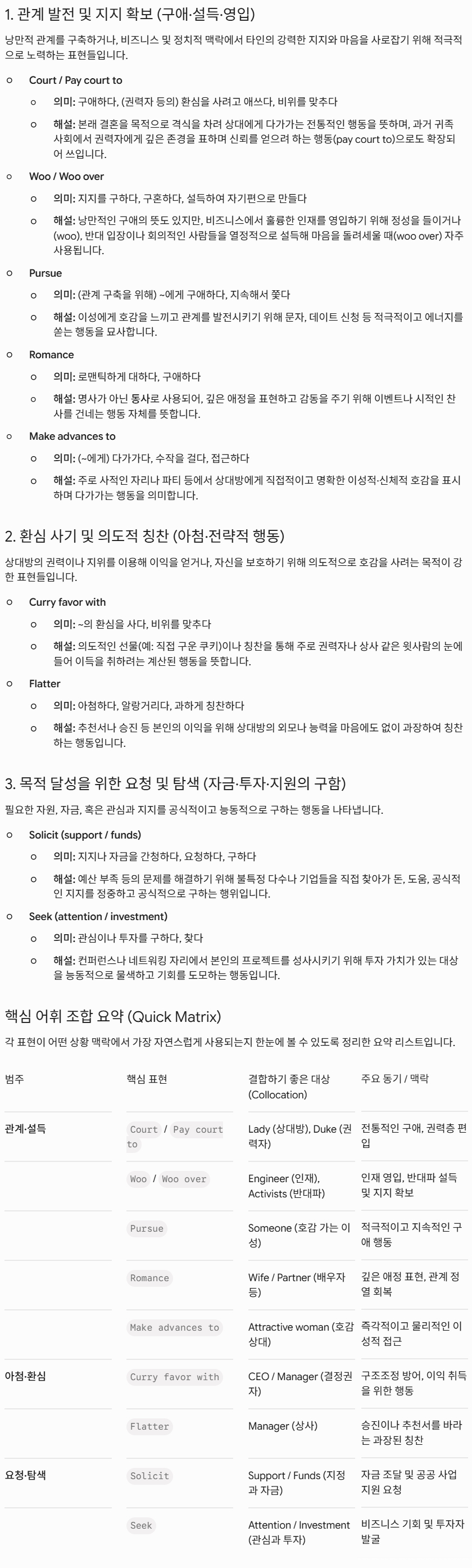
☞ [숙어 / 관용구 / 어휘 조합]
→ [추가]

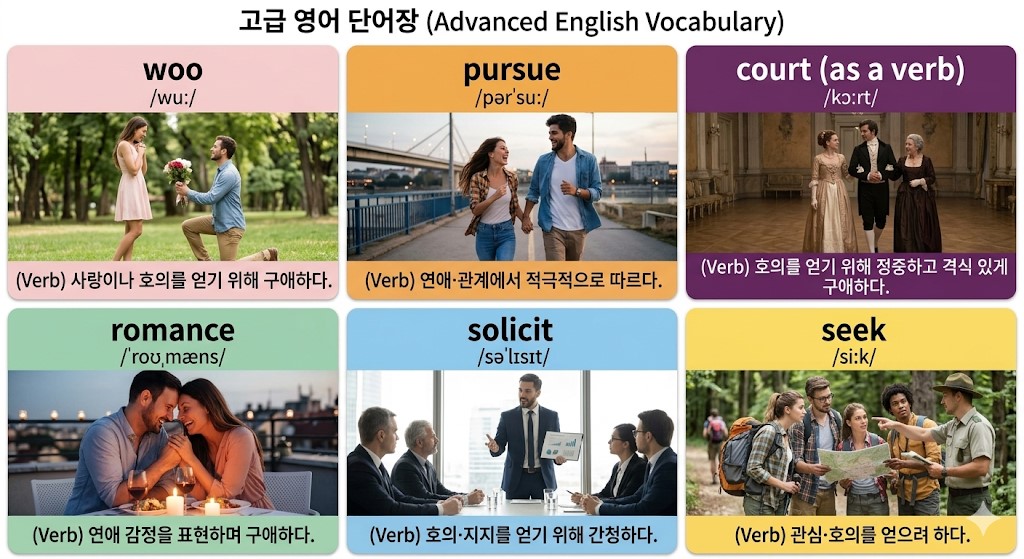
☞ [학습용 단어장]

'영어 어휘력 기르기 > 동의어 퀴즈' 카테고리의 다른 글
| 어휘력 [wish - (28)] - Ⅰ → [단어/숙어 32] → [테스트 6] (0) | 2026.05.28 |
|---|---|
| 어휘력 [wish - (28)] - Ⅰ → [단어/숙어 32] → [테스트 5] (0) | 2026.05.28 |
| 어휘력 [wish - (28)] - Ⅰ → [단어/숙어 32] → [테스트 3] (0) | 2026.05.27 |
| 어휘력 [wish - (28)] - Ⅰ → [단어/숙어 32] → [테스트 2] (0) | 2026.05.26 |
| 어휘력 [wish - (28)] - Ⅰ → [단어/숙어 32] → [테스트 1] (0) | 2026.05.25 |