★
테스트를 통해 어휘력 다지기!
☞ 어휘력 [wish - (28)] - Ⅰ → [단어/숙어 32]
★
"court"의 '명사형' 동의어 (2).
Q1.
How would you best describe
the fundamental difference between a palace and a castle?
A) A palace is primarily a royal residence designed for luxury,
whereas a castle is a fortified structure built for defense.
B) A palace is always built of wood,
whereas a castle is exclusively constructed from reinforced stone.
C) A palace serves only as a military barracks,
whereas a castle is used solely for farming purposes.
D) A palace is located in rural areas,
whereas a castle is always situated at the center of a modern city.
Correct Answer: A
Explanation:
A palace focuses on grand royal living and administrative luxury,
while a castle's primary historical purpose
is military defense and fortification.
Q2.
Which of the following best allows a person
to distinguish a mansion from a villa?
A) A mansion is a small apartment in a crowded city,
while a villa is a massive skyscraper.
B) A mansion is defined strictly by its enormous size and grandeur,
while a villa often refers to
a high-end country estate or luxury vacation residence.
C) A mansion is always owned by the government,
while a villa can only be rented by tourists.
D) There is no difference;
a villa must always be larger and more heavily fortified
than a mansion.
Correct Answer: B
Explanation:
A mansion emphasizes a massive, grand permanent residence,
whereas a villa is typically associated with an elegant,
upper-class country home or a luxurious holiday retreat.
Q3.
When we examine the difference between a château and an estate,
which statement is most accurate?
A) A château specifically implies a French-style castle or manor house,
whereas an estate refers to
the extensive vast land and the property upon it.
B) A château is a mobile home,
whereas an estate refers only to urban public parks.
C) A château is built underground,
whereas an estate is a modern commercial shopping complex.
D) A château must be located in Spain,
whereas an estate is exclusively located in the United Kingdom.
Correct Answer: A
Explanation:
"Château" carries a specific cultural/architectural connection
to French grand houses or castles,
while "estate" refers to the broad economic or physical unit
of extensive land holding and its buildings.
Q4.
Which option correctly helps to distinguish an alcazar from a seraglio?
A) An alcazar is a public marketplace,
while a seraglio is a modern corporate headquarters.
B) An alcazar is an open-air theater,
while a seraglio is a religious monastery.
C) An alcazar refers to a Spanish fortress-palace of Moorish origin,
while a seraglio specifically refers to
an Ottoman Turkish palace or court.
D) An alcazar is a temporary tent,
while a seraglio is a permanent stone bridge.
Correct Answer: C
Explanation:
An alcazar is historically tied to Islamic architecture in Spain
(Moorish palaces),
while a seraglio refers directly to
the historic palaces of the Ottoman sultans.
Q5.
What is the structural difference
between a courtyard and a quadrangle (quad)?
A) A courtyard is always covered by a glass roof,
while a quadrangle has no walls around it at all.
B) A courtyard is a broad term for an enclosed yard next to a building,
while a quadrangle is specifically a four-sided courtyard
completely surrounded by buildings, often in universities.
C) A courtyard is used only for parking vehicles,
while a quadrangle is designed exclusively for indoor sports.
D) A courtyard is a narrow hallway,
while a quadrangle is a circular garden located on top of a roof.
Correct Answer: B
Explanation:
While both are enclosed open spaces,
a quadrangle (or quad) specifically highlights a rectangular
or four-sided layout completely bordered by buildings,
typically found in institutional or academic settings.
Q6.
How can you best distinguish an atrium from a courtyard?
A) An atrium is a paved outdoor public street,
whereas a courtyard is an underground tunnel.
B) An atrium is a tiny wooden shed,
whereas a courtyard is a multi-story parking garage.
C) An atrium is a large, open,
often skylighted central hall inside a modern building,
whereas a courtyard is an outdoor space open to the sky
surrounded by buildings.
D) An atrium is exclusively used for naval defense,
whereas a courtyard is designed for agricultural storage.
Correct Answer: C
Explanation:
An atrium is an integrated indoor architectural feature
(often with a glass ceiling),
whereas a courtyard is fundamentally an outdoor space
enclosed by walls or buildings.
Q7.
Consider the difference between a plaza and a yard.
Which explanation is correct?
A) A plaza is a private garden attached to a rural cottage,
while a yard is a massive highway system.
B) A plaza is a public open square in a city or town,
while a yard is a piece of land
immediately surrounding a house or building.
C) A plaza is a dense forest area,
while a yard is a restricted military testing zone.
D) A plaza is always located indoors,
while a yard is never allowed to have grass or trees.
Correct Answer: B
Explanation:
A plaza is an urban, public space designed for community gathering,
whereas a yard is typically private or semi-private land
directly adjacent to a house or specific functional building.
Q8.
Which of the following states
the precise difference between a terrace and a forecourt?
A) A terrace is an elevated, outdoor paved platform next to a building,
while a forecourt is an open area directly in front of a large building.
B) A terrace is an indoor basement,
while a forecourt is the highest point of a castle's tower.
C) A terrace is a long hallway connecting two offices,
while a forecourt is a public park located outside the city limits.
D) A terrace is designed exclusively for heavy machinery,
while a forecourt is used only for growing crops.
Correct Answer: A
Explanation:
A terrace focuses on being an elevated outdoor living/sitting area
attached to a structure,
while a forecourt is explicitly the prominent front yard or entry court
leading up to the main entrance of a grand building.
Q9.
In a legal context,
how would you distinguish a tribunal from a standard court of law?
A) A tribunal is a criminal organization,
whereas a court of law is a public library.
B) A tribunal is a physical chair where a king sits,
whereas a court of law is the entire country.
C) A tribunal often refers to a specialized body
appointed to adjudicate specific types
of disputes or administrative matters,
whereas a court of law is part of the traditional judicial system
handling general legal cases.
D) A tribunal handles only international maritime trade,
whereas a court of law handles only traffic tickets.
Correct Answer: C
Explanation:
While both resolve disputes,
a tribunal is frequently a specialized,
sometimes administrative or temporary panel
set up for a distinct category of cases,
whereas a court of law represents the permanent,
broader institutional judiciary.
Q10.
What is the semantic difference between the bench and the bar
within a courtroom setting?
A) The bench refers to the seating area for the audience,
while the bar refers to the secure holding cell for criminals.
B) The bench refers to the location or institution of the judges,
while the bar refers to the legal profession
as a whole or the area where attorneys sit.
C) The bench represents the jury members,
while the bar represents the administrative clerks.
D) The bench is where physical evidence is stored,
while the bar is the table where the court reporters type.
Correct Answer: B
Explanation:
"The bench" metonymically represents
the judges or the judicial seat itself,
whereas "the bar" refers to the legal practitioners, attorneys,
and the legal profession collectively.
Q11.
Which statement best clarifies
the difference between the judiciary and a forum?
A) The judiciary is a secret society,
while a forum is a physical building
used only for storing legal documents.
B) The judiciary refers to the branch of government
responsible for administering justice,
while a forum is a place, meeting, or medium
where ideas and views on an issue (including legal ones)
can be exchanged.
C) The judiciary consists only of the police force,
while a forum consists exclusively of elected politicians.
D) The judiciary is a private law firm,
while a forum is an international sports arena.
Correct Answer: B
Explanation:
The judiciary is the formal,
constitutional branch of law enforcement/justice
(the court system),
whereas a forum is historically and conceptually
a place for open discussion, debate, or public proceedings.
Q12.
How does one distinguish a general court (as a noun)
from a specific court of law
based on the provided vocabulary context?
A) A court can refer broadly to a royal household or an open area,
whereas a court of law specifically designates the judicial institution
where legal justice is administered.
B) A court is always an outdoor sports arena,
whereas a court of law is a digital website.
C) A court is a minor police station,
whereas a court of law is a supreme parliament.
D) There is no distinction;
both words are never used outside of royal castles.
Correct Answer: A
Explanation:
"Court" has a wide range of meanings
including a royal court or an architectural yard,
whereas "court of law" explicitly narrows
the definition down to the official judicial body
that hears legal cases.
Q13.
What is the primary difference between a palace and a mansion?
A) A palace is always a commercial building,
whereas a mansion is a public park.
B) A palace is historically the official residence
of a sovereign ruler or monarch,
whereas a mansion is simply an exceptionally large,
impressive private house for any wealthy individual.
C) A palace is built entirely underground,
whereas a mansion is built on a boat.
D) A palace cannot have bedrooms,
whereas a mansion is composed entirely of hallways.
Correct Answer: B
Explanation:
A palace is tied to royalty, state heads, or high sovereign rulers,
whereas a mansion denotes a massive,
luxurious private residential property regardless of royal status.
Q14.
Which option accurately explains
the difference between a castle and a château?
A) A castle is a modern glass skyscraper,
while a château is a prehistoric cave dwelling.
B) A castle is used for storing grain,
while a château is used for manufacturing military weapons.
C) A castle is a general term
for a fortified historic building built for defense,
while a château refers specifically to
a French manor house or castle,
which may or may not be fortified.
D) A castle must be built in Asia,
while a château is strictly a temporary summer tent.
Correct Answer: C
Explanation:
"Castle" emphasizes
fortification and defensive military architecture globally,
whereas "château" specifically highlights
French heritage, architectural elegance,
and can refer to grand country manors that aren't heavily fortified.
Q15.
How do you distinguish a villa from an estate?
A) A villa refers to the luxurious residential building itself
(often a vacation home),
while an estate encompasses the vast tract of land,
including all buildings, fields, and grounds.
B) A villa is a small public bus stop,
while an estate is a massive commercial airport.
C) A villa is always located in the freezing arctic,
while an estate is always built in the desert.
D) A villa is an urban apartment building,
while an estate is a small portable greenhouse.
Correct Answer: A
Explanation:
A villa is the dwelling structure itself,
characterized by luxury or retreat styling.
An estate focuses on the comprehensive property unit
—the vast landed wealth and everything situated on it.
Q16.
What is the fundamental difference between an alcazar and a palace?
A) An alcazar is a generic modern office,
while a palace is always an ancient ruins site.
B) An alcazar is a specific type
of Spanish palace or fortress with historical Moorish influence,
whereas palace is the broad, universal term
for any grand royal residence.
C) An alcazar is a wooden cabin, while a palace is a stone church.
D) An alcazar is located exclusively in South America,
while a palace can only exist in Asia.
Correct Answer: B
Explanation:
"Palace" is the overarching generic category,
while "alcazar" is a highly culturally and geographically specific subset
referring to the Moorish-fortified palaces found in Spain.
Q17.
To distinguish a seraglio from a mansion,
which of the following points is true?
A) A seraglio is a tiny public restroom,
whereas a mansion is a large city school.
B) A seraglio is a modern apartment complex,
whereas a mansion is a defensive fortress.
C) A seraglio is historically an Ottoman Turkish palace compound,
whereas a mansion is simply a large,
luxurious westernized private residence
without sovereign or historical Ottoman contexts.
D) A seraglio is built of ice,
whereas a mansion is always built of steel.
Correct Answer: C
Explanation:
A seraglio carries a deep historical and cultural meaning
tied to the Ottoman empire's royal court and palace living,
distinguishing it completely from a standard modern
or western luxury mansion.
Q18.
What is the architectural difference between a quadrangle and a plaza?
A) A quadrangle is an open public square in a city center for festivals,
while a plaza is an enclosed academic hallway.
B) A quadrangle is a circular fountain, while a plaza is a triangular park.
C) A quadrangle is an inner courtyard
completely enclosed on four sides by buildings (often institutional),
while a plaza is an open public square in a city
meant for gathering and walking.
D) A quadrangle is always built on a mountain peak,
while a plaza is an underground parking lot.
Correct Answer: C
Explanation:
A quadrangle is an enclosed, structural courtyard
typically belonging to an institution like a university,
whereas a plaza is an open, paved urban public space
accessible to the general city population.
Q19.
How can one distinguish a yard from a terrace?
A) A yard is a general ground area
immediately surrounding or adjacent to a building,
while a terrace is an elevated, flat,
paved outdoor platform or patio attached to a structure.
B) A yard is a completely enclosed indoor kitchen,
while a terrace is a deep water well.
C) A yard is always made of glass,
while a terrace is made exclusively of soil and grass.
D) A yard is used only by the government,
while a terrace is completely open to public highway traffic.
Correct Answer: A
Explanation:
A yard refers to the ground-level land around a house
(often containing lawns or work areas),
whereas a terrace is a specific,
purposefully raised and paved outdoor architectural feature
intended for leisure.
Q20.
Within the legal system,
what is the difference between the judiciary and the tribunal?
A) The judiciary is the entire branch of government
that encompasses the whole system of courts,
while a tribunal is a specific court or adjudication body
appointed to hear a particular case or type of dispute.
B) The judiciary is a political party, while a tribunal is a law school.
C) The judiciary consists only of private defense lawyers,
while a tribunal consists only of police officers.
D) The judiciary is a commercial bank,
while a tribunal is a public library committee.
Correct Answer: A
Explanation:
The judiciary represents the complete institutional branch
of the state responsible for justice,
whereas a tribunal refers to a specific, localized,
or specialized adjudicating entity
operating within or alongside that system.
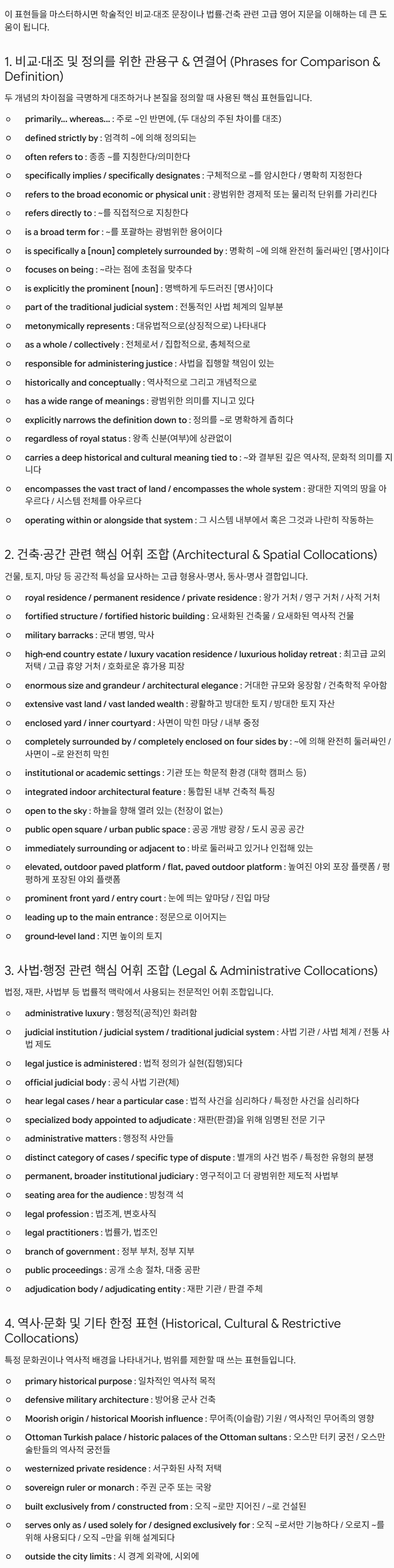
☞ [숙어 / 관용구 / 어휘 조합]
'영어 어휘력 기르기 > 동의어 퀴즈' 카테고리의 다른 글
| 어휘력 [wish - (28)] - Ⅰ → [단어/숙어 32] → [테스트 4] (0) | 2026.05.28 |
|---|---|
| 어휘력 [wish - (28)] - Ⅰ → [단어/숙어 32] → [테스트 3] (0) | 2026.05.27 |
| 어휘력 [wish - (28)] - Ⅰ → [단어/숙어 32] → [테스트 1] (0) | 2026.05.25 |
| 어휘력 [wish - (28)] - Ⅰ → [단어/숙어 31] → [테스트 3] (0) | 2026.05.23 |
| 어휘력 [wish - (28)] - Ⅰ → [단어/숙어 31] → [테스트 2] (0) | 2026.05.22 |