★
테스트를 통해 어휘력 다지기!
☞ 어휘력 [wish - (28)] - Ⅰ → [단어/숙어 31]
★
"traitor"의 동의어 (2).
1.
How do you distinguish a 'betrayer' from a 'turncoat'?
(A) A betrayer breaks personal trust or promises,
whereas a turncoat changes their political or group allegiance
for personal benefit.
(B) A betrayer defects to an enemy nation,
whereas a turncoat primarily passes government secrets to the police.
(C) A betrayer acts out of sheer cowardice during a battle,
whereas a turncoat remains completely loyal to their original faith.
(D) A betrayer tries to overthrow a governing system,
whereas a turncoat petty-tattles on friends for small rewards.
Answer: (A)
Explanation:
A betrayer violates personal confidence and trust,
while a turncoat specifically shifts political loyalty or switches sides.
2.
What is the key difference between a 'renegade' and an 'apostate'?
(A) A renegade operates secretly within an organization,
whereas an apostate leads an armed military rebellion.
(B) A renegade leaves an established group or set of principles,
whereas an apostate specifically and formally renounces
their religious faith.
(C) A renegade acts as a double agent for cash,
whereas an apostate helps an invading army
build a puppet government.
(D) A renegade obeys all community laws,
whereas an apostate runs away from mandatory military service.
Answer: (B)
Explanation:
A renegade is a general rebel who abandons a group or cause,
whereas an apostate is explicitly defined
by the abandonment of religious beliefs.
3.
How can one distinguish a 'defector' from a 'deserter'?
(A) A defector is a coward who flees a physical fight,
whereas a deserter openly switches political parties
during an election.
(B) A defector operates as a childish informant,
whereas a deserter seeks political asylum in a foreign country.
(C) A defector leaves their country to join an opposing state,
whereas a deserter abandons their military duty and post,
usually to flee warfare.
(D) A defector works to undermine the entire legal system,
whereas a deserter pretends to be a close friend
while stabbing someone in the back.
Answer: (C)
Explanation:
A defector shifts national or state allegiance to an enemy,
while a deserter runs away from military obligations.
4.
What best highlights the difference
between a 'quisling' and a 'collaborator'?
(A) A quisling runs away from a battle out of fear,
whereas a collaborator double-crosses
two different criminal cartels simultaneously.
(B) A quisling breaks a private promise between spouses,
whereas a collaborator leaves a religious institution
to become an atheist.
(C) A quisling leaks minor secrets to school teachers,
whereas a collaborator actively overthrows a democratic government.
(D) A quisling is a traitor
who heads a puppet government for an occupier,
whereas a collaborator is anyone
who cooperates with an enemy force.
Answer: (D)
Explanation:
A quisling is a specific political puppet leader for invaders,
while collaborator is a broader term
for anyone cooperating with an enemy.
5.
How do you distinguish a 'backstabber' from a 'double-crosser'?
(A) A backstabber acts maliciously behind a friend's back
while pretending to be close,
whereas a double-crosser betrays an agreement or contract,
often deceiving both sides.
(B) A backstabber defects to a hostile nation for political asylum,
whereas a double-crosser runs away from military service.
(C) A backstabber works as an official government informant,
whereas a double-crosser formally renounces
their lifelong religious faith.
(D) A backstabber openly leads an armed political rebellion,
whereas a double-crosser helps an occupying army rule a city.
Answer: (A)
Explanation:
A backstabber ruins personal friendships through hidden deceit,
whereas a double-crosser betrays a specific mutual deal
or cheats a co-conspirator.
6.
What is the fundamental difference
between a 'double-dealer' and a 'recreant'?
(A) A double-dealer acts as a personal friend
but stabs someone in the back,
whereas a recreant changes political parties.
(B) A double-dealer engages in deceitful, two-faced business practices,
whereas a recreant is a cowardly betrayer who yields out of fear.
(C) A double-dealer leaves their country for political reasons,
whereas a recreant passes corporate secrets to a rival company.
(D) A double-dealer petty-tattles on minor rule violations,
whereas a recreant is a specific religious figure who renounces God.
Answer: (B)
Explanation:
A double-dealer maintains two conflicting faces
for financial or personal gain,
while a recreant is defined by cowardice and yielding to fear.
7.
How do you distinguish an 'informant' (or informer) from a 'snitch'?
(A) An informant provides official,
often confidential intelligence to authorities,
whereas a snitch petty-tattles or confesses secrets
within an informal context.
(B) An informant runs away from military guard duty,
whereas a snitch heads a puppet government during wartime.
(C) An informant betrays a mutual deal between two cartels,
whereas a snitch formally abandons their church vows.
(D) An informant works secretly within a country to aid an enemy army,
whereas a snitch plots to completely overthrow the regime.
Answer: (A)
Explanation:
Informant implies a more formal or structural delivery
of information to law enforcement,
whereas snitch is informal and often implies petty tattling.
8.
What describes the difference
between a 'squealer' (or tattletale) and a 'rat'?
(A) A squealer leaves their native country for asylum,
whereas a rat abandons their military battalion.
(B) A squealer is a puppet leader for an invading force,
whereas a rat helps a community build a religious sanctuary.
(C) A squealer formally renounces their philosophical beliefs,
whereas a rat works as an undercover military commander.
(D) A squealer childishly tells on others for minor infractions,
whereas a rat is a slang term for a serious informer
who betrays an entire close-knit group or gang.
Answer: (D)
Explanation:
Squealer or tattletale carries a childish or petty connotation,
while rat is a harsh underworld slang for a traitor
who violates a deep code of silence.
9.
How can one distinguish a 'Judas' from a 'fifth columnist'?
(A) A Judas is a deeply personal betrayer of a close friend or master,
whereas a fifth columnist is a faction working secretly from within
to aid an invading enemy.
(B) A Judas changes their political party for money,
whereas a fifth columnist is a coward
who runs away from physical combat.
(C) A Judas formally leaves a religious institution,
whereas a fifth columnist acts
as a business professional with two different faces.
(D) A Judas leaks petty secrets to school authorities,
whereas a fifth columnist seeks political asylum in a foreign land.
Answer: (A)
Explanation:
A Judas represents archetypal, highly personal betrayal,
whereas a fifth columnist refers to a group or individual
covertly undermining a nation from within for an external enemy.
10.
What is the key difference
between a 'subverter' (or conspirator) and a 'traitor'?
(A) A subverter works covertly to undermine
an established political system,
whereas a traitor is the comprehensive term
for anyone committing treason
against their country or collective trust.
(B) A subverter tells minor secrets to teachers,
whereas a traitor runs away from military service
out of pure cowardice.
(C) A subverter formally abandons their religious church,
whereas a traitor pretends to be a nice friend
while acting two-faced.
(D) A subverter changes political parties during an election,
whereas a traitor double-crosses a business partner for money.
Answer: (A)
Explanation:
A subverter focuses on undermining structural systems and regimes,
while traitor is the ultimate, broadest definition
for severe betrayal of allegiance or country.
11.
How do you distinguish a 'turncoat' from a 'defector'?
(A) A turncoat primarily operates as a childish informant at school,
whereas a defector runs away from a military battle out of fear.
(B) A turncoat breaks a personal promise between close friends,
whereas a defector acts as a puppet leader for an occupying force.
(C) A turncoat switches political or group allegiances
based on shifting power,
whereas a defector officially leaves their nation or state
to join an enemy country.
(D) A turncoat works to undermine a religious church,
whereas a defector maintains a two-faced business identity.
Answer: (C)
Explanation:
Turncoats shift their loyalties and affiliations
within a system or group,
while defectors explicitly cross national borders or state lines
to join an opposing state.
12.
What is the difference between an 'apostate' and a 'recreant'?
(A) An apostate is defined by abandoning a religion or belief,
whereas a recreant is a cowardly betrayer
who surrenders due to fear.
(B) An apostate provides structural intelligence to the police,
whereas a recreant acts as a personal friend
but stabs someone in the back.
(C) An apostate heads a puppet government for invaders,
whereas a recreant leaves their country to seek political asylum.
(D) An apostate double-crosses two different business partners,
whereas a recreant petty-tattles on minor rules.
Answer: (A)
Explanation:
An apostate renounces ideological or religious systems,
whereas a recreant's betrayal is driven
by cowardice, fear, or a lack of courage.
13.
How can one distinguish a 'deserter' from a 'renegade'?
(A) A deserter changes their business partnership for cash,
whereas a renegade provides confidential tips to the federal police.
(B) A deserter acts two-faced in commercial markets,
whereas a renegade leaves their country for political asylum.
(C) A deserter breaks a personal marriage promise,
whereas a renegade acts as a puppet politician for an invading army.
(D) A deserter specifically runs away from military service and duty,
whereas a renegade is a general rebel
who rejects an established group or principles.
Answer: (D)
Explanation:
Deserters have a specific military context of fleeing duty,
while renegades are general outlaws or rebels
who break away from conventional constraints or beliefs.
14.
What describes the difference
between a 'quisling' and a 'fifth columnist'?
(A) A quisling is an explicit puppet leader operating openly
under an occupier,
whereas a fifth columnist operates covertly inside a country
to aid an advancing enemy.
(B) A quisling runs away from active military combat,
whereas a fifth columnist formally renounces their religious faith.
(C) A quisling tells petty secrets to school teachers,
whereas a fifth columnist double-crosses two business partners.
(D) A quisling breaks a personal promise between friends,
whereas a fifth columnist seeks political asylum across a border.
Answer: (A)
Explanation:
Quislings are visible, collaborator heads of puppet regimes,
whereas fifth columnists are hidden saboteurs
working internally to weaken a nation.
15.
How do you distinguish a 'backstabber' from a 'Judas'?
(A) A backstabber leaves their country to join a rival nation,
whereas a Judas abandons their military guard post out of fear.
(B) A backstabber subtly works against a peer
while maintaining a friendly facade,
whereas a Judas represents the ultimate personal betrayal
of a master or deep love, often for material gain.
(C) A backstabber works as an official informer for law enforcement,
whereas a Judas changes their political party affiliation.
(D) A backstabber overthrows a governmental regime,
whereas a Judas engages in two-faced corporate business deals.
Answer: (B)
Explanation:
While both imply personal betrayal,
a backstabber is a general term for sneaky peer betrayal,
whereas a Judas evokes a profound, ultimate betrayal
of a sacred bond or master, reminiscent of biblical context.
16.
What is the difference between a 'double-crosser' and a 'double-dealer'?
(A) A double-crosser betrays a specific mutual scheme or deal
by turning on co-conspirators,
whereas a double-dealer continuously practices deceitful,
two-faced actions in business or politics.
(B) A double-crosser runs away from a military trench,
whereas a double-dealer leaves their country for political asylum.
(C) A double-crosser provides information to the local police,
whereas a double-dealer formally abandons a religious faith.
(D) A double-crosser acts as an open puppet leader for invaders,
whereas a double-dealer petty-tattles on minor infractions.
Answer: (A)
Explanation:
Double-crossing implies actively violating a set plan or pact
to burn a partner,
while double-dealing is a broader, persistent behavior
of playing two opposing sides against each other.
17.
How do you distinguish a 'rat' from an 'informant'?
(A) A rat is an underworld slang for an internal betrayer
who breaks a code of silence,
whereas an informant is a neutral or official term
for someone providing data to authorities.
(B) A rat runs away from a military post out of fear,
whereas an informant switches political parties during an election.
(C) A rat works openly as a puppet leader for an invading force,
whereas an informant seeks political asylum in a foreign land.
(D) A rat breaks a private marriage promise,
whereas an informant formally renounces their church beliefs.
Answer: (A)
Explanation:
"Rat" is highly pejorative slang
used within close-knit or criminal groups for a traitor,
while "informant" is a professional or technical term
used by law enforcement.
18.
What highlights the difference
between a 'subverter' and a 'collaborator'?
(A) A subverter petty-tattles on classmates,
whereas a collaborator runs away from a military battle.
(B) A subverter formally leaves their religious church,
whereas a collaborator acts two-faced
in commercial real estate deals.
(C) A subverter actively works
to undermine and overthrow an established state system,
whereas a collaborator cooperates with an enemy or occupying force.
(D) A subverter breaks a personal promise between friends,
whereas a collaborator leaves their country for political asylum.
Answer: (C)
Explanation:
A subverter focuses on the destruction or collapse of an existing regime,
while a collaborator focuses on
working together with an external occupying power.
19.
How do you distinguish a 'betrayer' from a 'traitor'?
(A) A betrayer breaks general or personal trust and promises,
whereas a traitor commits the ultimate crime of treason
against their own country, sovereign, or ultimate allegiance.
(B) A betrayer runs away from military combat,
whereas a traitor petty-tattles on school rules.
(C) A betrayer formally leaves a religious faith,
whereas a traitor acts as a two-faced corporate businessman.
(D) A betrayer seeks political asylum across a border,
whereas a traitor works as an official police informant.
Answer: (A)
Explanation:
Betrayer is widely applicable to personal relationships and broken trust,
whereas traitor carries a heavy legal and political weight
involving treason against a nation or fundamental duty.
20.
What is the key difference between a 'snitch' and a 'quisling'?
(A) A snitch petty-tattles on minor rules or peers informally,
whereas a quisling is a major political traitor
who runs a puppet government for an invading enemy.
(B) A snitch runs away from a military unit during wartime,
whereas a quisling seeks political asylum in a foreign country.
(C) A snitch formally abandons their church and religious vows,
whereas a quisling acts two-faced in corporate business.
(D) A snitch overthrows a democratic government system,
whereas a quisling betrays a personal promise between close friends.
Answer: (A)
Explanation:
A snitch deals with low-stakes, informal information or tattling,
whereas a quisling operates at the highest level
of national and political wartime betrayal.
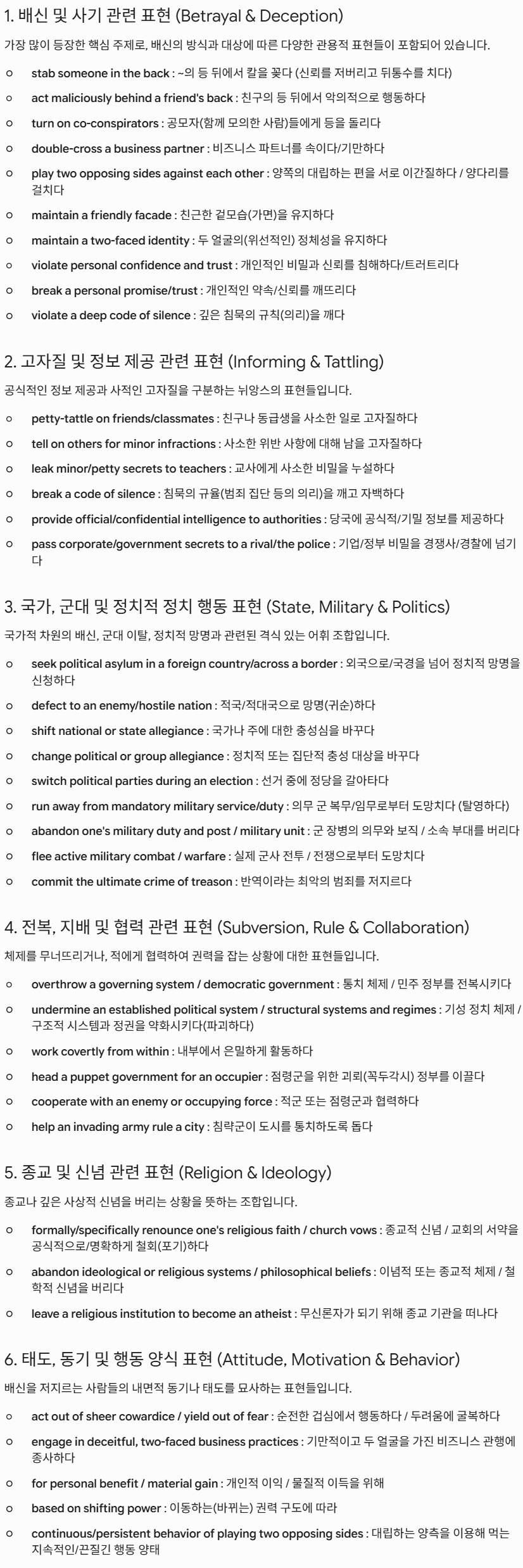
☞ [숙어 / 관용구 / 어휘 조합]
'영어 어휘력 기르기 > 동의어 퀴즈' 카테고리의 다른 글
| 어휘력 [wish - (28)] - Ⅰ → [단어/숙어 32] → [테스트 1] (0) | 2026.05.25 |
|---|---|
| 어휘력 [wish - (28)] - Ⅰ → [단어/숙어 31] → [테스트 3] (0) | 2026.05.23 |
| 어휘력 [wish - (28)] - Ⅰ → [단어/숙어 31] → [테스트 1] (0) | 2026.05.22 |
| 어휘력 [wish - (28)] - Ⅰ → [단어/숙어 30] → [테스트 3-2] (0) | 2026.05.20 |
| 어휘력 [wish - (28)] - Ⅰ → [단어/숙어 30] → [테스트 3-1] (0) | 2026.05.19 |