★
테스트를 통해 어휘력 다지기!
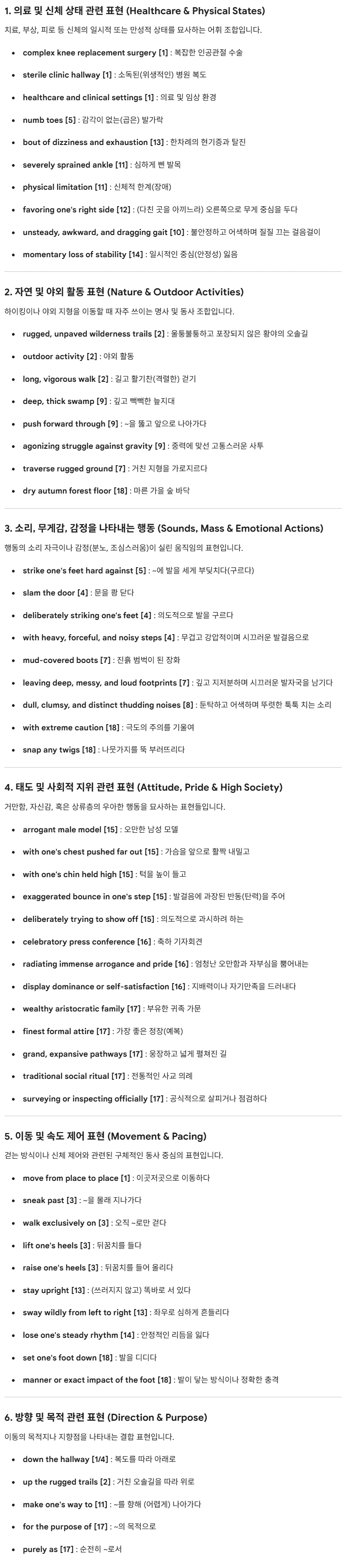
☞ 어휘력 [wish - (28)] - Ⅰ → [단어/숙어 30]
★
"tread"의 동의어 (1-2).
1.
Following a complex knee replacement surgery,
the physical therapist carefully assisted the elderly patient
as he tried to stand up
and perform basic walking movements down the sterile clinic hallway.
Which professional word is best suited here?
(A) stride
(B) stroll
(C) ambulate
(D) saunter
Answer: (C)
Explanation:
"Ambulate" is a formal and medical term
that means to walk or move from place to place,
commonly used in healthcare and clinical settings.
2.
Armed with a wooden walking stick, a map,
and a large bottle of water,
Sarah spent her Saturday climbing up the rugged,
unpaved wilderness trails of Mount Bukhansan.
Which word best describes this outdoor activity?
(A) march
(B) scramble
(C) shuffle
(D) hike
Answer: (D)
Explanation:
"Hike" specifically refers to taking a long, vigorous walk in nature,
the countryside, or mountains, usually on rough trails.
3.
To avoid waking up his sleeping parents,
a teenager carefully lifted his heels
and walked exclusively on the very front edges of his feet
as he sneaked past their bedroom door.
Which word perfectly describes this quiet action?
(A) tiptoe
(B) stomp
(C) stride
(D) march
Answer: (A)
Explanation:
"Tiptoe" means to walk very quietly and carefully
with one's heels raised,
moving only on the tips of the toes to avoid noise.
4.
Furious after losing his favorite video game,
the angry young boy slammed his door
and walked heavily down the hallway,
deliberately striking his feet against the floor
to make as much noise as possible.
Which word captures this angry movement?
(A) stroll
(B) stomp
(C) amble
(D) saunter
Answer: (B)
Explanation:
"Stomp" means to walk with heavy, forceful, and noisy steps,
often indicating anger, frustration, or a deliberate attempt to be loud.
5.
Standing outside in the freezing winter air
while waiting for the train,
commuters repeatedly struck their feet hard
against the concrete platform
to generate friction and bring some warmth back
to their numb toes.
Which word best describes this action?
(A) walk
(B) stride
(C) stamp
(D) ramble
Answer: (C)
Explanation:
"Stamp" means
to bring down one's foot heavily and noisily onto the ground,
often done to show anger, clear off dirt, or warm up the feet.
6.
During the chaotic music festival,
an excited rush of thousands of fans
ran directly over the beautiful flowerbeds near the stage,
completely crushing and destroying the plants under their rushing feet.
Which word best describes this destructive crushing?
(A) trample
(B) stroll
(C) march
(D) saunter
Answer: (A)
Explanation:
"Trample" means to step heavily on something, crushing, damaging,
or destroying it underfoot.
7.
The children came home from the rainy playground
and walked heavily all over the clean living room rug
with their mud-covered boots,
leaving deep, messy, and loud footprints everywhere.
Which word best captures this heavy, messy walking?
(A) walk
(B) stroll
(C) stride
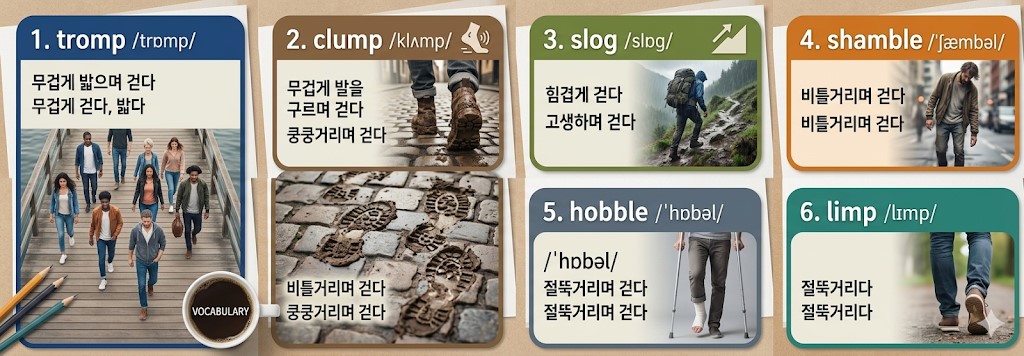
(D) tromp
Answer: (D)
Explanation:
"Tromp" means to walk heavily, loudly,
and often destructively,
similar to stomping but frequently associated
with making a mess or traversing rugged ground.
8.
Wearing incredibly heavy, stiff wooden clogs,
the performer walked across the hollow wooden stage,
creating a series of dull, clumsy,
and distinct thudding noises with every single step.
Which word best identifies this specific sound and movement?
(A) clump
(B) amble
(C) saunter
(D) stride
Answer: (A)
Explanation:
"Clump" means to walk with heavy, clumsy steps
that make a dull, distinctive thudding or clattering noise.
9.
The soldiers had to push forward through a deep, thick swamp
where the wet mud reached up to their knees,
making every single forward movement an intense,
agonizing struggle against gravity.
Which word best describes this exhausting battle?
(A) stroll
(B) slog
(C) march
(D) swagger
Answer: (B)
Explanation:
"Slog" means to walk or work heavily and with great effort,
especially through difficult obstacles like deep mud, snow, or water.
10.
In the horror movie,
the reanimated zombies moved down the abandoned city street
with an unsteady, awkward, and dragging gait,
looking completely uncoordinated as if their limbs barely worked.
Which word best characterizes this eerie movement?
(A) stride
(B) march
(C) shamble
(D) pace
Answer: (C)
Explanation:
"Shamble" means to walk with a slow, lazy, shuffling,
or awkward gait,
often appearing uncoordinated or unstable.
11.
Having severely sprained his ankle during the soccer match,
the athlete tried to make his way to the sidelines
by unevenly shifting his weight
and taking short, painful, limping steps.
Which word best describes his restricted movement?
(A) hobble
(B) stride
(C) march
(D) swagger
Answer: (A)
Explanation:
"Hobble" means to walk with a restricted, uneven,
or awkward movement,
usually caused by an injury, pain, or a physical limitation.
12.
Because a sharp little pebble had secretly fallen inside his left boot,
the hiker walked with a clear, noticeable tilt,
favoring his right side to avoid putting pressure
on his hurting left foot.
Which word best matches this uneven walking?
(A) stride
(B) limp
(C) march
(D) pace
Answer: (B)
Explanation:
"Limp" specifically refers to walking unevenly
because one leg or foot is hurt, damaged, or painful to step on.
13.
Blinded by a sudden, intense bout of dizziness and exhaustion
at the end of the marathon,
the runner swayed wildly from left to right,
nearly collapsing as he fought to stay upright before the finish line.
Which word highlights this lack of balance?
(A) stride
(B) march
(C) stagger
(D) pace
Answer: (C)
Explanation:
"Stagger" means to walk or move unsteadily,
as if about to fall,
typically due to dizziness, intoxication, weakness, or a heavy blow.
14.
As the nervous young gymnast walked across the high balance beam,
her legs suddenly lost their steady rhythm for a brief second,
showing a sudden hesitation and wobble in her movement
before she regained control.
Which word best fits this momentary loss of stability?
(A) falter
(B) stride
(C) march
(D) swagger
Answer: (A)
Explanation:
"Falter" means to lose strength, momentum,
or stability while moving,
resulting in a hesitant, stumbling, or unsteady movement.
15.
The arrogant male model walked down the fashion runway
with his chest pushed far out,
his chin held high, and an exaggerated bounce in his step,
deliberately trying to show off his expensive clothes.
Which word best captures this prideful walk?
(A) trudge
(B) plod
(C) shuffle
(D) strut
Answer: (D)
Explanation:
"Strut" means to walk with a proud, stiff, and arrogant gait,
often with the chest pushed out, to impress others or show off.
16.
After winning the world championship trophy,
the boxer entered the celebratory press conference room
with a highly confident,
swinging body language,
radiating immense arrogance and pride.
Which word best describes this attitude?
(A) swagger
(B) trudge
(C) plod
(D) shuffle
Answer: (A)
Explanation:
"Swagger" means to walk or behave in a very confident, arrogant,
and aggressive way,
often swinging the shoulders to display dominance or self-satisfaction.
17.
The wealthy aristocratic family dressed in their finest formal attire
and went out to slowly inspect the grand,
expansive pathways of their private estate garden,
purely as a traditional social ritual.
Which formal word best fits this high-society walk?
(A) walk
(B) stride
(C) march
(D) perambulate
Answer: (D)
Explanation:
"Perambulate" is a highly formal and literary term
that means to walk through, about, or over a place,
often for the purpose of surveying or inspecting it officially or ritually.
18.
The hunter moved through the dry autumn forest floor
with extreme caution,
carefully placing his boots on the ground
so he wouldn't snap any twigs or make any sound
that might alert the nearby deer.
Which word best captures this deliberate action
of setting down the feet?
(A) tread
(B) stomp
(C) march
(D) swagger
Answer: (A)
Explanation:
"Tread" means to set one's foot down or walk on something,
often emphasizing the manner, carefulness,
or exact impact of the foot touching a surface.
☞ [숙어 / 관용구]
☞ [학습용 단어장]


'영어 어휘력 기르기 > 동의어 퀴즈' 카테고리의 다른 글
| 어휘력 [wish - (28)] - Ⅰ → [단어/숙어 30] → [테스트 2-2] (0) | 2026.05.18 |
|---|---|
| 어휘력 [wish - (28)] - Ⅰ → [단어/숙어 30] → [테스트 2-1] (0) | 2026.05.18 |
| 어휘력 [wish - (28)] - Ⅰ → [단어/숙어 30] → [테스트 1-1] (0) | 2026.05.18 |
| 어휘력 [wish - (28)] - Ⅰ → [단어/숙어 29] → [테스트 3] (0) | 2026.05.17 |
| 어휘력 [wish - (28)] - Ⅰ → [단어/숙어 29] → [테스트 2] (1) | 2026.05.17 |