★
테스트를 통해 어휘력 다지기!
☞ 어휘력 [wish - (28)] - Ⅰ → [단어/숙어 29]
★
"mortal"의 동의어 (3).
1.
Classical dramatists often relied on the concept of hamartia,
arguing that even the most heroic protagonists
are bound by their fundamentally ________ limitations,
such as pride, jealousy, and the inevitable emotional fragility
that prevents total perfection.
A) corporeal
B) earthly
C) human
D) ephemeral
Answer: C
Explanation:
"Human" captures the intrinsic qualities, vulnerabilities,
psychological complexities,
and behavioral imperfections associated with being a person,
distinguishing human nature from the infallible or the divine.
2.
After analyzing the structural degradation
of the ancient cathedral,
the civil engineers noted
that the foundational beams had entered
a ________ phase of structural fatigue,
meaning that no amount of superficial retrofitting
could stop the inevitable, progressive collapse
of the entire roof.
A) terminal
B) temporal
C) corporeal
D) transitory
Answer: A
Explanation:
"Terminal" refers to the final, incurable stage
of a progressive decline
leading inevitably to the end or destruction of a subject.
While often used medically,
it perfectly fits an irreversible, fatal final stage
of mechanical or structural failure.
3.
As the investigators descended deeper into the catacombs,
they were met with a ________ silence
that seemed to chill the very marrow of their bones,
carrying an ominous stillness
that made them feel
as though the ancient stone walls themselves
were entombed in a permanent state of decay.
A) deathly
B) deadly
C) temporal
D) finite
Answer: A
Explanation:
"Deathly" means resembling or suggesting death
in appearance, sound, or atmosphere.
A "deathly silence" implies an eerie, grim,
and cold atmosphere
that evokes the feeling of death,
rather than something actively capable of causing
physical expiration.
4.
The historical records confirm
that the diplomatic blunder committed by the prime minister
proved to be ________ to the peace negotiations,
instantly triggering a mobilization of troops along the border
and shattering a decade of careful geopolitical stabilization.
A) lethal
B) fatal
C) terminal
D) corporeal
Answer: B
Explanation:
In a metaphorical but highly advanced context,
"fatal" describes a mistake, error,
or event that results in total destruction, failure,
or death of a process (like peace negotiations).
While "lethal" refers to
physical weapons or tools designed to kill,
"fatal" is the precise fit for a disastrous, irreversible outcome.
5.
The explorers were warned
that navigating the volcanic valley
during the active sulfur eruption
was a ________ endeavor,
as the invisible, odorless gasses pooling in the lowlands
had a mathematically high probability
of causing instantaneous asphyxiation to anyone
without specialized military-grade oxygen gear.
A) transitory
B) perishable
C) deadly
D) human
Answer: C
Explanation:
"Deadly" means capable of causing death
or filled with extreme hazard in a natural context.
The context emphasizes
that the environment itself is highly dangerous
and carries a high probability of causing death.
6.
Environmental toxicologists discovered
that the industrial byproduct,
even when diluted to one part per million,
retained its ________ potency,
carrying the exact chemical architecture
required to systematically shut down
the respiratory systems of aquatic organisms
within minutes of exposure.
A) human
B) deathly
C) earthly
D) lethal
Answer: D
Explanation:
"Lethal" is the correct term here
because it refers to the inherent, physical capacity
of a substance, chemical, or weapon to cause death
through its biological or chemical design.
7.
The logistics coordinator emphasized that
because organic enzymes and live vaccines
are highly ________ materials,
any unexpected delay in the temperature-controlled cold chain
would cause the proteins to denature,
rendering the entire multimillion-dollar cargo completely useless.
A) finite
B) perishable
C) earthly
D) mortal
Answer: B
Explanation:
"Perishable" describes substances, organic materials,
or food products
that are inherently subject to rapid decay, spoilage,
or destruction
if not kept in specific preservation conditions.
8.
Ascetic monks often spent decades
meditating on the illusion of luxury,
actively training their minds to disregard ________ anxieties
regarding real estate, political power,
and material fortunes
in order to focus entirely on the intangible elevation of the soul.
A) earthly
B) finite
C) mortal
D) terminal
Answer: A
Explanation:
"Earthly" refers to material, secular,
or worldly affairs tied to our existence on this planet,
directly contrasted with spiritual, transcendental,
or heavenly matters.
9.
While Cartesian philosophers argued
that the human mind functions
as an immaterial, thinking entity,
they simultaneously acknowledged
that our ________ interactions with the environment
depend entirely on biological sensory organs
made of bone, muscle, and nerve tissue.
A) transitory
B) ephemeral
C) lethal
D) corporeal
Answer: D
Explanation:
"Corporeal" means relating to the physical,
tangible body of flesh and blood,
or having a material substance
that can be physically touched,
as opposed to spiritual or intellectual concepts.
10.
Secular historians analyze legal frameworks
through a purely ________ lens,
treating the constitutions of empires
not as divine, eternal decrees dropped from heaven,
but as products of specific historical eras bound to change
as social structures evolve over time.
A) deathly
B) fatal
C) temporal
D) deadly
Answer: C
Explanation:
"Temporal" relates to time, chronological eras,
and secular, worldly affairs
that are non-eternal and bound
by the physical timeline of human history.
11.
Quantum physicists note
that the alignment of subatomic particles
during the collision experiment is
an intensely ________ phenomenon,
existing in a state of delicate equilibrium
for a fraction of a microsecond
before destabilizing
and shifting into an entirely different energy matrix.
A) transitory
B) finite
C) perishable being
D) lethal
Answer: A
Explanation:
"Transitory" describes a state, condition,
or phenomenon
that is non-permanent, fleeting,
and characterized by constant passage or transformation
from one phase to another.
12.
The poet lamented the ________ nature
of fame in the digital age,
comparing a modern influencer's viral celebrity
to a morning mist
that flashes brilliantly
under the early sun only to vanish completely
from public memory before the afternoon arrives.
A) human
B) ephemeral
C) terminal
D) deadly
Answer: B
Explanation:
"Ephemeral" implies extreme brevity of existence,
lasting for an exceptionally short period
(traditionally a single day).
It perfectly matches the imagery
of a flash-in-the-pan viral trend or a morning mist.
13.
In ecological economics,
sustainability models are built on the grim realization
that our planet possesses a ________ volume
of rare earth elements,
meaning that infinite industrial growth is physically impossible
within a system governed by capped, exhaustible supplies.
A) finite
B) transitory
C) corporeal
D) perishable
Answer: A
Explanation:
"Finite" means having definite, calculable limits, boundaries,
or a restricted capacity
that is not infinite and can be completely exhausted over time.
14.
The existentialist essayist argued
that man must find meaning within his own limitations,
accepting that he is ultimately a ________
who cannot escape the biological certainty
of aging, decay,
and final physical expiration.
A) terminal
B) earthly
C) deathly
D) mortal
Answer: D
Explanation:
"Mortal" (used here as a noun) refers to a living creature,
specifically a human being,
who is biologically destined to die
and is subject to the inescapable rules of physical mortality.
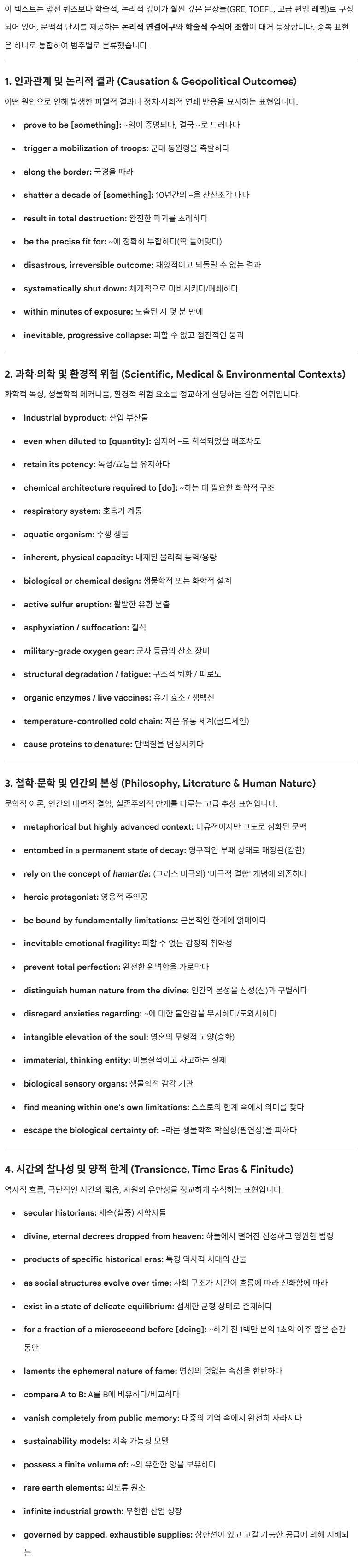
☞ [숙어 / 관용구]
'영어 어휘력 기르기 > 동의어 퀴즈' 카테고리의 다른 글
| 어휘력 [wish - (28)] - Ⅰ → [단어/숙어 30] → [테스트 1-2] (0) | 2026.05.18 |
|---|---|
| 어휘력 [wish - (28)] - Ⅰ → [단어/숙어 30] → [테스트 1-1] (0) | 2026.05.18 |
| 어휘력 [wish - (28)] - Ⅰ → [단어/숙어 29] → [테스트 2] (1) | 2026.05.17 |
| 어휘력 [wish - (28)] - Ⅰ → [단어/숙어 29] → [테스트 1] (0) | 2026.05.17 |
| 어휘력 [wish - (28)] - Ⅰ → [단어/숙어 28] → [테스트 3] (0) | 2026.05.15 |