★
테스트를 통해 어휘력 다지기!
☞ 어휘력 [wish - (28)] - Ⅰ → [단어/숙어 30]
★
"tread"의 동의어 (1-1).
1.
After spending the entire afternoon
sitting in a cramped office chair,
Emily decided to leave her car behind
and travel to the nearby grocery store on her own two feet
just to get some basic movement and fresh air.
Which word best describes her action?
(A) stride
(B) walk
(C) shuffle
(D) stomp
Answer: (B)
Explanation:
"Walk" is the most general and neutral term
for moving forward on foot at a regular pace,
which perfectly fits a simple,
everyday trip to the store for basic exercise.
2.
While moving through the pitch-black hallway
in the middle of the night,
Joshua carefully lifted his right foot
and placed it forward with short,
deliberate movements to avoid
tripping over his dog's toys on the floor.
Which word best captures this precise movement?
(A) step
(B) roam
(C) march
(D) saunter
Answer: (A)
Explanation:
"Step" refers to the specific,
singular action of lifting and setting down a foot,
especially when doing so carefully or with precise placement.
3.
Highly confident and running late for his crucial executive meeting,
the CEO moved through the corporate lobby
with massive, powerful paces,
covering the distance rapidly and looking extremely purposeful.
Which word best highlights this manner of walking?
(A) amble
(B) trudge
(C) stride
(D) falter
Answer: (C)
Explanation:
"Stride" implies taking long, decisive, and confident steps,
often associated with purpose, speed,
or an authoritative presence.
4.
Inside the hospital waiting room,
an anxious father-to-be walked back
and forth along the exact same stretch of the corridor,
maintaining a steady, rhythmic speed
while nervously checking his watch every few seconds.
Which word best fits this repetitive, steady walking?
(A) tramp
(B) stroll
(C) wander
(D) pace
Answer: (D)
Explanation:
"Pace" means to walk back and forth
with regular, measured steps,
frequently driven by anxiety, nervousness,
or deep concentration.
5.
The disciplined line of soldiers
moved in perfect unison down the main avenue,
keeping their bodies rigid and swinging their arms
in synchronized harmony
to the rhythm of the drums.
Which word best describes this organized movement?
(A) march
(B) ramble
(C) saunter
(D) tiptoe
Answer: (A)
Explanation:
"March" denotes walking with regular, rhythmic,
and highly regulated steps,
typically in a military context or a formal demonstration.
6.
On a warm Sunday afternoon, a couple wandered casually
through the botanical gardens,
holding hands and stopping occasionally
to admire the blooming roses
without any rush or specific destination in mind.
Which word best describes their leisurely activity?
(A) stomp
(B) stroll
(C) scramble
(D) trudge
Answer: (B)
Explanation:
"Stroll" means to walk in a relaxed, slow,
and leisurely manner,
purely for pleasure, relaxation, or recreation.
7.
An elderly dog and its owner
moved along the countryside path
at a remarkably slow, gentle,
and unhurried rate,
enjoying the sunshine
without showing any signs of exertion or haste.
Which word best represents this easy, relaxed speed?
(A) stamp
(B) stride
(C) amble
(D) foot it
Answer: (C)
Explanation:
"Amble" emphasizes an easy, gentle, and slow pace,
often describing an unhurried, peaceful way of moving.
8.
The carefree tourist,
dressed in loose linen clothing and sunglasses,
walked along the beach boardwalk
with an air of complete nonchalance,
looking completely relaxed and proud of his idle time.
Which word best captures this relaxed and confident vibe?
(A) saunter
(B) tramp
(C) scramble
(D) hobble
Answer: (A)
Explanation:
"Saunter" means to walk in a slow, relaxed manner,
but often carries a specific nuance of confidence, elegance,
or casual nonchalance.
9.
Exhausted after working a grueling twelve-hour shift
at the construction site,
Min-ho slowly made his way up the steep hill toward his home,
dragging his heavy legs with great effort against the pouring rain.
Which word best reflects his painful, exhausting journey?
(A) swagger
(B) strut
(C) tiptoe
(D) trudge
Answer: (D)
Explanation:
"Trudge" implies walking slowly and with heavy, labored steps,
typically due to exhaustion, harsh weather, or difficult terrain.
10.
The old farm donkey pulled the massive wooden cart
loaded with heavy logs along the muddy path,
moving with slow, monotonous,
and uninspired steps
that showed endurance rather than speed.
Which word best describes the donkey’s movement?
(A) strut
(B) plod
(C) step
(D) pace
Answer: (B)
Explanation:
"Plod" means to walk heavily and slowly,
emphasizing a dull, tedious,
and continuous effort over a long period.
11.
Waking up half-asleep on a freezing morning,
Kevin didn't bother lifting his feet off the floor,
causing his slippers to make a scraping noise
against the wooden tiles
as he dragged his body toward the kitchen.
Which word best identifies this dragging movement?
(A) stride
(B) walk
(C) shuffle
(D) hoof it
Answer: (C)
Explanation:
"Shuffle" refers to
walking without lifting one's feet fully off the ground,
resulting in a dragging, scraping sound.
12.
During their countryside vacation,
the hikers spent the morning
turning left and right down various unmarked paths,
exploring the woods and fields
wherever their curiosity led them.
Which word best describes this exploratory, winding walk?
(A) march
(B) stomp
(C) pace
(D) ramble
Answer: (D)
Explanation:
"Ramble" means to walk for pleasure in the countryside,
often along a long, wandering, and non-linear route.
13.
A solitary wolf traveled across hundreds of miles of the vast,
open Arctic tundra, moving freely over huge distances
without any permanent territory or specific destination.
Which word best fits this widespread wandering?
(A) roam
(B) strut
(C) stamp
(D) trudge
Answer: (A)
Explanation:
"Roam" means to move or travel over a wide,
often unrestricted geographic area
without a fixed destination or purpose.
14.
Lost in a deep daydream about his future,
David realized
he had walked completely out of his neighborhood
and was now turning down random streets
without paying any attention to where he was going.
Which word best captures this aimless walking?
(A) stride
(B) wander
(C) march
(D) pace
Answer: (B)
Explanation:
"Wander" emphasizes walking aimlessly or losing one's direction,
often because of a lack of focus, a plan, or fixed intent.
15.
Jane’s mother dragged her
through five different crowded department stores all afternoon
just to compare prices on pillows,
leaving Jane to follow behind reluctantly,
feeling bored and tired of the endless, tiring walking.
Which word best describes Jane's experience?
(A) traipse
(B) strut
(C) swagger
(D) tiptoe
Answer: (A)
Explanation:
"Traipse" means to walk around thoroughly or travel about,
often wearily, reluctantly, or unnecessarily over a long distance.
16.
Backpackers wearing heavy boots
spent three days trekking firmly through thick, muddy forest trails,
creating a loud, heavy stamping noise
with every single step they took on the rough earth.
Which word best captures this rugged hike?
(A) amble
(B) saunter
(C) tramp
(D) shuffle
Answer: (C)
Explanation:
"Tramp" implies walking with firm, heavy, and resounding steps,
typically associated with long, arduous journeys on foot or hiking.
17.
Realizing that the very last bus of the night had already departed,
the two friends had no choice but to use their own legs
to get back home,
setting off on a long, brisk walk across the dark city.
Which word best represents this colloquial situation?
(A) walk
(B) stroll
(C) amble
(D) hoof it
Answer: (D)
Explanation:
"Hoof it" is an informal, slang expression
that means to go on foot or walk,
especially when alternative transportation is unavailable.
18.
When their taxi suddenly broke down
in the middle of a massive traffic jam right outside the stadium,
the fans decided to get out and travel the final mile on foot
to avoid missing the start of the concert.
Which word acts as a synonym for this choice?
(A) stomp
(B) foot it
(C) swagger
(D) trudge
Answer: (B)
Explanation:
"Foot it" is another idiomatic phrase meaning to walk
or travel on foot,
often used when someone must walk
due to a necessity or a change in plans.
☞ [숙어 / 관용구]
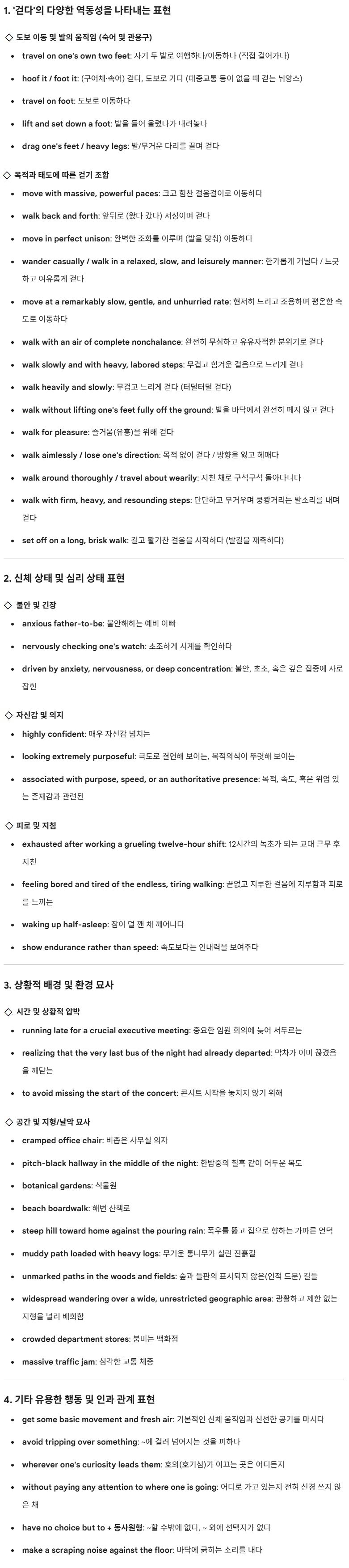
☞ [학습용 단어장]
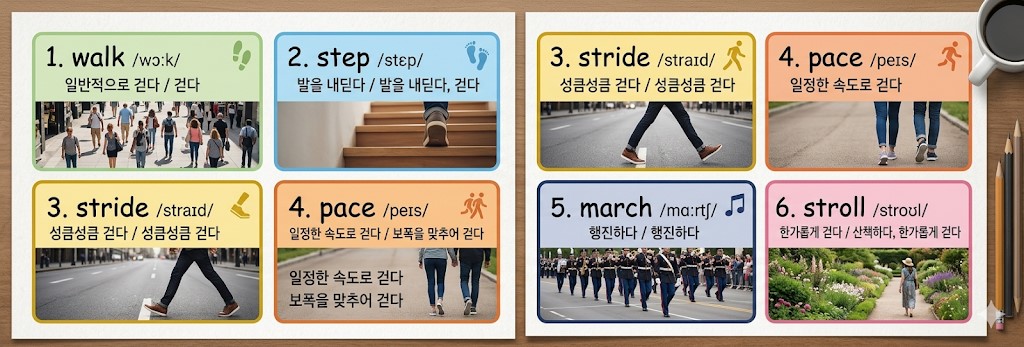
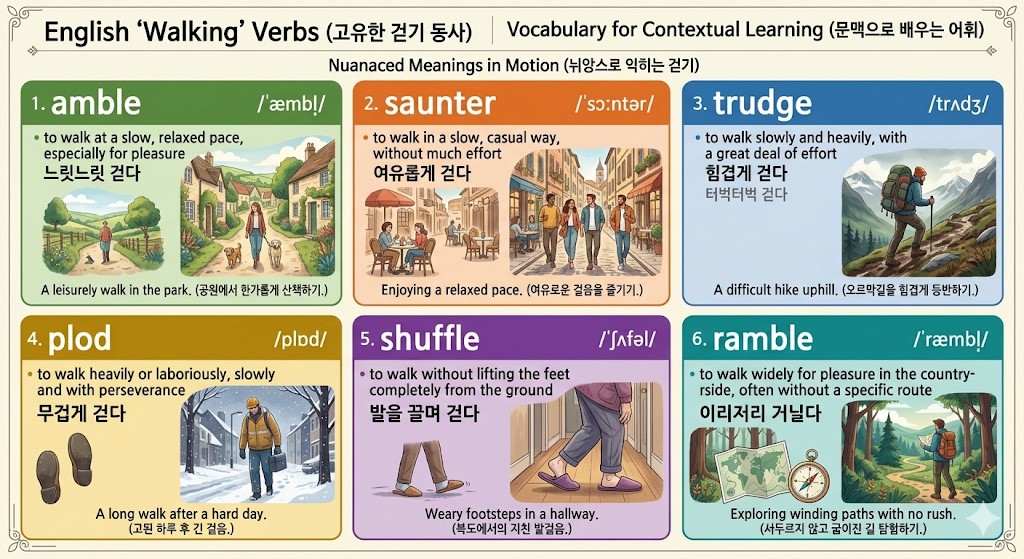
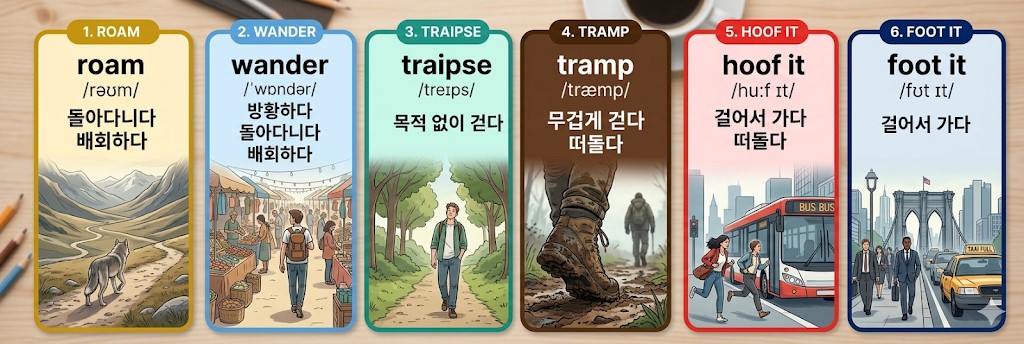
'영어 어휘력 기르기 > 동의어 퀴즈' 카테고리의 다른 글
| 어휘력 [wish - (28)] - Ⅰ → [단어/숙어 30] → [테스트 2-1] (0) | 2026.05.18 |
|---|---|
| 어휘력 [wish - (28)] - Ⅰ → [단어/숙어 30] → [테스트 1-2] (0) | 2026.05.18 |
| 어휘력 [wish - (28)] - Ⅰ → [단어/숙어 29] → [테스트 3] (0) | 2026.05.17 |
| 어휘력 [wish - (28)] - Ⅰ → [단어/숙어 29] → [테스트 2] (1) | 2026.05.17 |
| 어휘력 [wish - (28)] - Ⅰ → [단어/숙어 29] → [테스트 1] (0) | 2026.05.17 |