★
테스트를 통해 어휘력 다지기!
☞ 어휘력 [wish - (28)] - Ⅰ → [단어/숙어 20]
★
"poison"의 동의어 (3).
<Instruction>
Choose the most appropriate word
to complete each sentence.
These sentences are designed to reflect complex contexts
where the specific nuances of each term
are critical for accurate meaning.
1.
Urban planners are struggling
to mitigate the impact of nitrogen dioxide,
a common atmospheric _______
that severely degrades air quality
and triggers chronic respiratory issues in children.
A) Venin
B) Zootoxin
C) Pollutant
D) Pathogen
Correct Answer: C
Explanation:
A "Pollutant" is a substance
that dirties the environment and causes health damage.
2.
During the quality control audit,
it was found
that the raw grain supply
had been exposed to a biological _______,
rendering the entire shipment unfit for human consumption
due to health risks.
A) Contaminant
B) Pathogen
C) Infection
D) Poison
Correct Answer: A
Explanation:
A "Contaminant" is a substance
that mixes into food or the environment and causes harm.
3.
The environmental investigation concluded
that the high levels of mercury found in the soil
were not natural,
but rather a _______ introduced
by decades of unregulated industrial runoff.
A) Venin
B) Bane
C) Toxicant
D) Zootoxin
Correct Answer: C
Explanation:
A "Toxicant" is a toxic or fatal substance
typically introduced into the environment
through human or chemical activity.
4.
The pharmaceutical team successfully isolated a _______
from the bacterial culture,
which they discovered was the primary factor responsible
for disrupting host cellular metabolism.
A) Toxin
B) Toxicant
C) Adulterant
D) Impurity
Correct Answer: A
Explanation:
A "Toxin" is a harmful substance
naturally produced within living organisms,
such as bacteria, plants, or animals.
5.
For the struggling agricultural community,
the persistent multi-year drought
became the absolute _______ of their existence,
leading to total crop failure and economic ruin.
A) Toxoid
B) Bane
C) Adulterant
D) Impurity
Correct Answer: B
Explanation:
"Bane" refers to a fatal factor
that threatens life or causes destruction and ruin.
6.
Genetic analysis of the predatory sea snail revealed
that its _______ contains a complex cocktail of neuropeptides
specifically evolved to paralyze prey upon injection.
A) Pollutant
B) Venom
C) Miasma
D) Toxoid
Correct Answer: B
Explanation:
"Venom" refers to toxic substances
actively secreted and injected by animals
like snakes, spiders, or insects.
7.
The medical report warned
that the new strain of the virus was a particularly _______,
capable of overwhelming the patient's immune system
within hours of the first symptom.
A) Virulent substance
B) Adulterant
C) Impurity
D) Miasma
Correct Answer: A
Explanation:
A "Virulent substance" is defined
as an extremely powerful and dangerous toxic substance.
8.
Factory workers were required to wear advanced respirators
to prevent the inhalation of any _______
that might be released
during the high-temperature chemical bonding process.
A) Poison
B) Toxic waste
C) Noxious substance
D) Miasma
Correct Answer: C
Explanation:
A "Noxious substance" is a component
that is harmful or dangerous to health.
9.
The epidemiologist identified the rare fungus
as the primary _______ responsible for the sudden outbreak,
noting its ability to survive in extreme temperatures.
A) Pathogen
B) Toxicant
C) Bane
D) Contaminant
Correct Answer: A
Explanation:
A "Pathogen" is a microorganism or toxic body
that causes disease.
10.
Despite initial treatment,
the patient suffered a secondary _______
when the bacteria entered the bloodstream
through a neglected surgical wound.
A) Impurity
B) Infection
C) Adulterant
D) Toxoid
Correct Answer: B
Explanation:
"Infection" refers to a harmful factor
that invades a living body and causes damage.
11.
By heating the tetanus toxin and treating it with formaldehyde,
scientists created a _______
that could safely trigger an immune response
without causing the disease itself.
A) Venom
B) Zootoxin
C) Toxoid
D) Pathogenic agent
Correct Answer: C
Explanation:
A "Toxoid" is a substance similar to a toxic substance,
often used in vaccines
because it retains immunological properties
without the toxicity.
12.
Historically,
the swampy regions were avoided
because of the thick _______
that rose from the decaying vegetation,
which locals believed carried the seeds of the plague.
A) Poison
B) Toxic waste
C) Pathogen
D) Miasma
Correct Answer: D
Explanation:
"Miasma" refers to
polluted air or an unhealthy atmosphere/aura
that was historically thought to cause disease.
13.
Investigators discovered
that the luxury olive oil had been compromised
by a cheap oil _______,
which was added to increase
volume and deceive high-end consumers.
A) Adulterant
B) Toxoid
C) Infection
D) Pathogen
Correct Answer: A
Explanation:
An "Adulterant" is an impure substance
mixed into a original product
that makes it harmful or inferior.
14.
Even a microscopic _______ in the silicon wafer
can cause a complete failure of the integrated circuit
during the manufacturing process.
A) Pathogen
B) Infection
C) Impurity
D) Bane
Correct Answer: C
Explanation:
An "Impurity" is a harmful component
that contaminates the original substance or ruins its purity.
15.
The detective found traces of a lethal synthetic _______
in the victim's coffee,
confirming that the death was not from natural causes
but from a premeditated act.
A) Venin
B) Miasma
C) Contaminant
D) Chemical (Poisonous substance)
Correct Answer: D
Explanation:
A "Chemical (Poisonous substance)" is
an artificially manufactured harmful
or poisonous chemical component.
16.
Strict international laws govern the disposal of _______
to prevent radioactive or chemically hazardous materials
from leaking into the groundwater.
A) Miasma
B) Toxic waste
C) Pathogen
D) Venom
Correct Answer: B
Explanation:
"Toxic waste" refers to discarded materials
that are fatal to the environment and living organisms.
17.
The researcher focused on _______
—specifically the toxic proteins found in pufferfish—
to understand how biological poisons evolve
in aquatic environments.
A) Pollutant
B) Chemical
C) Zootoxin
D) Miasma
Correct Answer: C
Explanation:
A "Zootoxin" is a toxic substance
specifically derived from animals.
18.
Because the rare fruit can absorb heavy metals
from the soil
and produce its own defensive chemicals,
it is classified as a _______
that requires careful preparation before eating.
A) Venomous substance
B) Toxoid
C) Impurity
D) Contaminant
Correct Answer: A
Explanation:
A "Venomous substance" is a harmful component
that can originate from animal or chemical sources.
19.
The clinical study sought to isolate the specific _______
that triggers the autoimmune reaction,
hoping to find a way
to neutralize its effect on the nervous system.
A) Toxicant
B) Pathogenic agent
C) Adulterant
D) Impurity
Correct Answer: B
Explanation:
A "Pathogenic agent" is a toxic substance or entity
that triggers or induces disease.
20.
In the 19th century,
arsenic was a common _______
found in many household products,
leading to widespread accidental deaths
before its extreme toxicity was fully understood.
A) Poison
B) Miasma
C) Contaminant
D) Impurity
Correct Answer: A
Explanation:
"Poison" is a general term for a substance
that causes harm, illness, or death to a living organism
when introduced or absorbed
(added to the list as requested).
21.
The biochemical lab successfully extracted the active _______
from the viper's glandular secretion to study its potential
as a blood-thinning medication.
A) Noxious substance
B) Venin
C) Pathogen
D) Toxoid
Correct Answer: B
Explanation:
"Venin" refers to the specific toxic fluid or venom
secreted by animals like snakes or insects.
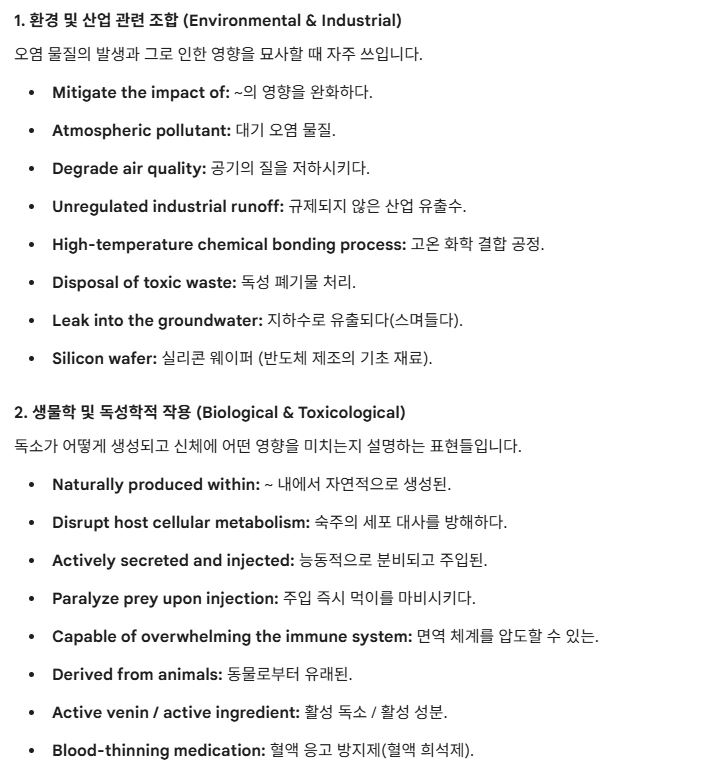
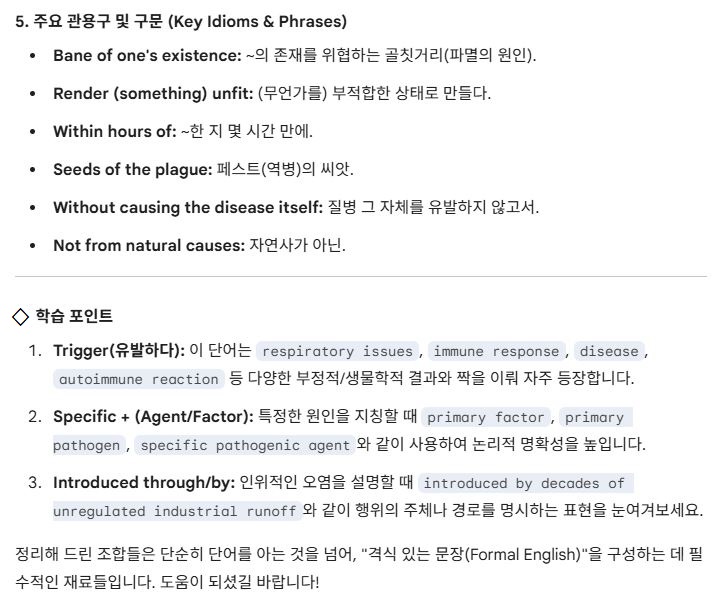
☞ [숙어 / 관용구]

'영어 어휘력 기르기 > 동의어 퀴즈' 카테고리의 다른 글
| 어휘력 [wish - (28)] - Ⅰ → [단어/숙어 21] → [테스트 2] (0) | 2026.05.04 |
|---|---|
| 어휘력 [wish - (28)] - Ⅰ → [단어/숙어 21] → [테스트 1] (1) | 2026.05.04 |
| 어휘력 [wish - (28)] - Ⅰ → [단어/숙어 20] → [테스트 2] (0) | 2026.05.02 |
| 어휘력 [wish - (28)] - Ⅰ → [단어/숙어 20] → [테스트 1] (0) | 2026.05.02 |
| 어휘력 [wish - (28)] - Ⅰ → [단어/숙어 19] → [테스트 3] (0) | 2026.04.29 |