★
테스트를 통해 어휘력 다지기!
☞ 어휘력 [wish - (28)] - Ⅰ → [단어/숙어 20]
★
"poison"의 동의어 (1).
<Instruction>
Read the following scenarios carefully
and identify the term
that most accurately describes
the specific substance or agent involved.
Choose the best option from the four choices provided.
1.
A researcher is studying a specific harmful substance
that is naturally produced by a bacterium
to survive inside a host.
Which term best describes
this biologically produced harmful substance?
A) Toxin
B) Toxicant
C) Adulterant
D) Impurity
Correct Answer: A
Explanation:
A "toxin" specifically refers to
a poisonous substance produced
within living cells or organisms,
such as bacteria, plants, or animals.
2.
While hiking in a dense jungle,
a traveler is bitten by a rare species of spider.
Within minutes,
the traveler experiences localized swelling
and pain caused
by the specialized chemical the spider injected.
This substance is best classified as:
A) Pollutant
B) Venom
C) Miasma
D) Toxoid
Correct Answer: B
Explanation:
"Venom" is a specific type of toxin
that is actively injected into a victim
through a bite or sting by animals
like spiders, snakes, or scorpions.
3.
An environmental inspector discovers
that a local factory
has been illegally dumping synthetic heavy metals
into a nearby stream.
Since these substances are man-made
and introduced into the environment
by human activity,
they are called:
A) Venin
B) Bane
C) Toxicant
D) Zootoxin
Correct Answer: C
Explanation:
A "toxicant" is a toxic substance
that is introduced into the environment
by human activity (man-made),
rather than being naturally biological in origin.
4.
During a routine safety check at a food processing plant,
a technician finds
that a batch of flour has been accidentally mixed
with trace amounts of dust and micro-plastics
from the packaging machine.
This accidental "extra" substance is known as a:
A) Contaminant
B) Pathogen
C) Infection
D) Poison
Correct Answer: A
Explanation:
A "contaminant" is any substance (often unintended)
that makes food or the environment impure,
or unfit for use,
though it may not always be immediately lethal.
5.
For centuries,
a particular invasive beetle has been the primary cause
of the total destruction of local oak forests,
leading to the collapse of the entire ecosystem.
In this context of ruin and destruction,
the beetle is considered the:
A) Toxoid
B) Bane
C) Adulterant
D) Impurity
Correct Answer: B
Explanation:
"Bane" refers to a cause of great distress, annoyance,
or something that leads to death and ruin.
6.
A city official reports
that the smog levels have reached a record high,
releasing harmful particles into the air
that degrade the atmosphere
and damage the respiratory health of citizens.
These substances are:
A) Venins
B) Zootoxins
C) Pollutants
D) Pathogens
Correct Answer: C
Explanation:
"Pollutants" are substances that pollute something,
especially water or the atmosphere,
often resulting from industrial or urban waste.
7.
A laboratory is analyzing a newly discovered strain of a virus
that spreads incredibly fast and causes severe,
life-threatening symptoms in a very short period.
The scientists describe this substance as a highly:
A) Virulent substance
B) Adulterant
C) Impurity
D) Miasma
Correct Answer: A
Explanation:
"Virulent substance" refers to
something extremely severe, harmful, or powerful in its effects,
particularly regarding the ability of a pathogen to cause disease.
8.
Residents living near an old abandoned warehouse
complain of a lingering, foul smell
that seems to hang in the air,
making people feel nauseous and unwell.
In historical or literary terms,
this harmful "bad air" is a:
A) Poison
B) Toxic waste
C) Noxious substance
D) Miasma
Correct Answer: D
Explanation:
"Miasma" refers to
a highly unpleasant or unhealthy smell or vapor,
historically believed to cause disease.
9.
A doctor explains to a patient
that their stomach flu was caused by a specific microorganism
—a bacterium that entered the body and began multiplying.
This biological agent of disease is a:
A) Pathogen
B) Toxicant
C) Bane
D) Contaminant
Correct Answer: A
Explanation:
A "pathogen" is a bacterium, virus,
or other microorganism that can cause disease.
10.
After a flood,
the local water supply becomes unsafe
because harmful bacteria have entered the pipes
and are now actively growing within the human hosts
who drank the water.
This condition is called an:
A) Impurity
B) Infection
C) Adulterant
D) Toxoid
Correct Answer: B
Explanation:
"Infection" refers to the process of an organism
(like a pathogen)
invading the body and causing harm.
11.
A pharmaceutical company is developing a vaccine.
They take a harmful toxin
and treat it so that its poisonous properties are destroyed,
but its ability to stimulate an immune response remains.
This modified substance is a:
A) Venom
B) Zootoxin
C) Toxoid
D) Pathogenic agent
Correct Answer: C
Explanation:
A "toxoid" is a chemically modified toxin
from a pathogenic microorganism,
which is no longer toxic but is still antigenic
and can be used as a vaccine.
12.
In a classic mystery novel,
a villain secretly adds a lethal chemical
—arsenic—into a victim's drink
with the intent to kill.
This substance,
used to cause death or injury when swallowed,
is a:
A) Poison
B) Miasma
C) Contaminant
D) Impurity
Correct Answer: A
Explanation:
"Poison" is the general term for a substance
that is capable of causing the illness or death
of a living organism
when introduced or absorbed (like arsenic).
13.
A vintage perfume collector notices
that an old bottle has lost its clarity
and now contains small, cloudy particles of degraded oil
that shouldn't be there.
These substances that lower the quality of the perfume are:
A) Pathogens
B) Infections
C) Impurities
D) Banes
Correct Answer: C
Explanation:
"Impurity" refers to a constituent
which impairs the purity of something
or makes it dirty or unclean.
14.
A dishonest honey producer mixes cheap corn syrup
into their pure honey to increase the volume and profit.
The corn syrup,
which shouldn't be there and makes the original product inferior,
is an:
A) Adulterant
B) Toxoid
C) Infection
D) Pathogen
Correct Answer: A
Explanation:
An "adulterant" is a substance found
within other substances
such as food, fuels, or chemicals
which compromises the safety or purity of the item.
15.
A specialized cleanup crew is called to a site
where barrels of corrosive chemicals and radioactive materials
have been left to rot.
These discarded materials
that pose a threat to the ecosystem are:
A) Miasmas
B) Toxic waste
C) Pathogens
D) Venoms
Correct Answer: B
Explanation:
"Toxic waste" refers to
discarded chemical or biological substances
that are potentially harmful to living things or the environment.
16.
A biologist is studying the specific chemical structure of the liquid
secreted by a cobra's fangs.
Though it is a venom,
they are specifically looking at
the animal-derived toxin components,
known as:
A) Adulterants
B) Toxoids
C) Banes
D) Venin (or Zootoxin)
Correct Answer: D
Explanation:
"Venin" (or "Zootoxin") refers specifically to
the toxic substance
produced by an animal.
17.
A safety inspector is evaluating a warehouse
that stores industrial cleaning fluids.
He notes that while the liquids are not immediately lethal,
they emit vapors that are physically harmful and destructive
to human health over time.
These are classified as a:
A) Noxious substance
B) Venin
C) Pathogen
D) Toxoid
Correct Answer: A
Explanation:
A "Noxious substance" is defined as a component
that is harmful or dangerous to health.
18.
In a high-security biological laboratory,
scientists are isolating a specific biological entity
—neither a simple toxin nor a full bacteria—
that acts as the primary trigger for a new respiratory syndrome.
This specific biological trigger is a:
A) Toxicant
B) Pathogenic agent
C) Adulterant
D) Impurity
Correct Answer: B
Explanation:
A "Pathogenic agent" is a toxic entity or substance
that specifically triggers or induces a disease.
19.
A veterinarian is treating a dog that ate a wild toad.
The dog is suffering from a specific biological poison
that originated from the skin of the toad.
This animal-derived toxic substance is a:
A) Pollutant
B) Chemical
C) Zootoxin
D) Miasma
Correct Answer: C
Explanation:
A "Zootoxin" is a toxic substance
that originates specifically from animals.
20.
A forensic chemist is examining a synthetic pesticide
found in a garden shed.
The label identifies it as a man-made substance
composed of various artificial elements
designed to be lethal to pests.
This artificial substance is a:
A) Venin
B) Bane
C) Infection
D) Chemical (Poisonous substance)
Correct Answer: D
Explanation:
A "Chemical (Poisonous substance)" refers to
a harmful chemical component
that is artificially or synthetically manufactured.
21.
During a wildlife survey,
a biologist identifies a specific lizard species
that possesses a physical delivery system
to release harmful substances
derived from either its biological makeup
or chemical sources it has ingested.
This harmful material is a:
A) Venomous substance
B) Toxoid
C) Impurity
D) Contaminant
Correct Answer: A
Explanation:
A "Venomous substance" refers to a harmful component
that originates from an animal or a chemical source.
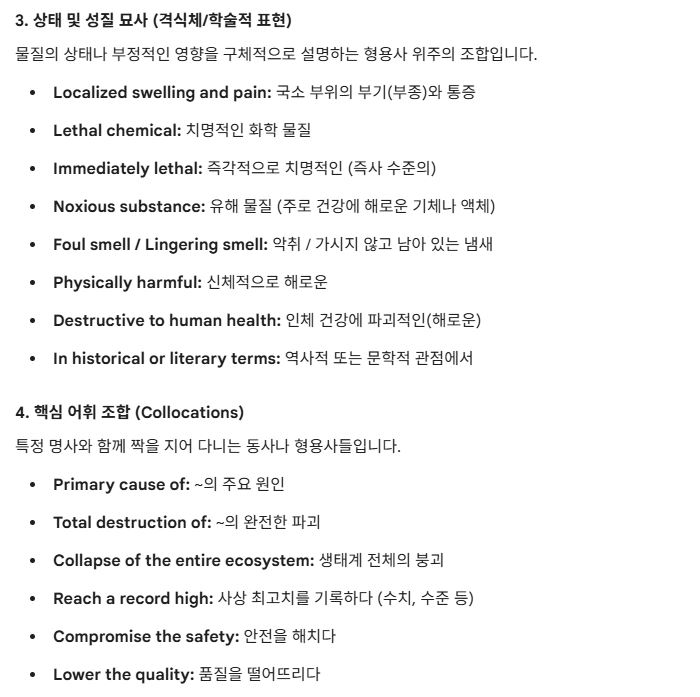
☞ [숙어 / 관용구]


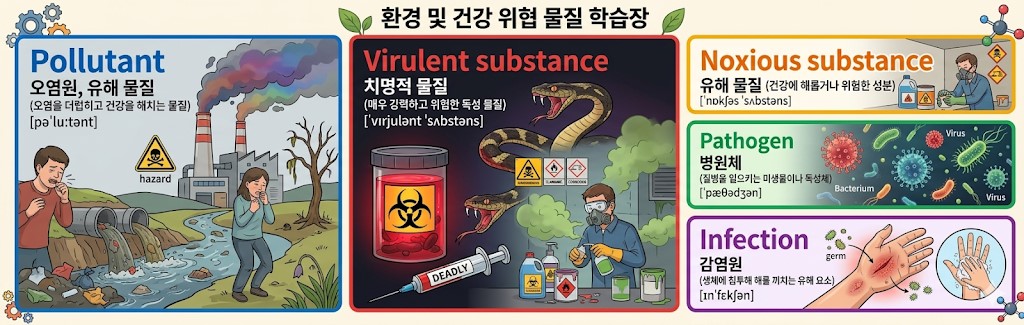
☞ [학습용 단어장]



'영어 어휘력 기르기 > 동의어 퀴즈' 카테고리의 다른 글
| 어휘력 [wish - (28)] - Ⅰ → [단어/숙어 20] → [테스트 3] (0) | 2026.05.02 |
|---|---|
| 어휘력 [wish - (28)] - Ⅰ → [단어/숙어 20] → [테스트 2] (0) | 2026.05.02 |
| 어휘력 [wish - (28)] - Ⅰ → [단어/숙어 19] → [테스트 3] (0) | 2026.04.29 |
| 어휘력 [wish - (28)] - Ⅰ → [단어/숙어 19] → [테스트 2] (0) | 2026.04.29 |
| 어휘력 [wish - (28)] - Ⅰ → [단어/숙어 19] → [테스트 1] (0) | 2026.04.29 |