★
테스트를 통해 어휘력 다지기!
☞ 어휘력 [wish - (28)] - Ⅰ → [단어/숙어 19]
★
"arrogance"의 동의어 (3).
<Instruction>
Choose the most appropriate word
from the given options to complete each sentence.
Each question is designed
to test your understanding of the subtle nuances
between various synonyms for pride, arrogance, and disdain.
Pay close attention to the specific context
—such as social status, facial expressions,
overstepping authority, or excessive self-admiration—
to identify the correct term
that fits the sentence's tone and meaning.
1.
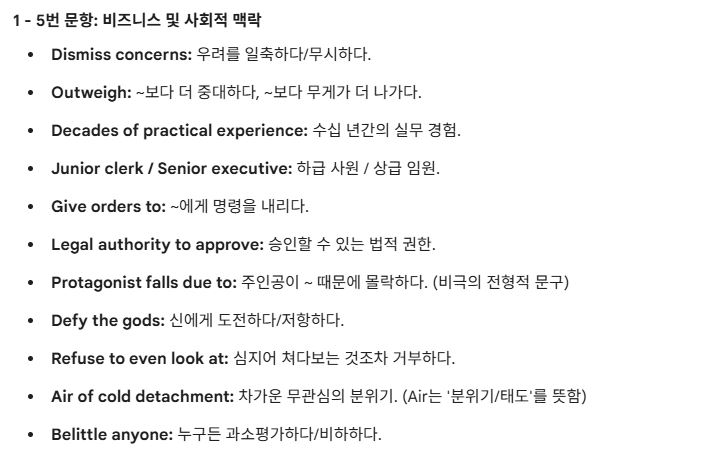
The CEO’s _______ was evident
when he dismissed the concerns of the veteran engineers,
assuming that his Ivy League degree outweighed
their decades of practical experience.
A) Arrogance
B) Smugness
C) Vanity
D) Swagger
Answer: A
Explanation:
Arrogance involves an offensive display of self-importance
and a sense of superiority
that leads one to dismiss or undervalue others' expertise.
2.
Despite being only a junior clerk,
he acted with such _______
that he frequently gave orders to senior executives
and signed documents he had no legal authority to approve.
A) Hauteur
B) Presumption
C) Disdain
D) Hubris
Answer: B
Explanation:
Presumption specifically refers to
the act of overstepping one’s bounds
or taking liberties by assuming rights or authority
one does not possess.
3.
In Greek tragedies,
the protagonist often falls due to _______,
a form of excessive pride
that blinds them to their human limitations
and leads them to defy the gods.
A) Pretension
B) Insolence
C) Hubris
D) Lordliness
Answer: C
Explanation:
Hubris is a specific type of extreme pride or overconfidence,
often resulting in retribution, especially
when a mortal defies divine or natural laws.
4.
The professor’s _______ was
so thick that she refused to even look at her students
while lecturing,
gazing instead at the back wall
with an air of cold, aristocratic detachment.
A) Snobbishness
B) Cockiness
C) Self-importance
D) Haughtiness
Answer: D
Explanation:
Haughtiness emphasizes a chilly, distant, and superior attitude,
often characterized by looking down on others
as if they are physically or socially beneath one.
5.
Her constant _______ regarding her social connections
made the dinner party unbearable,
as she spent the evening subtly belittling anyone
who hadn't attended an elite school.
A) Imperiousness
B) Condescension
C) Snobbishness
D) Pomposity
Answer: C
Explanation:
Snobbishness refers to the tendency to judge people
based on social status, wealth, or background,
and treating those considered "inferior" with contempt.
6.
The diplomat’s _______ manner and his insistence
on being addressed by his full list of ceremonial titles
made the informal negotiations much more difficult than necessary.
A) Self-importance
B) Pomposity
C) Scorn
D) Vanity
Answer: B
Explanation:
Pomposity is characterized by an excessive sense
of self-importance
displayed through exaggerated dignity, formal language,
or grand gestures.
7.
He looked at the tattered clothes of the beggar with pure _______,
curling his lip in a sneer
that showed he considered the man
to be nothing more than a stain on the streets.
A) Conceit
B) Superciliousness
C) Swagger
D) Disdain
Answer: D
Explanation:
Disdain is a feeling of intense contempt
for anything regarded as unworthy, inferior,
or beneath one's notice.
8.
Winning the local tournament fueled his _______
to such an extent that he began referring to himself
in the third person,
believing he was naturally invincible.
A) Conceit
B) Lordliness
C) Insolence
D) Hauteur
Answer: A
Explanation:
Conceit refers to an excessively high opinion
of one's own qualities or abilities,
often leading to a delusional sense of self-worth.
9.
The waiter’s _______ was unmistakable;
he raised a single eyebrow in a mocking fashion
when the guest struggled to pronounce the name
of the expensive French wine.
A) Hubris
B) Superciliousness
C) Arrogance
D) Smugness
Answer: B
Explanation:
Superciliousness is often expressed through facial expressions
(like a raised eyebrow)
that suggest one is superior to others.
10.
After his victory,
he walked through the locker room with a noticeable _______,
his chest puffed out and a mocking grin plastered on his face
as he ignored his defeated opponents.
A) Pretension
B) Vanity
C) Swagger
D) Condescension
Answer: C
Explanation:
Swagger refers to a very confident
and typically arrogant or aggressive gait or manner,
often intended to impress or intimidate.
11.
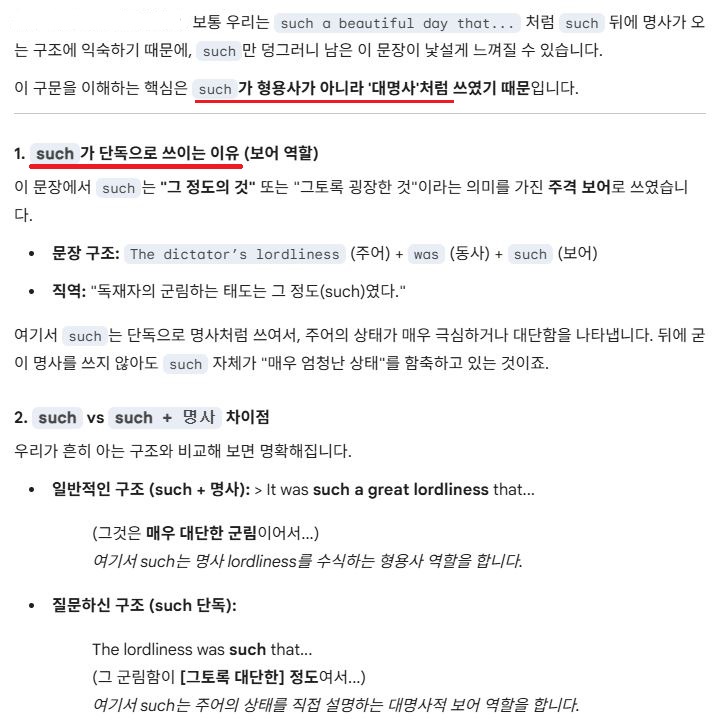
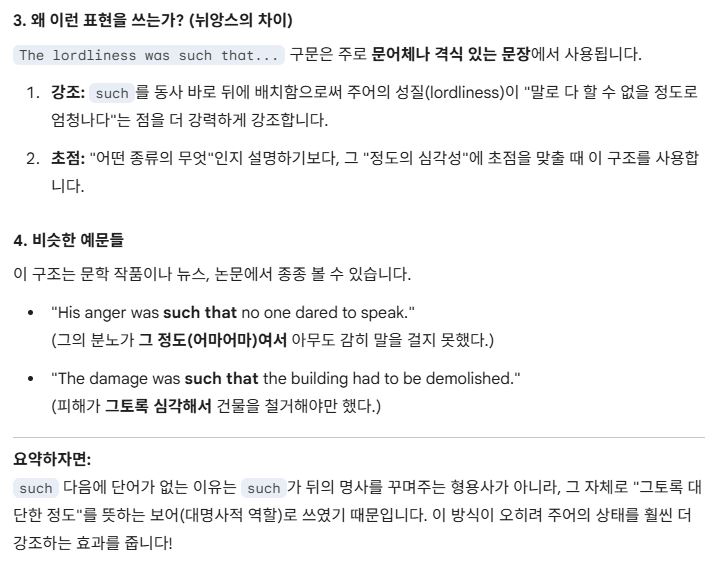
The dictator’s _______ was
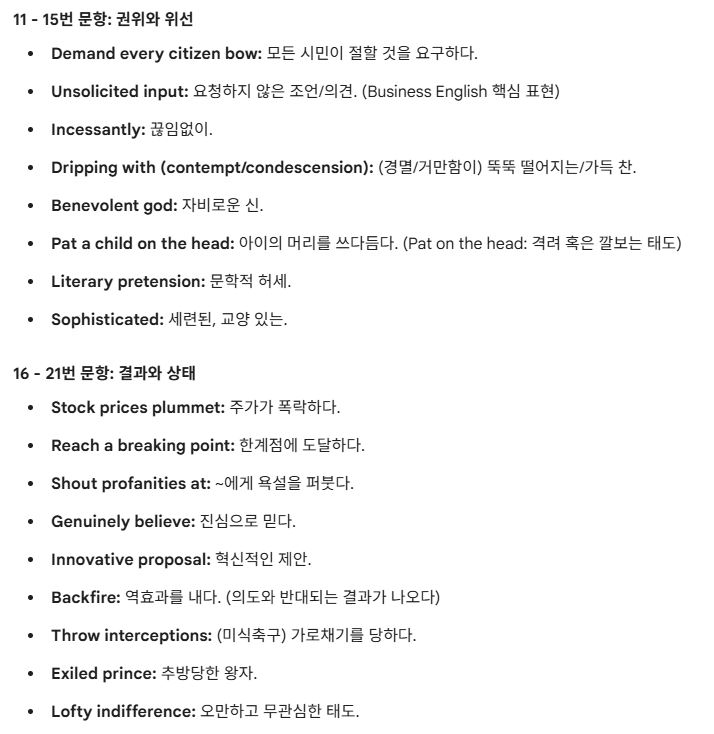
such that he demanded every citizen bow
when his motorcade passed,
treating the entire nation as if they were his personal servants.
(아래 참조)
A) Cockiness
B) Lordliness
C) Conceit
D) Presumption
Answer: B
Explanation:
Lordliness describes
an overbearing, commanding, or aristocratic manner
that suggests a desire to dominate others like a lord.
12.
When the young intern corrected the senior partner's typo,
she was met with a glare of pure _______
and told that her "unsolicited input" was neither needed nor wanted.
A) Insolence
B) Pomposity
C) Imperiousness
D) Smugness
Answer: C
Explanation:
Imperiousness describes
an arrogant, domineering, and dictatorial manner,
where one expects immediate obedience.
13.
He stared at his reflection in the mirror for nearly an hour,
his _______ driving him to adjust every single hair
and worry incessantly about the slightest wrinkle in his tie.
A) Vanity
B) Snobbishness
C) Hubris
D) Disdain
Answer: A
Explanation:
Vanity is excessive pride in or admiration
of one's own appearance, achievements, or possessions.
14.
The critic’s review was dripping with _______;
he spoke of the young artist’s work as "cute,"
as if he were a benevolent god patting a child on the head.
A) Swagger
B) Condescension
C) Haughtiness
D) Insolence
Answer: B
Explanation:
Condescension is an attitude of patronizing superiority,
often masked as kindness
or "talking down" to someone perceived as less capable.
15.
Although he had never written a poem,
his literary _______ led him to wear a velvet beret
and carry a first-edition book just to look sophisticated
at coffee shops.
A) Self-importance
B) Lordliness
C) Superciliousness
D) Pretension
Answer: D
Explanation:
Pretension involves the unpleasant use of behaviors or appearance
to seem more important, talented, or cultured than one actually is.
16.
Sitting in his corner office,
a look of unbearable _______ crossed his face
as he watched his rivals' stock prices plummet on the news screen.
A) Smugness
B) Arrogance
C) Scorn
D) Conceit
Answer: A
Explanation:
Smugness is characterized by excessive satisfaction with oneself,
often manifesting as a self-righteous or "I-told-you-so" attitude.
17.
The teenager was grounded for a month
after his _______ reached a breaking point,
culminating in him shouting profanities at his teacher
in front of the class.
A) Vanity
B) Cockiness
C) Haughtiness
D) Insolence
Answer: D
Explanation:
Insolence refers to rude and disrespectful behavior or speech,
especially toward someone in a position of authority.
18.
His _______ was so inflated
that he genuinely believed
the entire charity gala had been organized
specifically to celebrate his recent promotion.
A) Hauteur
B) Self-importance
C) Presumption
D) Hubris
Answer: B
Explanation:
Self-importance is an exaggerated sense
of one's own value or significance in the world.
19.
He dismissed the rookie's innovative proposal
with a look of _______,
suggesting that such "naive" ideas had no place
in a serious corporate environment.
A) Scorn
B) Pomposity
C) Swagger
D) Cockiness
Answer: A
Explanation:
Scorn is open contempt or disdain
for something or someone considered unworthy of respect.
20.
The rookie quarterback’s _______
before the big game—boasting to reporters
that he would break the league record—backfired
when he threw four interceptions.
A) Snobbishness
B) Condescension
C) Cockiness
D) Imperiousness
Answer: C
Explanation:
Cockiness refers to a bold, self-confident,
and often annoying or arrogant attitude,
frequently seen in competitive contexts.
21.
The exiled prince maintained his _______ even in poverty,
treating the local villagers with a cold, lofty indifference
that reminded everyone of his royal blood.
A) Lordliness
B) Presumption
C) Swagger
D) Hauteur
Answer: D
Explanation:
Hauteur is a French-derived term for "haughtiness."
It describes a proud, lofty, and often cold manner or spirit.
☞ 11번에서:
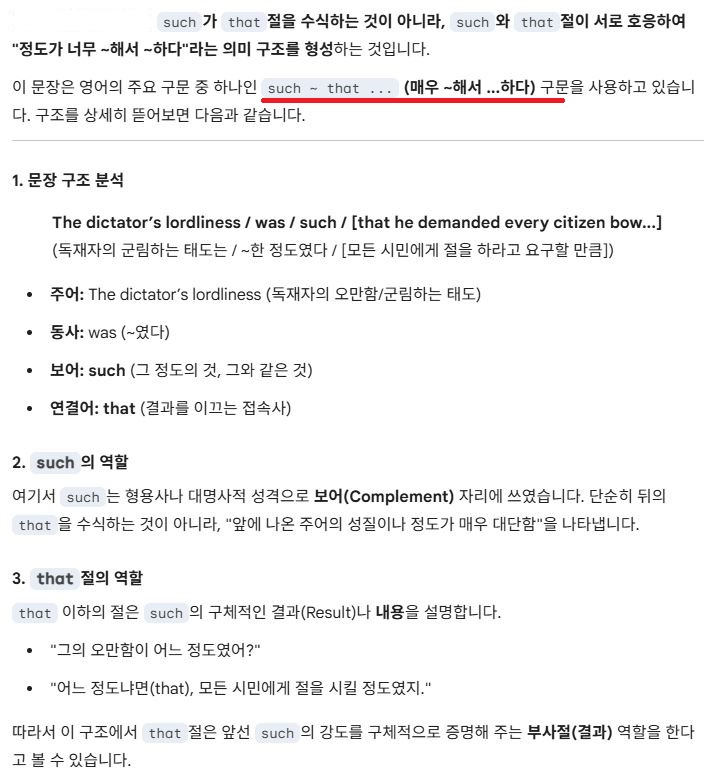
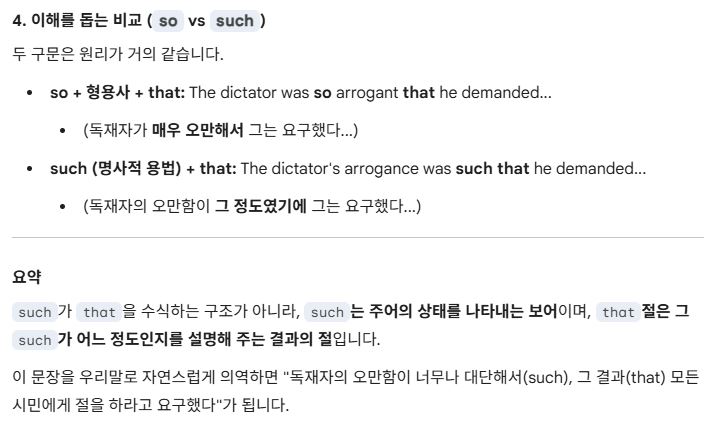
→ such가 단독:
☞ [숙어 / 관용구]


'영어 어휘력 기르기 > 동의어 퀴즈' 카테고리의 다른 글
| 어휘력 [wish - (28)] - Ⅰ → [단어/숙어 20] → [테스트 3] (0) | 2026.05.02 |
|---|---|
| 어휘력 [wish - (28)] - Ⅰ → [단어/숙어 20] → [테스트 2] (0) | 2026.05.02 |
| 어휘력 [wish - (28)] - Ⅰ → [단어/숙어 20] → [테스트 1] (0) | 2026.05.02 |
| 어휘력 [wish - (28)] - Ⅰ → [단어/숙어 19] → [테스트 2] (0) | 2026.04.29 |
| 어휘력 [wish - (28)] - Ⅰ → [단어/숙어 19] → [테스트 1] (0) | 2026.04.29 |