★
테스트를 통해 어휘력 다지기!
☞ 어휘력 [wish - (28)] - Ⅰ → [단어/숙어 21]
★
"exhaustion"의 동의어 (2).
1.
How would you distinguish Fatigue from general Tiredness?
A) Fatigue implies a temporary lack of sleep,
while Tiredness is a chronic medical condition.
B) Fatigue suggests a deep physical or mental depletion from labor,
whereas Tiredness is a more common, everyday lack of energy.
C) Fatigue only occurs due to lack of food,
while Tiredness occurs only after physical exercise.
D) There is no functional difference;
they are used interchangeably in all medical contexts.
Correct Answer: B
Explanation:
Fatigue is a sophisticated term
for exhaustion resulting from labor, exertion, or stress,
while Tiredness is a general lack of energy.
2.
Which sentence best describes
the difference between Burnout and Weariness?
A) Burnout results from long-term stress
and overwork leading to mental/physical depletion,
while Weariness is often linked to repetitive activity or tension.
B) Burnout is a sudden physical collapse,
whereas Weariness is a genetic state of weakness.
C) Burnout is caused by lack of nutrition,
while Weariness is caused by high-altitude climates.
D) Burnout refers to physical illness,
while Weariness refers exclusively to emotional apathy.
Correct Answer: A
Explanation:
Burnout specifically refers to exhaustion from long-term stress,
while Weariness relates to being tired from repetitive activity.
3.
In terms of physical manifestation,
how can one distinguish Collapse from Prostration?
A) Collapse is a slow process of weakening,
while Prostration is an instantaneous loss of consciousness.
B) Collapse is always mental,
while Prostration is always caused by a lack of vitamins.
C) Collapse refers to a sudden failure of function or falling down,
while Prostration is a state of extreme weakness
where one is completely spent and powerless.
D) Collapse occurs only in athletes,
while Prostration is a term used only for the elderly.
Correct Answer: C
Explanation:
Collapse is the act of falling down due to failure of function,
while Prostration is the state of total physical exhaustion.
4.
What is the primary difference between Lassitude and Lethargy?
A) Lassitude refers to a lack of vitality or energy,
while Lethargy emphasizes
a state of sluggishness combined with sleepiness.
B) Lassitude is a state of emotional indifference,
while Lethargy is a state of total physical collapse.
C) Lassitude refers to genetic weakness,
while Lethargy is a temporary state after a long hike.
D) Lassitude is caused by extreme cold,
while Lethargy is caused by extreme hunger.
Correct Answer: A
Explanation:
Lassitude describes a lack of vitality or energy,
whereas Lethargy specifically involves sluggishness and drowsiness.
5.
How would you distinguish Debility from Debilitation?
A) Debility is caused by heat,
while Debilitation is caused by excessive repetitive exercise.
B) There is no difference;
both refer exclusively to a lack of emotional interest.
C) Debility is a temporary state of sleepiness,
while Debilitation is a genetic trait.
D) Debility refers to a state of physical weakness or infirmity,
while Debilitation refers to
the process of being weakened over time.
Correct Answer: D
Explanation:
Debility is the condition/state of weakness,
whereas Debilitation is the actual process of losing strength.
6.
What is the distinguishing factor of Inanition
compared to general Exhaustion?
A) Inanition is a state
of being "fried" by too much social stimulation.
B) Inanition refers to a genetic fragility
that makes a person easily tired.
C) Inanition is a state of exhaustion
specifically resulting from a lack of nourishment or food.
D) Inanition is caused by overworking in an office environment.
Correct Answer: C
Explanation:
Inanition is uniquely defined
as exhaustion caused by severe lack of nutrition or hunger.
7.
Which best describes
the difference between Stupor and Sluggishness?
A) Stupor involves a dulling of the mind and near-unconsciousness,
while Sluggishness refers to a slowness in movement or thought.
B) Stupor is a lack of interest in others,
while Sluggishness is a state of total physical powerlessness.
C) Stupor is caused by repetitive tasks,
while Sluggishness is caused by long-term stress.
D) Stupor is a normal state of needing rest,
while Sluggishness is a medical emergency.
Correct Answer: A
Explanation:
Stupor is a state of mental clouding and reduced responsiveness,
while Sluggishness refers to slow movement or thought.
8.
How do you distinguish Apathy from Listlessness?
A) Apathy is a physical inability to move,
while Listlessness is a lack of sleep.
B) Apathy refers to genetic weakness,
while Listlessness refers to a sudden physical collapse.
C) Apathy is caused by hunger,
while Listlessness is a result of excessive caffeine.
D) Apathy is a lack of feeling, emotion, or interest,
whereas Listlessness is a spiritless state with no desire for activity.
Correct Answer: D
Explanation:
Apathy centers on emotional indifference,
while Listlessness describes a lack of drive or desire for activity.
9.
What is the difference between Enervation and Frazzle?
A) Enervation refers to a draining of energy or vitality,
while Frazzle implies a state of being completely worn out,
often with frayed nerves.
B) Enervation is a state of being "fried" by stress,
while Frazzle is a result of a hot climate.
C) Enervation is caused by lack of food,
while Frazzle is a genetic condition.
D) Enervation is a sudden collapse,
while Frazzle is a slow process of weakening.
Correct Answer: A
Explanation:
Enervation is the "sapping" of energy,
while Frazzle is being completely worn out with mental tension.
10.
How would you distinguish Overfatigue from regular Fatigue?
A) Overfatigue is only mental, while Fatigue is only physical.
B) Overfatigue refers to a serious, excessive state of exhaustion
from overexertion beyond recovery,
while Fatigue is standard exhaustion.
C) Overfatigue is a milder version of Fatigue
that requires only a short nap.
D) Overfatigue is caused by lack of nutrition,
while Fatigue is caused by cold weather.
Correct Answer: B
Explanation:
Overfatigue is a critical state caused by activity
that exceeds the body's recovery limit.
11.
What distinguishes Feebleness from Frailty?
A) Feebleness is caused by hunger,
while Frailty is caused by excessive sleep.
B) There is no distinction;
they are both synonyms for sudden physical collapse.
C) Feebleness is a lack of physical or mental strength,
while Frailty describes being delicate, easily tired, or fragile.
D) Feebleness is a temporary state after a race,
while Frailty is a state of near-unconsciousness.
Correct Answer: C
Explanation:
Feebleness focuses on the lack of strength or force,
while Frailty highlights a delicate and fragile constitution.
12.
How would you distinguish Exhaustion from Tiredness?
A) Exhaustion is a lack of emotional interest,
while Tiredness is a lack of food.
B) Exhaustion is a genetic trait,
while Tiredness is a state of near-unconsciousness.
C) Exhaustion only occurs during illness,
while Tiredness only occurs during exercise.
D) Exhaustion is a total depletion of resources or energy,
whereas Tiredness is a milder, everyday need for rest.
Correct Answer: D
Explanation:
Exhaustion represents the total emptying of energy,
while Tiredness is the common feeling of needing rest.
13.
What is the primary difference
between Debility and Feebleness?
A) Debility often results from disease or prolonged illness,
while Feebleness is a general lack of strength or force.
B) Debility is caused by heat, while Feebleness is caused by cold.
C) Debility is a sudden collapse,
while Feebleness is a state of near-unconsciousness.
D) Debility is a lack of emotion, while Feebleness is a lack of food.
Correct Answer: A
Explanation:
Debility is frequently used in medical contexts
regarding weakness from illness;
Feebleness is a broader lack of force.
14.
In terms of duration,
how can one distinguish Weariness from Burnout?
A) Weariness is a permanent state from birth,
while Burnout is a temporary state of sleepiness.
B) Weariness is caused by lack of food,
while Burnout is caused by hot weather.
C) Weariness can be a temporary state of being "done" with a task,
whereas Burnout is a long-term depletion from chronic stress.
D) There is no difference;
they both describe a sudden physical collapse.
Correct Answer: C
Explanation:
Burnout is a serious, long-term mental and physical depletion.
15.
How would you distinguish Prostration from Lethargy?
A) Prostration is a lack of emotion,
while Lethargy is a lack of food.
B) Prostration is a total physical powerlessness,
while Lethargy is a state of sluggishness and drowsiness.
C) Prostration is caused by repetitive work,
while Lethargy is caused by sudden shock.
D) Prostration is a genetic trait,
while Lethargy is a state of near-unconsciousness.
Correct Answer: B
Explanation:
Prostration is extreme physical weakness
where one cannot move,
whereas Lethargy is marked by sluggishness and drowsiness.
16.
What is the difference between Lassitude and Sluggishness?
A) Lassitude is a sudden collapse,
while Sluggishness is a state of near-unconsciousness.
B) There is no difference;
they both describe being "fried" by stress.
C) Lassitude is a lack of vitality or energy,
while Sluggishness is a state of slow movement or thought.
D) Lassitude is caused by hunger,
while Sluggishness is caused by cold weather.
Correct Answer: C
Explanation:
Lassitude refers to the absence of vitality,
while Sluggishness refers to the speed of action or thought.
17.
How do you distinguish Stupor from Apathy?
A) Stupor is a state of numbed senses/near-unconsciousness,
while Apathy is a lack of emotional concern or interest.
B) Stupor is caused by lack of food, while Apathy is caused by heat.
C) Stupor is a genetic trait, while Apathy is a sudden physical collapse.
D) Stupor is a lack of sleep, while Apathy is a state of slow movement.
Correct Answer: A
Explanation:
Stupor is a physical state of insensibility,
while Apathy is an emotional state of indifference.
18.
What is the distinguishing feature of Frailty?
A) It is a sudden collapse after a race.
B) It refers to being delicate, easily tired,
or having a fragile constitution.
C) It is a state of being "fried" by too much social interaction.
D) It is a state of exhaustion
specifically caused by lack of nourishment.
Correct Answer: B
Explanation:
Frailty describes a naturally delicate or fragile state
where one is easily tired.
19.
Which sentence accurately describes
the difference between Enervation and Inanition?
A) Enervation is caused by a lack of food,
while Inanition is caused by a hot climate.
B) Enervation is a sudden collapse,
while Inanition is a state of near-unconsciousness.
C) There is no difference;
they both describe genetic weakness.
D) Enervation is a general draining of vitality,
whereas Inanition is exhaustion from a severe lack of nutrition.
Correct Answer: D
Explanation:
Enervation is the depletion of energy/vitality,
while Inanition is exhaustion due to undernutrition.
20.
How would you distinguish Frazzle from Listlessness?
A) Frazzle is a genetic trait,
while Listlessness is a sudden physical collapse.
B) Frazzle is a state of being completely worn out/fried,
while Listlessness is a spiritless state with no desire for activity.
C) Frazzle is caused by lack of food,
while Listlessness is caused by cold weather.
D) There is no difference;
they both describe a state of near-unconsciousness.
Correct Answer: B
Explanation:
Frazzle involves being "fried" by overactivity,
whereas Listlessness is a spiritless lack of drive.
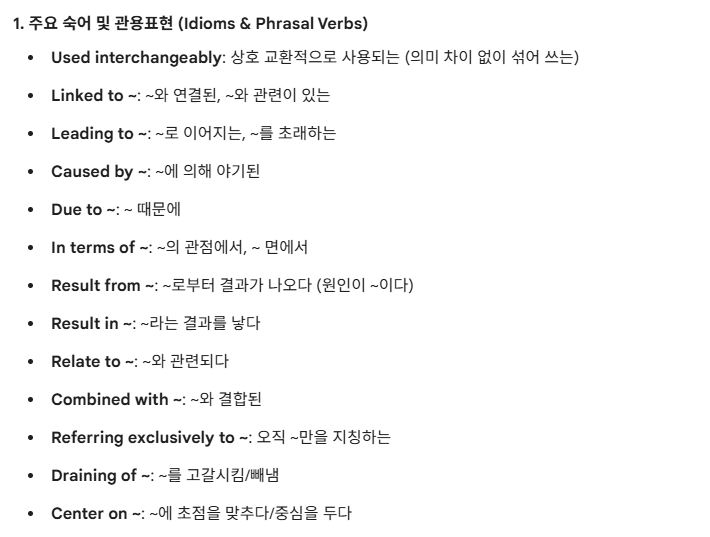
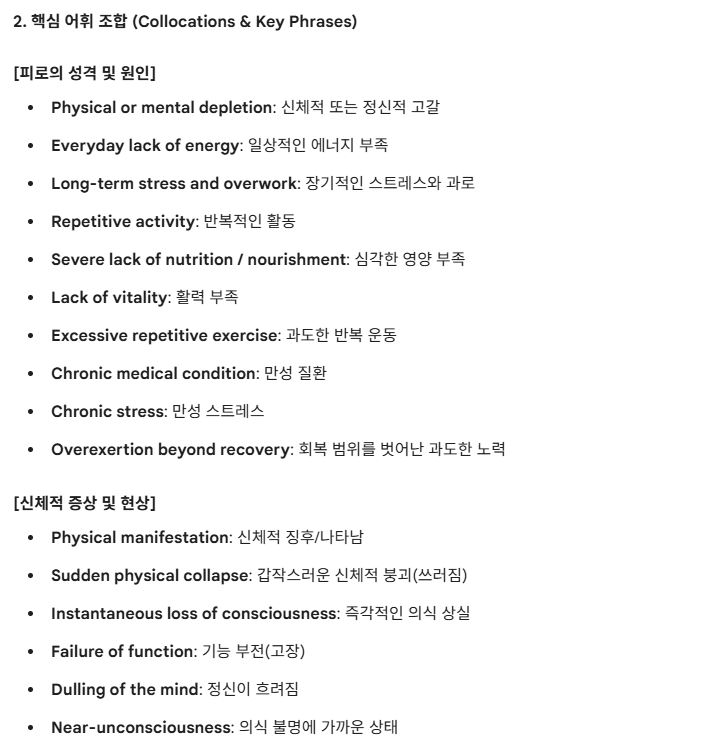
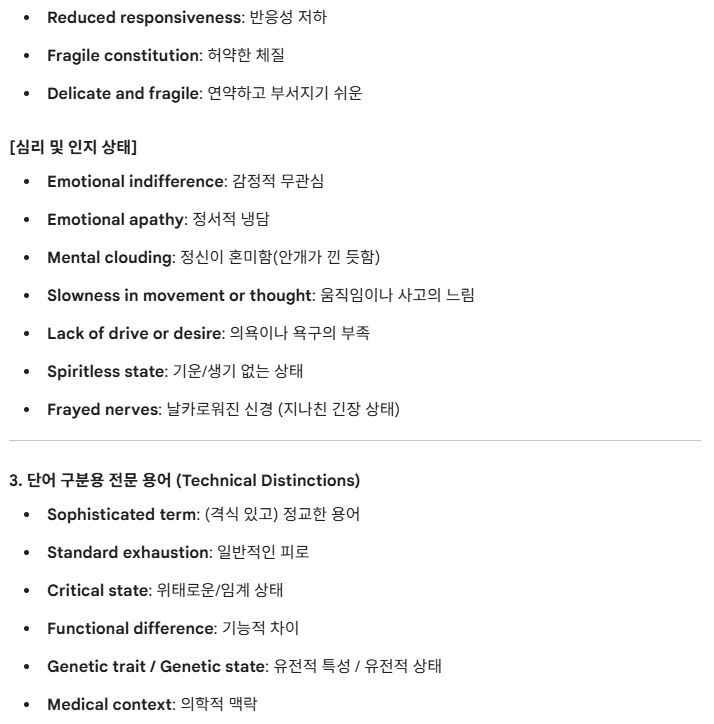
☞ [숙어 / 관용구]

'영어 어휘력 기르기 > 동의어 퀴즈' 카테고리의 다른 글
| 어휘력 [wish - (28)] - Ⅰ → [단어/숙어 24] → [테스트 1] (0) | 2026.05.07 |
|---|---|
| 어휘력 [wish - (28)] - Ⅰ → [단어/숙어 21] → [테스트 3] (0) | 2026.05.04 |
| 어휘력 [wish - (28)] - Ⅰ → [단어/숙어 21] → [테스트 1] (1) | 2026.05.04 |
| 어휘력 [wish - (28)] - Ⅰ → [단어/숙어 20] → [테스트 3] (0) | 2026.05.02 |
| 어휘력 [wish - (28)] - Ⅰ → [단어/숙어 20] → [테스트 2] (0) | 2026.05.02 |