★
테스트를 통해 어휘력 다지기!
☞ 어휘력 [wish - (28)] - Ⅰ → [단어/숙어 30]
★
"tread"의 동의어 (3-1).
1.
Despite the elevator being out of service,
the exhausted courier had to ________
up the twenty flights of stairs
carrying three heavy oversized boxes,
his boots scraping heavily against the concrete
with every agonizing step.
(A) walk
(B) saunter
(C) stroll
(D) amble
Correct Answer: A
Explanation:
The context emphasizes a basic physical action of moving on foot
under tiring circumstances.
While "trudge" or "plod" could fit the heavy movement,
among the choices provided,
the fundamental verb "walk" is the only logical
and grammatically correct option
to describe moving up the stairs,
as "saunter," "stroll," and "amble" all imply a relaxed, leisurely,
and slow pace which completely contradicts the exhaustion
and heavy lifting described.
2.
Before you commit to a lifelong career path,
it is often wise to ________ forward into the professional world
by taking a temporary internship,
allowing you to test the waters
without making a permanent declaration.
(A) wander
(B) step
(C) traipse
(D) roam
Correct Answer: B
Explanation:
The sentence uses a metaphorical expression
of moving into a new phase or career.
"Step" perfectly fits the phrase "step forward",
which means to advance or take an initial action into a new domain,
whereas words like "wander," "traipse," or "roam"
imply aimless or scattered movement.
3.
The ambitious CEO took a massive ________ toward global expansion
by acquiring their primary European competitor,
a decisive move that instantly doubled the company’s market share.
(A) march
(B) foot it
(C) stride
(D) shuffle
Correct Answer: C
Explanation:
"Take a stride" (or "make strides") is a common idiom meaning
to make significant progress
or take a long, decisive step toward a goal.
The high-stakes business context of acquiring a competitor
requires a word that connotes bold, impactful advancement,
making "stride" the perfect fit.
4.
The veteran orchestral conductor maintained a rigid,
unyielding ________ during the rehearsals,
ensuring that every musician stayed perfectly synchronized
with the metronome's relentless ticking.
(A) tramp
(B) ramble
(C) hoof it
(D) pace
Correct Answer: D
Explanation:
The context involves maintaining a specific,
consistent speed and rhythm in music.
"Pace" refers to
the speed or rate at which something happens or moves,
which directly correlates with the mention
of synchronization and a metronome.
5.
Activists from all across the nation
gathered at the capital to ________ in unison down the main avenue,
their rhythmic footsteps echoing a collective demand
for immediate legislative reform.
(A) amble
(B) march
(C) wander
(D) saunter
Correct Answer: B
Explanation:
The sentence describes an organized, deliberate,
and collective movement of activists demonstrating for a cause.
"March" is specifically used for organized walking in a stately,
rhythmic, or military-like fashion,
making it the only appropriate choice for a public demonstration.
6.
After a stressful week of intense corporate negotiations,
Evelyn decided to ________ leisurely through the botanical gardens,
pausing occasionally to admire the blooming orchids.
(A) trudge
(B) plod
(C) stroll
(D) shuffle
Correct Answer: C
Explanation:
The context involves relaxing and destressing in a garden.
"Stroll" means to walk in a leisurely, idle, or relaxed manner,
which perfectly aligns with the peaceful atmosphere
of admiring flowers to relieve stress.
7.
The elderly gentleman, enjoying his retirement to the fullest,
would ________ down the cobblestone street every morning
without a care in the world,
nodding politely to the local shopkeepers.
(A) march
(B) amble
(C) tramp
(D) step
Correct Answer: B
Explanation:
"Amble" signifies walking at a slow, relaxed, and easy pace.
The phrases "enjoying his retirement"
and "without a care in the world"
emphasize a slow, gentle, and unhurried movement,
making "amble" much more suitable
than the structured "march" or the heavy "tramp."
8.
With an air of aristocratic indifference,
the wealthy heir would ________ into the high-end boutique,
casually glancing at the priceless antiques
while ignoring the eager sales associates.
(A) saunter
(B) pace
(C) stride
(D) hoof it
Correct Answer: A
Explanation:
"Saunter" means to walk in a slow, relaxed manner,
often with a confident, proud, or arrogant attitude.
The mention of "aristocratic indifference"
and "casually glancing" strongly
points to a confident, slow, and leisurely walk,
which is the exact nuance of "saunter."
9.
After their vehicle broke down
in the middle of the muddy marshland,
the wet and miserable hikers had to ________
through miles of thick clay to reach the nearest rescue station.
(A) walk
(B) stroll
(C) trudge
(D) saunter
Correct Answer: C
Explanation:
The sentence depicts an arduous, difficult journey
through mud and clay
while being wet and miserable.
"Trudge" means to walk slowly and with heavy steps,
typically because of exhaustion or harsh conditions,
making it the most contextually accurate word.
10.
The overtired farmhand,
weighed down by hours of manual labor in the heat,
could only ________ slowly across the muddy fields,
his boots sinking deeper into the earth with every heavy step.
(A) step
(B) pace
(C) amble
(D) plod
Correct Answer: D
Explanation:
"Plod" means to walk heavily or laboriously,
often due to fatigue or difficult terrain.
The description of being "weighed down by hours of manual labor"
and his boots "sinking deeper into the earth"
emphasizes a slow, heavy, and monotonous movement,
which is best captured by "plod."
11.
Deprived of sleep and overwhelmed by exhaustion,
the hospital patient could barely lift his feet
and began to ________ slowly down the hallway,
the soles of his slippers dragging conspicuously
against the linoleum floor.
(A) shuffle
(B) march
(C) stride
(D) stroll
Correct Answer: A
Explanation:
The context explicitly states
that the patient "could barely lift his feet"
and that his slippers were "dragging against the floor."
This is the exact definition of "shuffle",
which means to walk by dragging one's feet along the ground
rather than lifting them.
12.
Without any set itinerary or maps,
the travel bloggers chose to ________ through the narrow,
winding alleys of the ancient European village,
discovering hidden cafes by pure chance.
(A) stride
(B) ramble
(C) step
(D) pace
Correct Answer: B
Explanation:
"Ramble" means
to walk for pleasure in the countryside or through streets,
often in an aimless, leisurely, or wandering fashion.
The lack of an itinerary or map
and the act of discovering things by chance point directly to "ramble."
13.
Legend says
that a mysterious solitary wolf used to ________ the vast,
snow-covered plains of Siberia,
traveling hundreds of miles without ever settling in a single territory.
(A) amble
(B) stroll
(C) roam
(D) march
Correct Answer: C
Explanation:
"Roam" means
to move about or travel aimlessly or unsystematically over a wide area.
It is heavily associated with wild animals or nomads
traversing vast territories over long distances,
which fits the context of a wolf
traveling hundreds of miles across Siberia.
14.
Lost in deep philosophical thought,
the professor would often ________ aimlessly
around the university campus for hours,
completely oblivious to his surroundings
until the evening bells rang.
(A) wander
(B) trudge
(C) plod
(D) shuffle
Correct Answer: A
Explanation:
"Wander" implies moving about aimlessly
or without a fixed destination,
often because one is distracted, lost, or absent-minded.
The phrases "lost in deep philosophical thought"
and "oblivious to his surroundings"
perfectly match the aimless, detached nature of wandering.
15.
The eccentric director forced
the actors to ________ all over the elaborate stage set
without any clear theatrical purpose,
causing the critics to complain
that the movement felt chaotic and lacked artistic direction.
(A) march
(B) step
(C) pace
(D) traipse
Correct Answer: D
Explanation:
"Traipse" means to walk or move about
aimlessly, needlessly, or wearisomely.
The context highlights
that the actors were forced to move
"without any clear theatrical purpose,"
resulting in a chaotic look,
which matches the slightly tedious and aimless nuance of "traipse."
16.
For years,
the nomadic laborer had to ________ across the country
from one industrial town to another,
carrying his entire life in a worn-out backpack
and sleeping in temporary shelters.
(A) saunter
(B) tramp
(C) stroll
(D) amble
Correct Answer: B
Explanation:
"Tramp" means to travel through or over a place on foot,
often slowly, heavily, or over long distances,
and is historically associated with long journeys
undertaken by laborers or vagrants.
The context of a nomadic laborer carrying his life
in a backpack across the country fits "tramp" perfectly.
17.
After their rental car suddenly broke down
in the middle of a remote desert highway with no cell service,
the stranded tourists had no choice but to ________ twenty miles
to the nearest service station.
(A) stroll
(B) saunter
(C) hoof it
(D) amble
Correct Answer: C
Explanation:
"Hoof it" is a colloquial/idiomatic expression meaning to walk,
especially when you have no other choice
because transportation is unavailable.
Since their car broke down in a remote area
and they had to walk twenty miles,
this idiom fits the conversational yet urgent tone
of the situation perfectly.
18.
Instead of wasting money on an expensive short-distance taxi ride
through the gridlocked downtown traffic,
we decided it would be much faster to just ________ to the theater.
(A) foot it
(B) roam
(C) wander
(D) ramble
Correct Answer: A
Explanation:
Similar to "hoof it," "foot it" is an idiom
that means to go on foot or walk.
The context compares it directly to taking a taxi,
emphasizing the choice of walking
as a mode of transportation to save money and time,
making "foot it" the correct idiomatic choice.
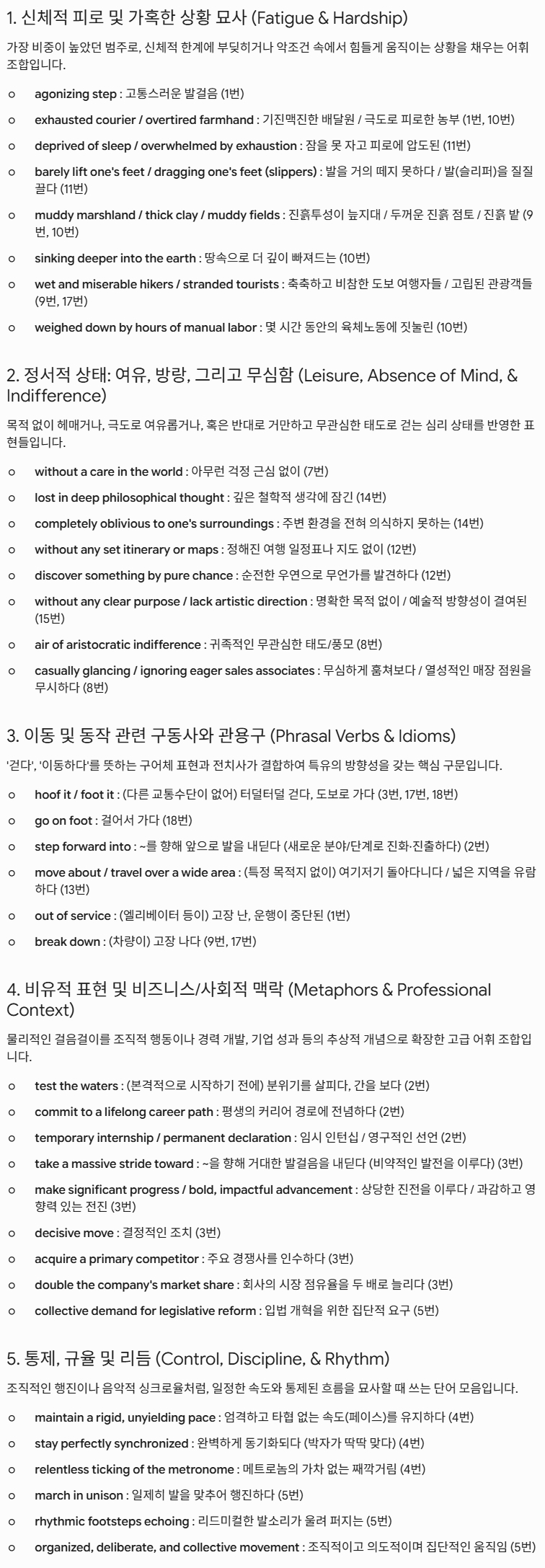
☞ [숙어 / 관용구]
'영어 어휘력 기르기 > 동의어 퀴즈' 카테고리의 다른 글
| 어휘력 [wish - (28)] - Ⅰ → [단어/숙어 31] → [테스트 1] (0) | 2026.05.22 |
|---|---|
| 어휘력 [wish - (28)] - Ⅰ → [단어/숙어 30] → [테스트 3-2] (0) | 2026.05.20 |
| 어휘력 [wish - (28)] - Ⅰ → [단어/숙어 30] → [테스트 2-2] (0) | 2026.05.18 |
| 어휘력 [wish - (28)] - Ⅰ → [단어/숙어 30] → [테스트 2-1] (0) | 2026.05.18 |
| 어휘력 [wish - (28)] - Ⅰ → [단어/숙어 30] → [테스트 1-2] (0) | 2026.05.18 |