★
테스트를 통해 어휘력 다지기!
☞ 어휘력 [wish - (28)] - Ⅰ → [단어/숙어 26]
★
"fate"의 동의어 (3).
<Instruction>
Carefully read each of the following high-complexity sentences
and select the most appropriate vocabulary word
from the given options that best fits the blank.
Each sentence is designed to provide a nuanced context
that distinguishes specific shades of "destiny," "fate," or "outcome."
Pay close attention to subtle clues
such as theological implications, causal relationships,
and emotional connotations
to determine the correct answer.
1.
While most of his peers attributed the company’s sudden bankruptcy
to poor management,
the CEO stoically accepted the collapse as his personal ________,
a specific portion of hardship he felt he was born to endure.
A) lot
B) chance
C) providence
D) kismet
Answer: A
Explanation:
"Lot" refers to one's assigned portion or station in life,
often implying a set of circumstances or burdens one must accept.
2.
The ancient Greek tragic heroes
often found themselves struggling against ________,
an impersonal and unalterable power
that dictated their downfall
regardless of their moral character or heroic efforts.
A) future
B) fate
C) fortune
D) circumstance
Answer: B
Explanation:
"Fate" (often personified as Moira) represents an inescapable,
often grim, external power that predetermines events.
3.
In the intricate tapestry of Eastern philosophy,
________ is the governing law of moral causation,
where every intentional action seeds a specific consequence
that will inevitably bloom in this life or the next.
A) doom
B) predestination
C) karma
D) fate
Answer: C
Explanation:
"Karma" specifically refers to the cycle of cause and effect
based on an individual's ethical actions.
4.
The explorers felt a sense of divine ________
when a sudden, localized rainstorm saved them
from dehydration in the desert,
convinced that a benevolent higher power
was watching over their mission.
A) outcome
B) fate
C) chance
D) providence
Answer: D
Explanation:
"Providence" refers to
the protective care or timely intervention
of God or a spiritual power.
5.
Despite the grim predictions of the oracle,
the young prince believed
his ________ was not to die in obscurity
but to unite the warring kingdoms
under a banner of peace and prosperity.
A) destiny
B) doom
C) circumstance
D) lot
Answer: A
Explanation:
"Destiny" usually suggests a grand, purposeful,
or positive future
that one is "meant" to achieve.
6.
As the protagonist stood
before the crumbling ruins of his ancestral home,
a sense of impending ________ washed over him,
as if the very stones were whispering
of an unavoidable and catastrophic end.
A) providence
B) doom
C) kismet
D) fortune
Answer: B
Explanation:
"Doom" is reserved
for an unavoidable disastrous fate or final ruin.
7.
Many theologians of the Reformation
argued for the doctrine of ________,
suggesting that the eternal salvation or damnation of every soul
was decreed by God long before the world was even created.
A) chance
B) outcome
C) predestination
D) karma
Answer: C
Explanation:
"Predestination" is the specific theological belief
that one's ultimate end is fixed by divine will
from the beginning.
8.
She often used the word ________ to describe her life's path,
reflecting her cultural heritage and the serene belief
that "what is written" by a higher power will always come to pass.
A) fortune
B) future
C) circumstance
D) kismet
Answer: D
Explanation:
"Kismet" is a loanword from Arabic/Turkish
that refers to fate or "one's portion" in a cultural context.
9.
The gambler’s life was a constant dance with ________;
he was mesmerized by the unpredictable turning of the wheel
that could bring him immense wealth or total poverty
in a single night.
A) fortune
B) karma
C) predestination
D) lot
Answer: A
Explanation:
"Fortune" (often personified as Lady Fortune) refers to
the capricious and unpredictable nature of luck.
10.
Scientists are meticulously analyzing the data
to predict the final ________ of the experiment,
as this specific result will determine
the success of the entire project.
A) moira
B) kismet
C) fate
D) outcome
Answer: D
Explanation:
"Outcome" is the neutral, logical result
of a specific process or event.
11.
In many classical epics,
________ is depicted
as the personification of the thread of life,
meticulously spun, measured,
and eventually cut by the three sisters
who govern mortal existence.
A) moira
B) fortune
C) chance
D) future
Answer: A
Explanation:
"Moira" is the Greek personification of fate,
specifically the goddess(es) who assign individual destinies.
12.
Whether the two strangers would meet at that exact street corner
was a matter of pure ________,
a random occurrence
devoid of any underlying plan or divine intervention.
A) predestination
B) chance
C) providence
D) karma
Answer: B
Explanation:
"Chance" refers to
the accidental or random occurrence of events
without a design.
13.
The diplomat argued
that the country's current political instability
was not a result of fate,
but rather a consequence of unfortunate ________
that had converged during the post-war era.
A) doom
B) kismet
C) circumstance
D) moira
Answer: C
Explanation:
"Circumstance" refers to
the external conditions or situational facts
that influence a state of affairs.
14.
Philosophers often debate
whether the ________ is a blank slate
we can write upon through free will
or a fixed sequence of events
that we are merely traveling through.
A) lot
B) fortune
C) chance
D) future
Answer: D
Explanation:
"Future" refers to
the broad time ahead or the events
that will occur hereafter.
15.
The rigorous training program
was designed with the ________
that only the most resilient candidates
would survive the final evaluation,
ensuring a high-quality workforce.
A) predetermination
B) karma
C) fortune
D) moira
Answer: A
Explanation:
"Predetermination" refers to
the act of deciding or establishing an outcome in advance.
16.
While some saw the winning lottery ticket
as a sign of divine favor,
others viewed it
as the fickle whim of ________,
who smiles on one beggar while ignoring another.
A) kismet
B) Lady Fortune
C) predestination
D) outcome
Answer: B
Explanation:
"Lady Fortune" (Fortuna) personifies
the randomness and unpredictability of luck.
17.
The historian sought to distinguish the accidental events of the war
from those that seemed driven by a sense of national ________,
as if the country were moving toward an inevitable peak of power.
A) chance
B) lot
C) destiny
D) doom
Answer: C
Explanation:
"Destiny" implies a perceived forward movement
toward a significant or intended goal.
18.
To understand the tragic ending of the play,
one must analyze the hero's actions within a ________
where social pressures and personal flaws
make the catastrophe seem unavoidable.
A) providence
B) karma
C) moira
D) circumstance
Answer: D
Explanation:
Situational context or "circumstances"
often explain why an outcome feels inevitable.
19.
The monk taught that by detaching oneself from desire,
one could eventually break free from the cycle of ________
and reach a state of eternal peace beyond cause and effect.
A) karma
B) fortune
C) chance
D) outcome
Answer: A
Explanation:
Breaking the cycle of "Karma"
is a core concept in various Eastern spiritual traditions.
20.
In the final scene,
the king realized that his ________ was sealed;
his armies were defeated,
his city was burning,
and no amount of prayer could change
the imminent end of his reign.
A) providence
B) fate
C) future
D) kismet
Answer: B
Explanation:
When an end is "sealed" and unchangeable,
especially in a tragic context, "fate" is the most fitting term.
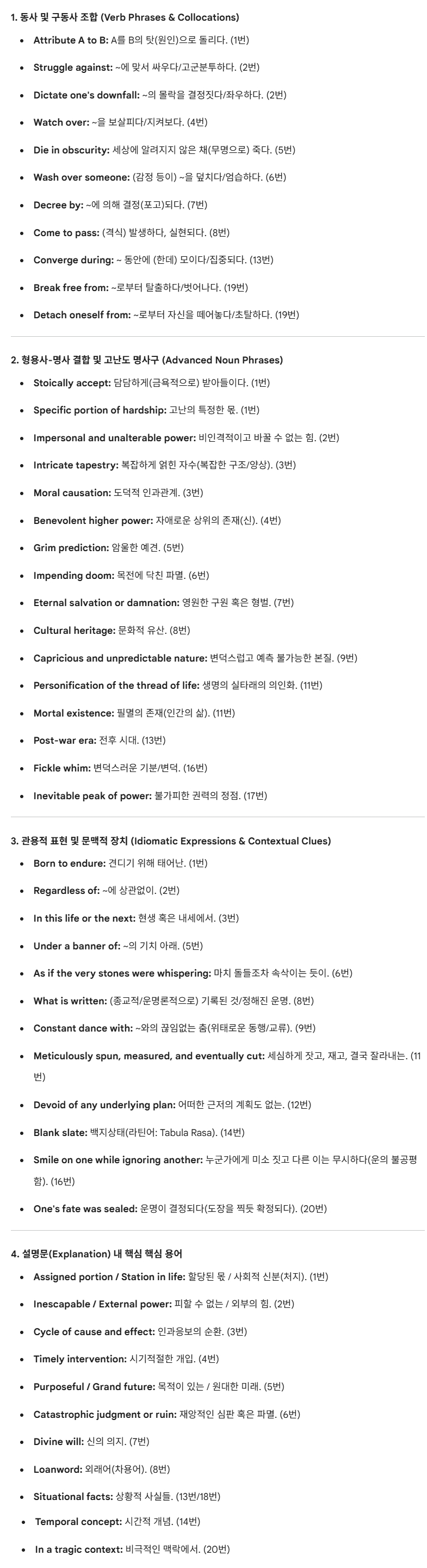
☞ [숙어 / 관용구]
'영어 어휘력 기르기 > 동의어 퀴즈' 카테고리의 다른 글
| 어휘력 [wish - (28)] - Ⅰ → [단어/숙어 28] → [테스트 2] (0) | 2026.05.15 |
|---|---|
| 어휘력 [wish - (28)] - Ⅰ → [단어/숙어 28] → [테스트 1] (0) | 2026.05.15 |
| 어휘력 [wish - (28)] - Ⅰ → [단어/숙어 26] → [테스트 2] (0) | 2026.05.11 |
| 어휘력 [wish - (28)] - Ⅰ → [단어/숙어 26] → [테스트 1] (0) | 2026.05.11 |
| 어휘력 [wish - (28)] - Ⅰ → [단어/숙어 25] → [테스트 3] (0) | 2026.05.09 |