★
테스트를 통해 어휘력 다지기!
☞ 어휘력 [wish - (28)] - Ⅰ → [단어/숙어 25]
★
"kingdom"의 동의어 (3).
1.
The theoretical physicist
ventured deep into the ________ of quantum mechanics,
attempting to reconcile the disparate laws
governing the subatomic world with those of general relativity.
A) realm
B) province
C) duchy
D) reign
Answer: A
Explanation:
In this context,
"realm" refers to a primary sphere or area of expertise and influence,
particularly suitable for abstract or scientific fields.
2.
Following the dissolution of the central government,
the outlying ________ struggled to maintain order,
often clashing with neighboring administrative units
over the allocation of dwindling resources.
A) province
B) principality
C) sovereignty
D) nation
Answer: A
Explanation:
A "province" is a principal administrative division
of a larger state or empire,
making it the correct fit for an internal regional unit.
3.
The charismatic leader sought to unify
the fractured tribes into a single, cohesive ________,
emphasizing a shared history and a collective vision
for a future free from external interference.
A) domain
B) nation
C) dominion
D) empire
Answer: B
Explanation:
"Nation" specifically describes a large body of people
united by common descent, history, or culture,
organized as a political entity.
4.
Although the island was geographically isolated,
it successfully asserted its ________
by establishing its own legal code
and refusing to pay tribute to the mainland powers.
A) sovereignty
B) territory
C) province
D) commonwealth
Answer: A
Explanation:
"Sovereignty" denotes the full right and power
of a governing body over itself,
characterized by independence and autonomy.
5.
The tech giant's digital ________ expanded rapidly
as it acquired smaller startups,
eventually controlling nearly every aspect
of the online marketplace and data infrastructure.
A) state
B) domain
C) monarchy
D) kingdom
Answer: B
Explanation:
"Domain" is frequently used to describe a specific sphere
of activity, ownership, or control,
especially in digital or technical contexts.
6.
Throughout his long and prosperous ________,
the Emperor oversaw the construction
of monumental architecture and the expansion
of trade routes
that linked the East to the West.
A) country
B) reign
C) dominion
D) duchy
Answer: B
Explanation:
"Reign" refers specifically to the period during
which a sovereign rules or the exercise
of royal authority itself.
7.
Several former colonies
decided to enter into a voluntary ________,
agreeing to cooperate on matters
of security and economic development
while retaining their individual political identities.
A) principality
B) empire
C) commonwealth
D) territory
Answer: C
Explanation:
A "commonwealth" is an association or political community
founded for the common good
and shared interests of its members.
8.
The explorer claimed the vast, uncharted ________
in the name of the Crown,
despite the fact that the borders remained poorly defined
and the indigenous population largely ignored the decree.
A) state
B) monarchy
C) territory
D) nation
Answer: C
Explanation:
"Territory" refers to an area of land
under the jurisdiction of a ruler or state,
often focusing on the geographic area itself.
9.
In the classic ________,
the transition of power was strictly hereditary,
ensuring that the throne remained within the royal lineage
regardless of the heir's personal capability.
A) province
B) duchy
C) domain
D) monarchy
Answer: D
Explanation:
A "monarchy" is a political system
where a king or queen serves as the head of state,
often through family inheritance.
10.
After the Duke was exiled for treason,
his once-flourishing ________ was seized by the King
and redistributed among loyal knights
who had fought in the recent civil war.
A) commonwealth
B) sovereignty
C) duchy
D) reign
Answer: C
Explanation:
A "duchy" is the specific territory or fiefdom
traditionally ruled by a duke or duchess.
11.
The historian argued
that the rise of the modern ________
was accelerated by the Industrial Revolution,
which required a centralized government
to manage complex urban populations.
A) empire
B) principality
C) realm
D) state
Answer: D
Explanation:
"State" refers to a nation or territory
considered as an organized political community
under one government.
12.
Monaco is a well-known example of a ________,
where the ruling Prince maintains a significant degree of influence
over both the legislative process and the social traditions of the land.
A) country
B) dominion
C) kingdom
D) principality
Answer: D
Explanation:
A "principality" is a small, independent state or territory
ruled by a prince.
13.
At the height of its power,
the Roman ________ spanned three continents,
imposing its laws, language,
and military might upon a diverse array of conquered peoples.
A) empire
B) nation
C) duchy
D) province
Answer: A
Explanation:
An "empire" is characterized by a single supreme authority
ruling over multiple countries or diverse regions.
14.
The treaty stipulated
that the distant colony would become a self-governing ________,
granting it legislative autonomy
while it remained formally linked to the mother country.
A) reign
B) dominion
C) monarchy
D) territory
Answer: B
Explanation:
Historically, "dominion" referred to self-governing territories
that still recognized a central monarch or government.
15.
Despite its small geographic size,
the ________ was incredibly wealthy
due to its strategic position on the trade route
and the wise management of its maritime fleet.
A) domain
B) realm
C) country
D) sovereignty
Answer: C
Explanation:
"Country" is a general and widely used term
for an independent political community
with its own people and territory.
16.
The legends of the ________ told of a benevolent ruler
whose wisdom brought a golden age of peace and prosperity
to the land and all its subjects.
A) commonwealth
B) principality
C) state
D) kingdom
Answer: D
Explanation:
"Kingdom" refers to a country or territory
ruled by a king or queen,
often used in both historical and literary contexts.
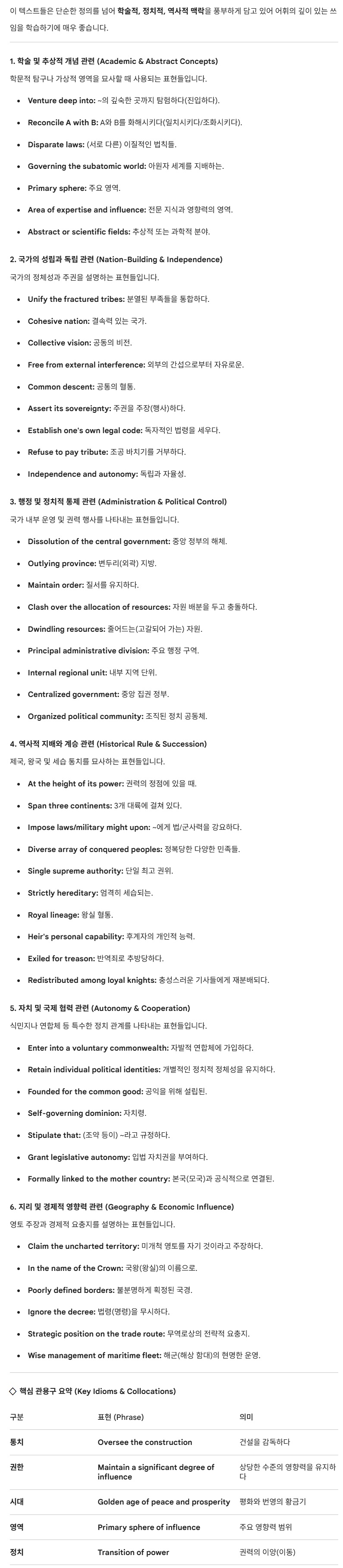
☞ [숙어 / 관용구]
'영어 어휘력 기르기 > 동의어 퀴즈' 카테고리의 다른 글
| 어휘력 [wish - (28)] - Ⅰ → [단어/숙어 26] → [테스트 2] (0) | 2026.05.11 |
|---|---|
| 어휘력 [wish - (28)] - Ⅰ → [단어/숙어 26] → [테스트 1] (0) | 2026.05.11 |
| 어휘력 [wish - (28)] - Ⅰ → [단어/숙어 25] → [테스트 2] (0) | 2026.05.09 |
| 어휘력 [wish - (28)] - Ⅰ → [단어/숙어 25] → [테스트 1] (0) | 2026.05.09 |
| 어휘력 [wish - (28)] - Ⅰ → [단어/숙어 24] → [테스트 3] (0) | 2026.05.07 |