★
테스트를 통해 어휘력 다지기!
☞ 어휘력 [wish - (28)] - Ⅰ → [단어/숙어 26]
★
"fate"의 동의어 (2).
1.
How would you distinguish karma from predestination?
A) Both terms describe outcomes
that are entirely accidental and without reason.
B) Karma suggests that the future is locked regardless of actions,
while predestination focuses on personal merit.
C) Karma involves the law of cause and effect
based on one's own actions,
while predestination suggests
that events are willed by a deity regardless of human agency.
D) Karma is a social status, while predestination is a political term.
Answer: C
Explanation:
Karma is rooted in personal action (cause/effect),
whereas predestination implies a divine decree made before birth.
2.
Which of the following best distinguishes fate from destiny?
A) Fate implies a favorable outcome guided by one's effort,
while destiny refers to a tragic, unavoidable end.
B) Fate is often viewed as an agency
that predetermines events negatively or neutrally,
whereas destiny frequently suggests
a grander, more purposeful, or positive future.
C) Fate refers to religious providence,
while destiny refers to accidental chance.
D) There is no difference between fate and destiny
as they are perfectly interchangeable.
Answer: B
Explanation:
Fate often carries a sense of inevitability (sometimes grim),
while destiny feels like a destination or a higher calling.
3.
What is the primary difference between providence and kismet?
A) Providence refers to the protective care of God or a spiritual power,
while kismet refers to fate
as a concept rooted in Turkish or Arabic cultural contexts.
B) Providence is about unlucky endings,
whereas kismet is about scientific cause and effect.
C) Kismet implies human choice,
while providence implies total randomness.
D) Providence is a synonym for doom,
and kismet is a synonym for fortune.
Answer: A
Explanation:
Providence emphasizes divine guidance;
Kismet is a loanword from Arabic/Turkish meaning "one's portion."
4.
When considering the difference between fortune and doom,
which statement is correct?
A) Fortune is always negative, while doom is always positive.
B) Fortune refers to one's general lot or luck (often positive),
whereas doom specifically indicates an unavoidable,
usually disastrous or dark fate.
C) Fortune only refers to money, and doom only refers to the weather.
D) Doom is a result of chance,
while fortune is a result of divine providence.
Answer: B
Explanation:
Fortune can fluctuate (luck),
but doom is a terminal and tragic conclusion.
5.
Which sentence best describes
the difference between lot and circumstance?
A) Lot refers to a person's assigned portion or station in life,
while circumstance refers to the external conditions or facts
that influence an event.
B) Lot is a scientific term for probability,
and circumstance is a religious term for sin.
C) Circumstance is a synonym for moira,
while lot is a synonym for future.
D) Lot implies that a person has total control,
while circumstance implies that God is in control.
Answer: A
Explanation:
"Lot" is your inherited share of life;
"circumstance" is the surrounding situation.
6.
To distinguish moira from Lady Fortune,
one must understand that:
A) Moira refers to a single goddess of luck,
while Lady Fortune is a Greek group of three.
B) Lady Fortune is a modern scientific concept,
while moira is a medieval myth.
C) Moira represents the Greek personification of fate (the Fates),
while Lady Fortune (Fortuna) is the Roman personification
of the capriciousness of luck.
D) Both moira and Lady Fortune refer to
the concept of outcome in a business context.
Answer: C
Explanation:
Moira is the Greek "shaper" of life;
Lady Fortune is the Roman "wheel" of luck.
7.
What is the difference
between outcome and future in the context of destiny?
A) Outcome is what happens before a trial,
and future is what happens after.
B) Future refers only to bad things,
while outcome refers only to good things.
C) These words are antonyms
and cannot be used in the same context.
D) Outcome is the final result of a specific process,
while future is the broader time yet to come
or the events that will happen.
Answer: D
Explanation:
Outcome is a specific result (the end of a game);
Future is the overall time ahead.
8.
Which best distinguishes predetermination from chance?
A) Chance is willed by God,
while predetermination is caused by human accidents.
B) Predetermination is used for gambling,
and chance is used for theology.
C) There is no difference;
both imply that events are completely unpredictable.
D) Predetermination implies a plan made in advance,
while chance implies
the absence of a plan and the occurrence of events randomly.
Answer: D
Explanation:
Predetermination is a "set" outcome;
chance is the lack of any set outcome.
9.
How does fate differ from fortune?
A) Fate is always about money, while fortune is about death.
B) Fate is an unalterable power controlling all events,
whereas fortune often refers to the luck (good or bad)
that befalls a person.
C) Fortune is a Greek word, and fate is an Arabic word.
D) Fate can be changed by hard work, but fortune is set in stone.
Answer: B
Explanation:
Fate is a grand cosmic force;
Fortune is the randomness of being lucky or unlucky.
10.
What distinguishes destiny from lot?
A) Lot is a synonym for doom,
and destiny is a synonym for circumstance.
B) Destiny is only used for kings,
while lot is only used for objects.
C) Lot is a temporary state,
while destiny only lasts for one day.
D) Destiny is the destination one is headed toward,
while lot is the specific share
of life's burdens or benefits one receives.
Answer: D
Explanation:
Destiny is the "path/goal"; Lot is the "portion/assignment."
11.
To distinguish providence from predestination, consider that:
A) Predetermination is a synonym for chance,
while providence means doom.
B) Providence focuses on God’s ongoing benevolent care,
whereas predestination specifically focuses on
the divine decree of one’s ultimate salvation.
C) Providence is a secular term,
while predestination is only used in physics.
D) Predestination allows for total free will,
while providence denies it.
Answer: B
Explanation:
Providence is active guidance;
Predestination is a fixed theological end-point.
12.
Which statement correctly identifies
the difference between kismet and karma?
A) Kismet is an Indian concept of rebirth,
while karma is a Turkish concept.
B) Kismet is the fixed "portion" of fate,
while karma is the fate we earn through our moral choices.
C) Karma is always negative, while kismet is always positive.
D) Both terms refer to the scientific method of predicting the future.
Answer: B
Explanation:
Kismet is "it is written" (passive);
Karma is "as you sow, so shall you reap" (active).
13.
How would you distinguish doom from destiny?
A) Doom is an inevitable positive end,
while destiny is a chosen negative path.
B) Destiny suggests a purpose or goal,
while doom suggests a final, catastrophic judgment or ruin.
C) Doom refers to the past, while destiny refers to the present.
D) They are synonyms and both imply
that the person will become a hero.
Answer: B
Explanation:
Destiny can be glorious;
Doom is almost always fatal or destructive.
14.
What is the difference between chance and circumstance?
A) Chance is the random possibility of an event,
whereas circumstance is the set
of conditions surrounding and influencing that event.
B) Circumstance is a synonym for kismet,
and chance is a synonym for providence.
C) Chance is a religious term,
and circumstance is a mathematical term.
D) Circumstance can be controlled by humans,
but chance is decided by the government.
Answer: A
Explanation:
Chance is the "probability";
Circumstance is the "context/situation."
15.
Distinguishing outcome from fate involves understanding that:
A) Outcome is the logical result of actions,
while fate is an external, supernatural force
that predetermines results.
B) Fate is a synonym for chance,
and outcome is a synonym for moira.
C) Outcome only happens in the past,
while fate only happens in the future.
D) Outcome is decided by the gods,
and fate is decided by humans.
Answer: A
Explanation:
Outcome is cause-and-effect;
Fate is "meant to be" by a higher power.
16.
Which best describes
the difference between predetermination and moira?
A) Moira refers to wealth,
while predetermination refers to poverty.
B) Predetermination is an ancient Greek term,
while moira is modern.
C) Predetermination is the general concept of setting results early,
while moira is the mythological personification of that limit.
D) Moira can be changed by magic, but predetermination cannot.
Answer: C
Explanation:
Predetermination is the abstract theory;
Moira is the mythological entity.
17.
How does Lady Fortune differ from providence?
A) Providence is a woman, and Lady Fortune is a man.
B) Lady Fortune is a synonym for doom,
and providence is a synonym for chance.
C) Lady Fortune is seen as fickle and random (blind luck),
while providence is seen as wise and purposeful.
D) Both terms imply that humans have 100% control over their lives.
Answer: C
Explanation:
Lady Fortune is unstable (the wheel);
Providence is a deliberate divine plan.
18.
What is the difference between future and predestination?
A) Predestination is a synonym for lot,
and future is a synonym for karma.
B) Future only refers to technology,
while predestination only refers to history.
C) Future is the time that hasn't happened yet,
while predestination is the belief
that events within that time are already fixed.
D) Future is determined by the stars,
but predestination is determined by the wind.
Answer: C
Explanation:
Future is a temporal concept;
Predestination is a theological/philosophical concept.
19.
Distinguishing lot from circumstance involves noting that:
A) Circumstance is a synonym for destiny,
and lot is a synonym for fortune.
B) Lot refers to a large amount of items,
and circumstance refers to a small circle.
C) Lot feels like a permanent assignment or inheritance,
whereas circumstance feels like the fluctuating situation.
D) Both terms refer to the exact same concept of religious salvation.
Answer: C
Explanation:
You are "stuck" with your lot;
you "find yourself" in certain circumstances.
20.
Which of the following differentiates fate from kismet?
A) Kismet is a synonym for chance,
and fate is a synonym for outcome.
B) Fate is a positive word, and kismet is a negative word.
C) Kismet is decided by humans,
and fate is decided by animals.
D) Fate is the general term for an unalterable power,
while kismet is the specific term
borrowed from Eastern/Islamic traditions.
Answer: D
Explanation:
They are conceptually identical,
but differ in linguistic and cultural origin.
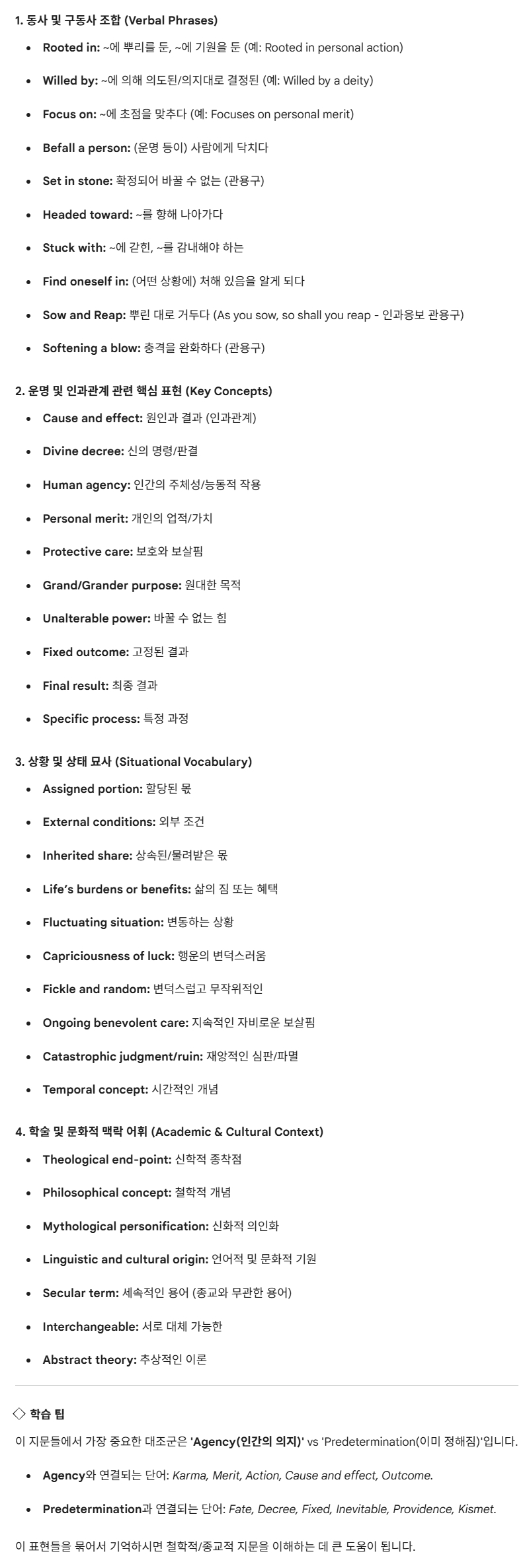
☞ [숙어 / 관용구]
'영어 어휘력 기르기 > 동의어 퀴즈' 카테고리의 다른 글
| 어휘력 [wish - (28)] - Ⅰ → [단어/숙어 28] → [테스트 1] (0) | 2026.05.15 |
|---|---|
| 어휘력 [wish - (28)] - Ⅰ → [단어/숙어 26] → [테스트 3] (0) | 2026.05.11 |
| 어휘력 [wish - (28)] - Ⅰ → [단어/숙어 26] → [테스트 1] (0) | 2026.05.11 |
| 어휘력 [wish - (28)] - Ⅰ → [단어/숙어 25] → [테스트 3] (0) | 2026.05.09 |
| 어휘력 [wish - (28)] - Ⅰ → [단어/숙어 25] → [테스트 2] (0) | 2026.05.09 |