★
테스트를 통해 어휘력 다지기!
☞ 어휘력 [wish - (28)] - Ⅰ → [단어/숙어 24]
★
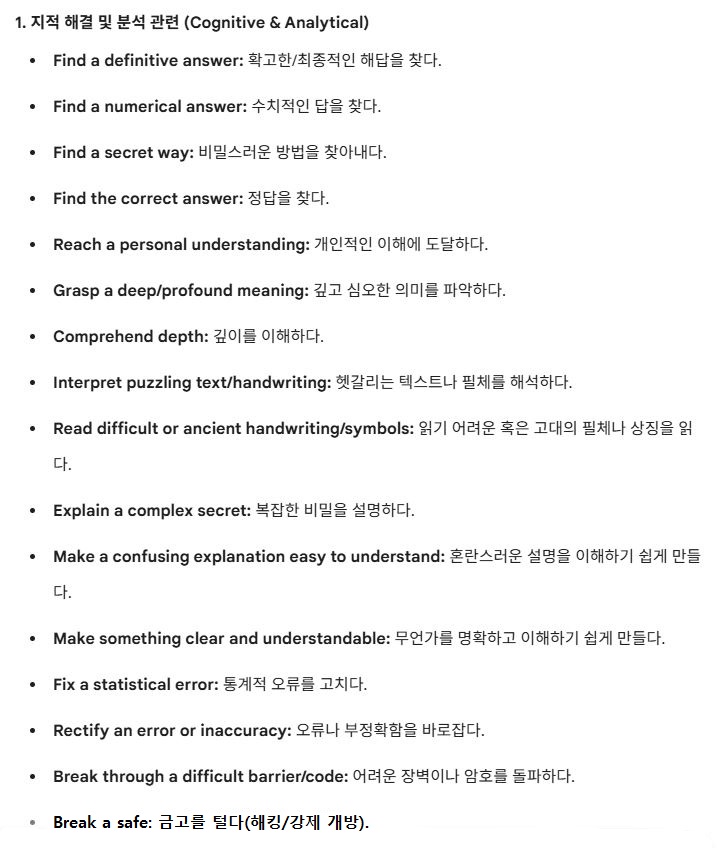
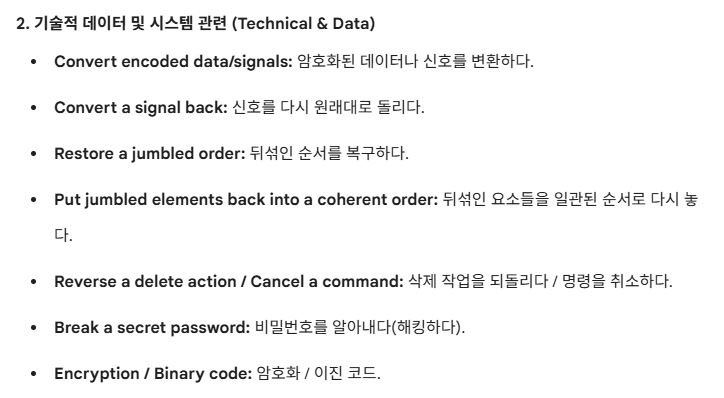
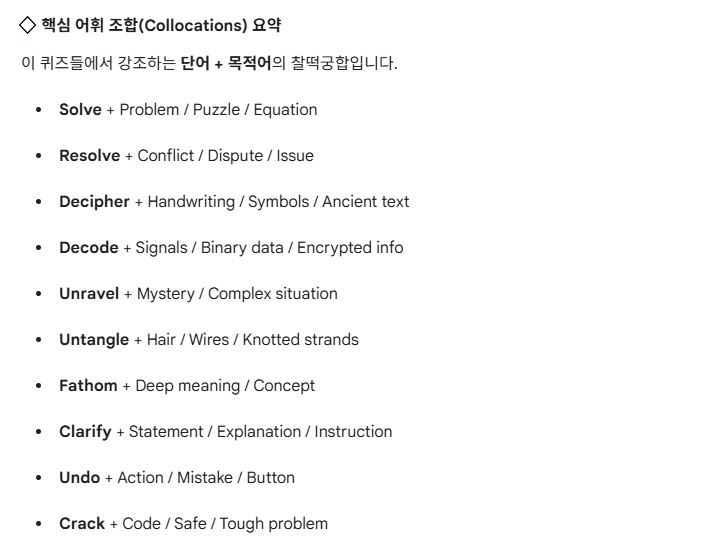
"unravel"의 동의어 (2).
1.
Which sentence correctly describes
the difference between 'Solve' and 'Resolve'?
A) To solve means to find a definitive answer
to a mathematical problem,
while to resolve implies reaching a settlement or a firm decision
regarding a conflict.
B) To solve is used only for settling legal disputes,
whereas to resolve is strictly for finding numerical answers
in a textbook.
C) Both terms are identical and can be used interchangeably
in the context of undoing a physical knot.
D) Resolve refers to taking a fabric apart thread by thread,
while solve refers to relaxing after a long day of work.
Answer: A
Explanation:
"Solve" focuses on finding the correct answer to a puzzle or problem,
whereas "resolve" focuses on settling a complex issue or conflict.
2.
How would you distinguish 'Unravel' from 'Untangle'?
A) Untangle specifically means to read ancient hieroglyphs,
while unravel is used for clearing a digital signal.
B) To unravel means to loosen the laces of a shoe,
whereas to untangle means to explain a complex secret to a group.
C) Unravel often refers to a mystery or a knitted fabric coming apart,
while untangle focuses on separating physical strands
like hair or wires that are knotted together.
D) There is no difference;
both are used exclusively for canceling an action
in a computer program.
Answer: C
Explanation:
"Unravel" has a connotation
of a complex situation or mystery coming apart,
while "untangle" is primarily for separating physical knots.
3.
What is the primary difference between 'Decipher' and 'Decode'?
A) Decipher is used for undoing a single knot,
while decode is used for making a person's behavior clear.
B) While both involve interpreting information,
decipher often implies reading difficult or ancient handwriting,
whereas decode refers to converting encoded data or signals
into a readable format.
C) Decode is used for taking off high-top sneakers,
while decipher is used for straightening a twisted rope.
D) Decipher means to relax your mind,
and decode means to take a tapestry apart.
Answer: B
Explanation:
"Decipher" is associated with interpreting puzzling text or handwriting;
"decode" is technical, often involving binary or encrypted signals.
4.
How does 'Unlace' differ from 'Unknot'?
A) Unlace refers specifically to loosening the strings of a garment or shoe,
while unknot refers to the general act of undoing a single tied knot.
B) Unknot is used for converting signals,
while unlace is used for resolving a border dispute between two nations.
C) Unlace means to find the answer to a riddle,
while unknot means to make a complex instruction easy to understand.
D) Both terms refer to the process of becoming less stressed
during a vacation.
Answer: A
Explanation:
"Unlace" is specific to laces (shoes, corsets);
"unknot" is the general term for removing a knot from any cord or rope.
5.
Distinguish 'Fathom' from 'Clarify' based on their usage.
A) Fathom means to cancel a previous computer command,
while clarify means to straighten a kinked wire.
B) Clarify means to understand a deep philosophical meaning,
while fathom means to explain something clearly to others.
C) Both are used to describe the process of unweaving a rug
to see how it was made.
D) To fathom is to grasp a deep or profound meaning
after much thought,
while to clarify is to make
a complicated statement clear and understandable for others.
Answer: D
Explanation:
"Fathom" is internal (deep understanding);
"clarify" is external (making something clear for others).
6.
Which statement accurately separates 'Unweave' from 'Untwist'?
A) Unweave refers to
taking apart a structure made of interwoven threads,
whereas untwist means
to restore a coiled or kinked strand to a straight state.
B) Untwist is used for reading hidden codes,
while unweave is used for solving a crime.
C) Unweave is used when a person relaxes at a spa,
while untwist is used when a person explains a math problem.
D) These words are synonyms for "Unlace"
and should only be used when talking about footwear.
Answer: A
Explanation:
"Unweave" is for fabrics/interwoven items;
"untwist" is for things that have been spiraled or coiled.
7.
How do you distinguish 'Figure out' from 'Work out'?
A) Figure out is strictly for physical knots,
while work out is only for ancient tablets.
B) To figure out is to understand or find an answer
through investigation,
while to work out often implies developing a solution
through a planned process or calculation.
C) Work out means to undo a shoelace,
and figure out means to relax your muscles.
D) Both are used only when a computer signal is jumbled by a storm.
Answer: B
Explanation:
While similar, "figure out" leans toward "understanding,"
while "work out" leans toward "solving/developing"
through effort or calculation.
8.
What is the difference between 'Disentangle' and 'Unsnarl'?
A) Unsnarl is for making a clear statement,
and disentangle is for converting binary code.
B) Unsnarl emphasizes clearing up a chaotic physical mess of knots,
while disentangle often refers to
separating complicated or interconnected situations or objects.
C) Disentangle means to cancel a delete action,
while unsnarl means to reach a final legal settlement.
D) These terms are only used for describing the depth of the ocean.
Answer: B
Explanation:
"Unsnarl" deals with "snarls" (messy knots);
"disentangle" is broader
and often applies to complex abstract relationships.
9.
Which of the following distinguishes 'Unscramble' from 'Undo'?
A) Undo is used for organizing jumbled letters,
while unscramble is used for canceling a mistake.
B) Unscramble means to restore a jumbled order
(like a signal or letters),
whereas undo means to cancel a specific action
or return something to its previous state.
C) Undo refers to the deep understanding of a mystery,
while unscramble refers to taking off a high-top sneaker.
D) Both are used to describe the process
of unweaving a piece of ancient cloth.
Answer: B
Explanation:
"Unscramble" is for re-ordering mixed items;
"undo" is for reversing an action.
10.
How does 'Unwind' differ from 'Crack'?
A) Unwind is often used for relaxing or uncoiling,
while crack is used for breaking a secret code
or solving an extremely difficult problem.
B) Crack means to loosen a shoe string,
and unwind means to reach a legal decision.
C) Unwind is for finding a numerical answer,
and crack is for taking a tapestry apart.
D) Both terms refer to the act
of removing a single knot from a silk scarf.
Answer: A
Explanation:
"Unwind" relates to tension/coiling;
"crack" relates to breaking through a difficult barrier or code.
11.
Distinguish 'Correction' from 'Clarify' in a technical context.
A) Clarify means to reverse a delete action,
and correction means to straighten a rope.
B) Correction refers to rectifying an error or inaccuracy,
while clarify refers to making a confusing explanation
easy to understand.
C) Clarify is used for knots, and correction is used for ancient symbols.
D) Both are used to describe the process of untangling earphone wires.
Answer: B
Explanation:
"Correction" fixes a mistake;
"clarify" fixes a lack of understanding.
12.
Which sentence separates 'Unknot' from 'Unsnarl'?
A) Unknot is used for deep philosophical understanding,
while unsnarl is for canceling a computer command.
B) Unknot is for taking a tapestry apart,
and unsnarl is for loosening shoelaces.
C) Unknot refers to undoing a specific, single knot,
while unsnarl refers to
clearing up a complex and messy tangle of multiple knots.
D) There is no difference;
they are both used to describe converting data signals.
Answer: C
Explanation:
"Unknot" is singular and simple;
"unsnarl" implies a larger, messier physical problem.
13.
What is the difference between 'Resolve' and 'Work out'?
A) Resolve usually focuses on settling a dispute or conflict,
while work out focuses on the process
of calculating or planning a solution to a problem.
B) Work out is for unweaving cloth,
and resolve is for straightening a twisted wire.
C) Resolve is for loosening laces,
and work out is for undoing a single knot.
D) Both terms are synonyms for relaxing at a park.
Answer: A
Explanation:
"Resolve" implies finality in a conflict;
"work out" implies the labor of finding a solution.
14.
Distinguish 'Untangle' from 'Disentangle' in an abstract sense.
A) Untangle is strictly for ancient languages,
and disentangle is for math problems.
B) Both are used for canceling a digital command
in a software program.
C) Untangle usually refers to physical strands,
whereas disentangle is more frequently used for separating oneself
from a restrictive or complicated situation.
D) Disentangle means to relax, and untangle means to break a code.
Answer: C
Explanation:
"Untangle" is usually literal;
"disentangle" is often used metaphorically
for complex involvement/situations.
15.
How would you distinguish 'Decipher' from 'Fathom'?
A) Decipher is the act of reading difficult or coded text,
while fathom is the act
of deeply understanding a profound or hidden concept.
B) Fathom is for fixing a numerical error,
and decipher is for reversing an action.
C) Decipher is used for shoelaces,
and fathom is used for physical knots.
D) Both are synonyms for "Unwind"
and describe the process of mental relaxation.
Answer: A
Explanation:
"Decipher" is about "reading/interpreting";
"fathom" is about "comprehending depth."
16.
Which statement accurately distinguishes 'Decode' from 'Unscramble'?
A) Decode means to convert an encoded signal back to its original form,
while unscramble means to put jumbled elements (like letters)
back into a coherent order.
B) Unscramble means to reach a legal settlement,
and decode means to straighten a wire.
C) Decode is for relaxing, and unscramble is for unweaving a rug.
D) These words are identical and are only used for physical ropes.
Answer: A
Explanation:
"Decode" involves a "code" or "signal";
"unscramble" involves "jumbled components."
17.
How does 'Unwind' differ from 'Undo'?
A) Undo is for straightening a rope, and unwind is for fixing a typo.
B) Unwind refers to uncoiling something or relaxing,
while undo specifically refers to
reversing an action or unfastening a knot/button.
C) Undo means to read ancient symbols,
and unwind means to solve a math problem.
D) Both terms are used for breaking a secret password.
Answer: B
Explanation:
"Unwind" is about coiling/stress; "undo" is about reversing/unfastening.
18.
Distinguish 'Crack' from 'Solve' in terms of difficulty.
A) Solve is for breaking a safe, and crack is for general math homework.
B) Solve is a general term for finding an answer,
while crack implies successfully breaking
through a particularly difficult code, safe, or "hard" problem.
C) Crack means to relax, and solve means to loosen a lace.
D) Both are used only for unweaving a tapestry.
Answer: B
Explanation:
"Crack" suggests a "breakthrough"
in something intentionally hidden or very tough.
19.
How do you distinguish 'Unweave' from 'Unlace'?
A) Unweave is for digital data, and unlace is for ancient mysteries.
B) Unlace is for straightening a coil,
and unweave is for canceling a command.
C) Both are used to describe reaching a legal settlement in a court of law.
D) Unweave means to take apart interwoven threads of a fabric,
while unlace means to undo the lacing of a shoe or garment.
Answer: D
Explanation:
"Unweave" is for textiles; "unlace" is for string-tied items like shoes.
20.
Which of the following distinguishes 'Clarify' from 'Figure out'?
A) Clarify means to make a complex thing clear to others,
while figure out means to reach a personal understanding or solution
through thought.
B) Figure out means to fix a statistical error,
and clarify means to undo a knot.
C) Clarify is for unweaving cloth, and figure out is for unlacing shoes.
D) These words are used exclusively for interpreting binary code.
Answer: A
Explanation:
"Clarify" is about the "explanation";
"figure out" is about the "discovery/realization."
☞ [숙어 / 관용구]


'영어 어휘력 기르기 > 동의어 퀴즈' 카테고리의 다른 글
| 어휘력 [wish - (28)] - Ⅰ → [단어/숙어 25] → [테스트 1] (0) | 2026.05.09 |
|---|---|
| 어휘력 [wish - (28)] - Ⅰ → [단어/숙어 24] → [테스트 3] (0) | 2026.05.07 |
| 어휘력 [wish - (28)] - Ⅰ → [단어/숙어 24] → [테스트 1] (0) | 2026.05.07 |
| 어휘력 [wish - (28)] - Ⅰ → [단어/숙어 21] → [테스트 3] (0) | 2026.05.04 |
| 어휘력 [wish - (28)] - Ⅰ → [단어/숙어 21] → [테스트 2] (0) | 2026.05.04 |