★
테스트를 통해 어휘력 다지기!
☞ 어휘력 [wish - (28)] - Ⅰ → [단어/숙어 24]
★
"unravel"의 동의어 (1).
1.
Scenario:
Your wired earphones have been in your pocket all day
and are now a messy ball of knots.
What action are you performing
when you carefully separate the individual cords
without breaking them?
A) Decipher
B) Untangle
C) Unscramble
D) Resolve
Answer: B
Explanation:
"Untangle" is the most appropriate term
for separating physical strands,
like wires or hair, that have become knotted together.
2.
Scenario:
A mediator is brought in to separate
the emotional personal issues
from the legal financial issues in a messy divorce.
Which term describes
separating these two deeply interconnected
and complicated aspects?
A) Unknot
B) Unwind
C) Disentangle
D) Undo
Answer: C
Explanation:
"Disentangle" is used for separating things or ideas
that are caught in a very complicated or restrictive relationship.
3.
Scenario:
A worker is trying to open a heavy package
tied with thick, multi-stranded rope
that has been coiled and kinked tightly.
What is the worker doing
when they turn the rope in the opposite direction
to straighten the fibers?
A) Work out
B) Untwist
C) Fathom
D) Clarify
Answer: B
Explanation:
"Untwist" literally means to open something
that has been twisted or to restore it to a straight state.
4.
Scenario:
A detective is looking at a complicated web of clues
that seems to lead nowhere,
but slowly, the truth begins to emerge.
Which word best describes the process of a complex mystery
gradually becoming clear or falling apart into understandable pieces?
A) Unravel
B) Unlace
C) Untwist
D) Unweave
Answer: A
Explanation:
"Unravel" is specifically used
when a complex mystery or a tangled situation
gradually becomes clear or undone.
5.
Scenario:
You receive a radio transmission that sounds like gibberish
because the signal was jumbled during a storm.
Which action describes
organizing these jumbled signals back into a coherent message?
A) Unscramble
B) Unsnarl
C) Solve
D) Decode
Answer: A
Explanation:
"Unscramble" refers to restoring a jumbled or mixed-up order
(like radio signals or letters) to an intelligible form.
6.
Scenario:
A fisherman's net has become a chaotic mess of knots
and seaweed after being dragged through a coral reef.
Which word emphasizes the physical effort
of clearing up this messy, knotted "snarl"?
A) Figure out
B) Unsnarl
C) Resolve
D) Clarify
Answer: B
Explanation:
"Unsnarl" specifically targets the act
of clearing up complicated physical knots or "snarls."
7.
Scenario:
You accidentally hit "Delete" on a paragraph in your essay
and want to return the document to its previous state.
Which command do you use to cancel that specific action?
A) Unweave
B) Unlace
C) Undo
D) Unknot
Answer: C
Explanation:
"Undo" means to cancel an action or return something
to its original state before the action occurred.
8.
Scenario:
An archaeologist finds a piece of ancient cloth
and needs to take it apart thread by thread
to study the weaving pattern.
What is the archaeologist doing to the fabric?
A) Unsnarl
B) Unweave
C) Untangle
D) Resolve
Answer: B
Explanation:
"Unweave" means to take apart something
that has been woven, like fabric or a tapestry.
9.
Scenario:
After a high-stress meeting,
a businessman goes to a quiet park
to let go of his mental tension and relax.
What is the businessman doing in relation to his stress?
A) Unscramble
B) Unwind
C) Decipher
D) Fathom
Answer: B
Explanation:
"Unwind" is commonly used figuratively to describe
the process of relaxing and releasing mental or physical tension.
10.
Scenario:
An athlete is taking off their high-top sneakers
by loosening the strings that crisscross through the eyelets.
What is the specific term for loosening these strings?
A) Unknot
B) Untwist
C) Unlace
D) Undo
Answer: C
Explanation:
"Unlace" is the specific term
for undoing the laces of a shoe, garment, or corset.
11.
Scenario:
A magician has tied
a very tight, singular lump in a silk scarf
and asks an audience member
to make it disappear by pulling the right loop.
What is the person doing to the scarf?
A) Work out
B) Resolve
C) Figure out
D) Unknot
Answer: D
Explanation:
"Unknot" specifically refers to the act
of undoing a single, specific knot.
12.
Scenario:
A student is looking at a difficult math equation in a textbook
and trying to find the correct numerical answer.
Which term best fits the act
of finding the answer to a math problem or a puzzle?
A) Unweave
B) Solve
C) Unsnarl
D) Unlace
Answer: B
Explanation:
"Solve" is the standard term
for finding an answer to a math problem, a puzzle, or a riddle.
13.
Scenario:
Two nations have been in a border dispute for years,
and they finally sit down to reach a final,
binding decision to end the conflict.
How would you describe the act
of settling this difficult, long-term problem?
A) Resolve
B) Unwind
C) Untangle
D) Crack
Answer: A
Explanation:
"Resolve" is used to describe the act
of reaching a final decision or settlement
in a difficult conflict or problem.
It conveys the idea of conclusively ending a long-standing dispute,
such as two nations agreeing to settle a border conflict.
14.
Scenario:
A linguist is looking at an ancient tablet
covered in mysterious symbols
that no one has been able to read for centuries.
What is the linguist trying to do to the symbols?
A) Unknot
B) Resolve
C) Decipher
D) Fathom
Answer: C
Explanation:
"Decipher" is the correct term
for interpreting or reading ancient, difficult,
or encoded writing/symbols.
15.
Scenario:
A computer programmer
is looking at a stream of binary data (1s and 0s)
and converting it back into a readable image.
What is the programmer doing to the encoded data?
A) Crack
B) Decode
C) Solve
D) Untwist
Answer: B
Explanation:
"Decode" means to interpret encoded information
or convert a signal back into an understandable format.
16.
Scenario:
You are trying to understand
why your car won't start by checking the battery,
the spark plugs, and the fuel tank.
Which term describes the process of investigating
until you finally understand the cause of the problem?
A) Figure out
B) Unscramble
C) Unsnarl
D) Unweave
Answer: A
Explanation:
"Figure out" means to understand or find an answer
through investigation or careful thought.
17.
Scenario:
A team of engineers is trying to develop a functional blueprint
for a new bridge
by calculating all the stress points and materials needed.
Which term describes the process of "working"
through the details to reach a final solution?
A) Unwind
B) Unlace
C) Work out
D) Resolve
Answer: C
Explanation:
"Work out" implies solving a problem or developing a solution
through a process of effort, calculation, and planning.
18.
Scenario:
A hacker is trying to break into a highly secure digital vault
by finding the secret password bypass.
What is the hacker trying to do to the security system?
A) Crack
B) Fathom
C) Unscramble
D) Clarify
Answer: A
Explanation:
"Crack" is often used for breaking a code or finding a secret way
to solve an extremely difficult problem
(like a "tough nut to crack").
19.
Scenario:
A philosopher spends his whole life trying
to understand the deepest,
most hidden meaning of human existence.
Which term describes
trying to grasp a very deep or profound concept?
A) Decipher
B) Unknot
C) Untangle
D) Fathom
Answer: D
Explanation:
"Fathom" means to understand the depth of something
or to grasp a very deep and complex meaning.
20.
Scenario:
A teacher realizes the students
are confused by the complex instructions,
so she explains them again in very simple, clear steps.
What is the teacher doing to the instructions?
A) Clarify
B) Decode
C) Solve
D) Crack
Answer: A
Explanation:
"Clarify" means to make something clear
and easy to understand by removing confusion.
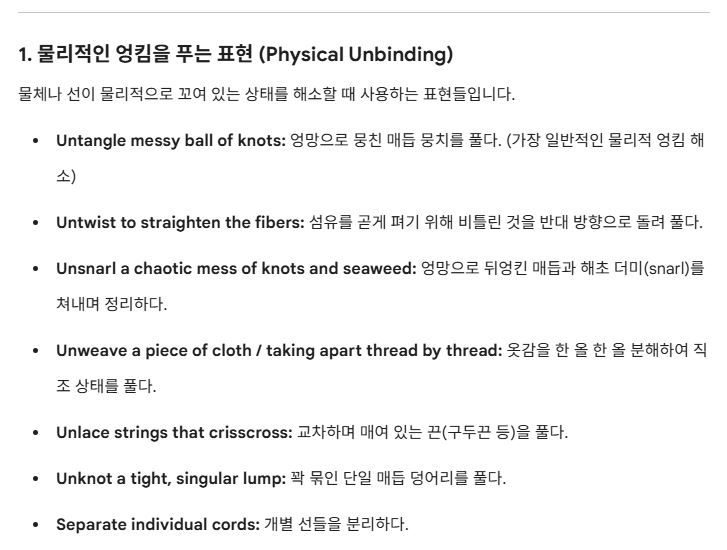
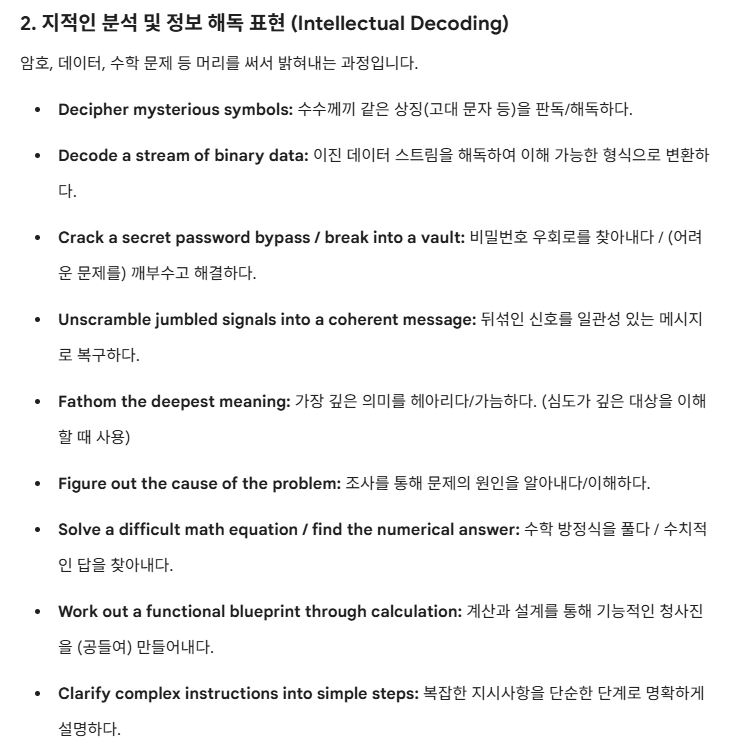
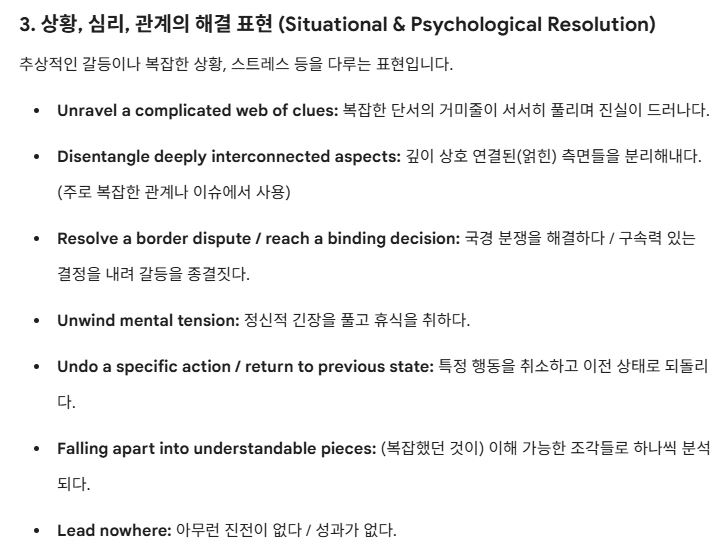
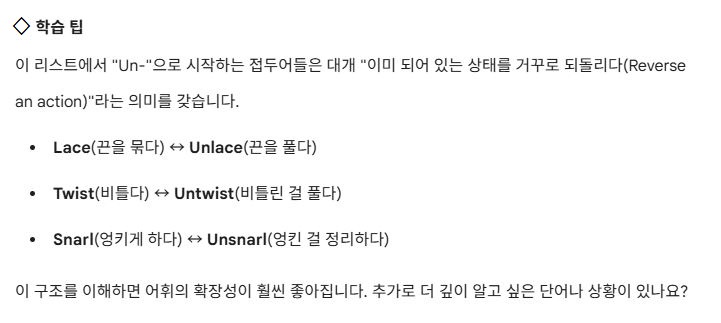
☞ [숙어 / 관용구]
☞ [학습용 단어장]


'영어 어휘력 기르기 > 동의어 퀴즈' 카테고리의 다른 글
| 어휘력 [wish - (28)] - Ⅰ → [단어/숙어 24] → [테스트 3] (0) | 2026.05.07 |
|---|---|
| 어휘력 [wish - (28)] - Ⅰ → [단어/숙어 24] → [테스트 2] (0) | 2026.05.07 |
| 어휘력 [wish - (28)] - Ⅰ → [단어/숙어 21] → [테스트 3] (0) | 2026.05.04 |
| 어휘력 [wish - (28)] - Ⅰ → [단어/숙어 21] → [테스트 2] (0) | 2026.05.04 |
| 어휘력 [wish - (28)] - Ⅰ → [단어/숙어 21] → [테스트 1] (1) | 2026.05.04 |