★
테스트를 통해 어휘력 다지기!
☞ 어휘력 [wish - (28)] - Ⅰ → [단어/숙어 8]
★
"unnerve"의 동의어 (1).
1.
Which word best describes
the act
of making someone lose
their confidence or courage
through discouragement?
("make+목적어+do"
+ 타동사 lose의 목적어)
A. Unnerve
B. Dishearten
C. Unbalance
D. Rattle
Correct Answer: B
Explanation:
To dishearten means
to cause someone to lose
determination or confidence,
often due to a setback or disappointment.
("cause+목적어+to do"
+ 타동사 lose의 목적어)
2.
If a sudden, loud noise
causes a speaker to lose their place
and become momentarily confused,
they have been:
A. Daunted
B. Terrified
C. Flustered
D. Unsettled
Correct Answer: C
Explanation:
To fluster someone
is
to make them nervous, confused, or agitated,
typically by making them hurry
or through a sudden distraction.
3.
Which term refers to
making someone feel afraid or timid,
often intentionally
to make them do
what one wants?
(what절은
타동사 do의 목적어 역할을 하는 명사절,
what은 관계대명사 →
wants라는 동사의 목적어가 빠져 있으며,
그 역할을 what이 대신.)
A. Intimidate
B. Discompose
C. Confound
D. Disquiet
Correct Answer: A
Explanation:
To intimidate is
to frighten or overawe someone,
especially in order to make them do
what one wants.
("in order to + 동사원형")
4.
When a complex problem
leaves a scientist completely baffled
because it contradicts everything they knew,
the problem has:
("leave+목적어+과거분사")
(everything that they knew
← 목적격 관계대명사 생략.)
A. Scared
B. Dispirited
C. Perturbed
D. Confounded
Correct Answer: D
Explanation:
To confound means
to cause
surprise or confusion
in someone,
especially by acting against their expectations.
5.
Which word describes
the feeling
of anxiety or worry
that disturbs one's peace of mind?
A. Disquiet
B. Frighten
C. Demoralize
D. Unhinge
Correct Answer: A
Explanation:
Disquiet refers to
a feeling
of anxiety or worry;
as a verb,
it means to make someone worried or uneasy.
6.
If a person’s mental stability
is severely disturbed
to the point
where they lose their grip on reality,
they are said to be:
A. Disconcerted
B. Dismayed
C. Unhinged
D. Disturbed
Correct Answer: C
Explanation:
To unhinge means
to make someone mentally unbalanced
or causes them to lose
their mental stability.
7.
Which verb is used
when someone is made
to feel shaky or nervous,
often losing their composure
due to a sudden shock?
A. Unbalance
B. Rattle
C. Agitate
D. Faze
Correct Answer: B
Explanation:
To rattle someone
means
to make them
nervous, worried, or irritated,
often causing them to lose
their steady focus.
8.
When a team loses
its fighting spirit and morale
because of a heavy defeat,
they have been:
A. Demoralized
B. Perturbed
C. Upset
D. Discomposed
Correct Answer: A
Explanation:
To demoralize means
to cause someone to lose
confidence or hope;
it specifically targets "morale" or spirit.
9.
Which word describes
causing someone to feel anxious
or lose their composure,
particularly by making them feel vulnerable?
("describe + 목적어로 동명사 causing"
→ "cause + 목적어 + to do" →
"감각동사 feel + 형용사 보어 anxious",
타동사 lose의 목적어로 "their composure",
목적격 보어 "to feel / to lose"가 병렬연결
+
전치사 by의 목적어로 동명사 making
→ "make+목적어+do" →
"감각동사 feel + 형용사 보어 vulnerable")
A. Terrify
B. Daunt
C. Unnerve
D. Disconcert
Correct Answer: C
Explanation:
To unnerve means
to make someone lose
their courage or confidence,
often making them
feel weak or "shaky."
10.
If an unexpected change in plans
makes you
feel confused and slightly embarrassed,
you are:
("make+목적어+do",
감각동사 feel 뒤에
과거분사의 형용사적 용법으로
감정 상태를 설명하는 형용사 보어인
confused/embarrassed.)
A. Disconcerted
B. Disheartened
C. Intimidated
D. Scared
Correct Answer: A
Explanation:
To disconcert someone
is to disturb their composure
or to unsettle them
by doing something unexpected.
11.
Which term is used
when someone's calm and orderly state
is disrupted,
causing them to lose their cool?
A. Unnerve
B. Discompose
C. Unhinge
D. Dismay
Correct Answer: B
Explanation:
To discompose means
to disturb the composure
or agitated the peace of mind of someone.
12.
When a challenge is
so intimidating that it makes you feel
like you shouldn't even try,
the challenge is:
A. Disturbed
B. Flustered
C. Daunting
D. Terrifying
Correct Answer: C
Explanation:
To daunt means
to make someone
feel intimidated or apprehensive
about a difficult task.
13.
Which verb describes
a state of emotional upheaval
or a loss of emotional balance?
A. Unbalance
B. Agitate
C. Disquiet
D. Upset
Correct Answer: D
Explanation:
To upset someone
is
to disturb
their physical or mental health,
or to make them
unhappy or disappointed.
14.
If a piece of bad news
makes you feel
a mixture of distress and disappointment,
you are feeling:
(여기서 feel은 타동사.)
A. Scared
B. Dismayed
C. Fazed
D. Discomposed
Correct Answer: B
Explanation:
Dismay is
a feeling
of distress or disappointment,
often caused by something unexpected.
15.
Which word specifically describes
the act
of making someone
feel "not level" or mentally unstable?
A. Unbalance
B. Rattle
C. Disconcert
D. Demoralize
Correct Answer: A
Explanation:
To unbalance means
to upset
the equilibrium or stability
of someone's mind or emotions.
16.
If someone is not bothered or affected
by a difficult situation,
we say they were NOT:
A. Dispirited
B. Intimidated
C. Fazed
D. Disturbed
Correct Answer: C
Explanation:
To faze means
to disturb or disconcert someone;
it is almost always used
in the negative (e.g., "he was unfazed").
17.
Which term describes
actively stirring up trouble
or making someone
feel physically or mentally restless?
("stir up")
A. Agitate
B. Dishearten
C. Unnerve
D. Unhinge
Correct Answer: A
Explanation:
To agitate is
to make someone
troubled or nervous,
or to stir up public concern
about an issue.
("make + 목적어 + 형용사 목적격 보어")
("to make..."와 "to stir up..".이
or를 중심으로 병렬연결되어
agitate의 두 가지 정의를 내리고 있음.)
18.
Imagine
a student is deeply focused on
solving a complex math problem
in a quiet library.
Suddenly,
someone nearby starts talking loudly
on a cell phone,
breaking the student's concentration
and ruining the peaceful environment.
Which word best describes
what the loud person did to the student?
A. Terrify
B. Disturb
C. Unbalance
D. Confound
Correct Answer: B
Explanation:
To disturb means
to interrupt
the quiet, rest, or concentration
of someone.
In this scenario,
the loud phone call
broke the peaceful atmosphere
and interfered with the student's mental focus,
which is the primary definition
of disturbing someone.
19.
Which word refers to
taking away
someone’s energy, enthusiasm, or "spirit"?
("take away")
A. Disconcert
B. Disquiet
C. Dispirit
D. Discompose
Correct Answer: C
Explanation:
To dispirit means
to cause someone
to lose enthusiasm or hope.
20.
If you are extremely afraid,
to the point
of being frozen
with fear,
you are:
A. Perturbed
B. Terrified
C. Upset
D. Disheartened
Correct Answer: B
Explanation:
To terrify is
to cause someone
to feel extreme fear or terror.
21.
Which verb describes
making someone
feel anxious or uneasy,
similar to "worrying" them?
A. Perturb
B. Frighten
C. Fluster
D. Demoralize
Correct Answer: A
Explanation:
To perturb means
to make someone
anxious or unsettled.
22.
A person is walking alone down
a dark,
empty street at night.
Suddenly,
a large shadow jumps out
from behind a corner and yells loudly.
The person’s heart begins to race,
and they feel a sudden, sharp surge
of alarm and fear.
Which action best describes
what the shadow did to the person?
A. Unsettle
B. Daunt
C. Disconcert
D. Frighten
Correct Answer: D
Explanation:
To frighten someone
is to cause them
a sudden feeling
of fear, shock, or alarm.
In this scenario,
the sudden jump and loud noise
created
an immediate physical and emotional reaction
of fear,
which perfectly matches the definition of "frighten."
23.
Which word means
to make someone
feel unstable or "shaky"
in their foundation or beliefs?
A. Unsettle
B. Rattle
C. Confound
D. Intimidate
Correct Answer: A
Explanation:
To unsettle is
to cause someone
to feel anxious or uneasy,
often by disrupting their stability.
24.
When a sudden threat
makes you jump
or feel immediate alarm,
you have been:
A. Unhinged
B. Scared
C. Dispirited
D. Discomposed
Correct Answer: B
Explanation:
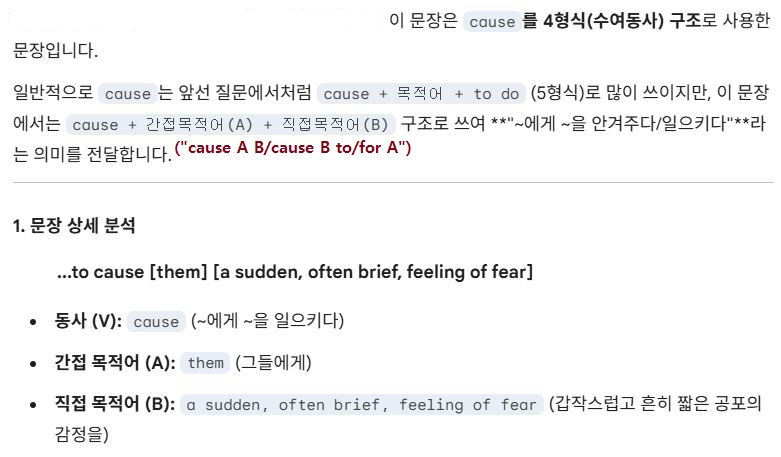
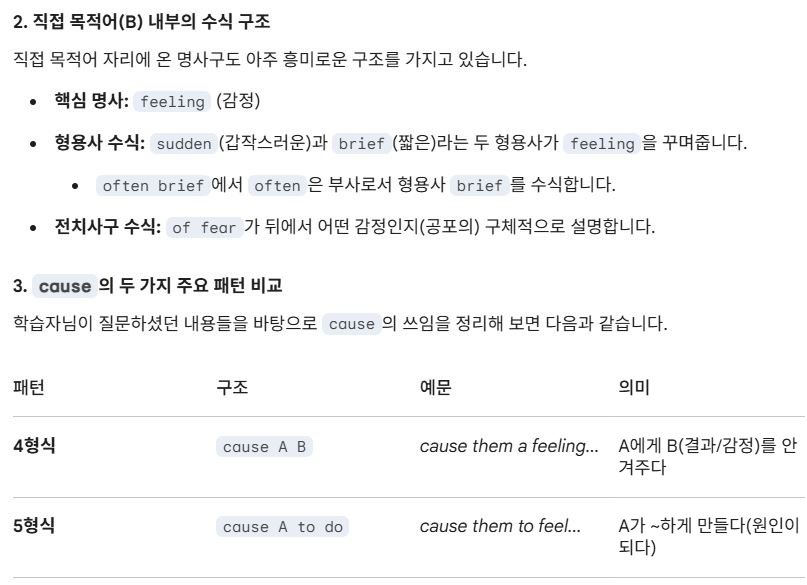
To scare someone
is
to cause them
a sudden, often brief, feeling
of fear.
(아래 참조)
☞
24번 설명문에서:
'영어 어휘력 기르기' 카테고리의 다른 글
| 어휘력 [wish - (28)] - Ⅰ → [단어/숙어 8] → [테스트 3] (0) | 2026.04.05 |
|---|---|
| 어휘력 [wish - (28)] - Ⅰ → [단어/숙어 8] → [테스트 2] (0) | 2026.04.05 |
| 어휘력 [wish - (28)] - Ⅰ → [단어/숙어 7] → [테스트 4] (0) | 2026.04.03 |
| 어휘력 [wish - (28)] - Ⅰ → [단어/숙어 7] → [테스트 3] (0) | 2026.04.03 |
| 어휘력 [wish - (28)] - Ⅰ → [단어/숙어 7] → [테스트 2] (0) | 2026.04.03 |