★
테스트를 통해 독해력/어휘력 다지기!
◆
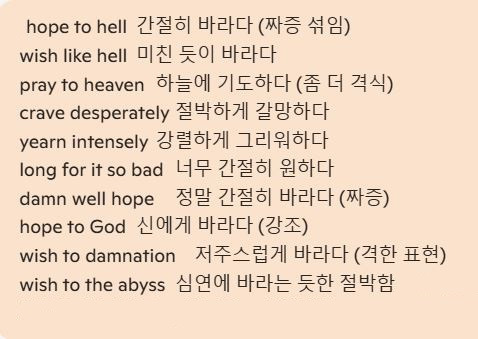
1.
Which phrase best expresses a desperate longing?
wish like hell
hope to God
crave desperately
damn well hope
2.
Which phrase is most suitable
for expressing frustration while hoping?
pray to heaven
hope to hell
yearn intensely
wish to the abyss
3.
Which phrase conveys
a formal and respectful tone of hope?
wish to damnation
pray to heaven
damn well hope
long for it so bad
4.
Which phrase emphasizes
intense yearning or longing?
wish to the abyss
yearn intensely
hope to God
wish like hell
5.
Which phrase conveys
a sense of exaggerated frustration while wishing?
crave desperately
pray to heaven
wish to damnation
long for it so bad
6.
Which phrase conveys an intense longing
that borders on obsession?
wish to the abyss
crave desperately
yearn intensely
long for it so bad
7.
Which phrase is most suitable for expressing hope
with a tone of irritation and urgency?
damn well hope
hope to God
pray to heaven
wish like hell
8.
Which phrase best captures
a desperate and fervent wish with a dramatic undertone?
hope to hell
wish to damnation
yearn intensely
long for it so bad
9.
Which phrase conveys
a solemn and formal plea for hope?
pray to heaven
wish to the abyss
hope to hell
damn well hope
10.
Which phrase emphasizes a longing
that is both intense and deeply emotional?
yearn intensely
crave desperately
wish like hell
hope to God
11.
Which phrase conveys
a sense of exaggerated frustration while expressing hope?
wish to damnation
hope to hell
wish like hell
damn well hope
12.
Which phrase best expresses a longing
that is both desperate and urgent?
wish to the abyss
long for it so bad
hope to God
crave desperately
13.
Which phrase conveys
a dramatic and profound sense of longing?
damn well hope
pray to heaven
wish to the abyss
yearn intensely
14.
Which phrase is most suitable for expressing hope
with a tone of solemnity and reverence?
wish like hell
pray to heaven
hope to God
long for it so bad
15.
Which phrase emphasizes a longing
that is both intense and deeply personal?
long for it so bad
wish to damnation
yearn intensely
crave desperately
◆
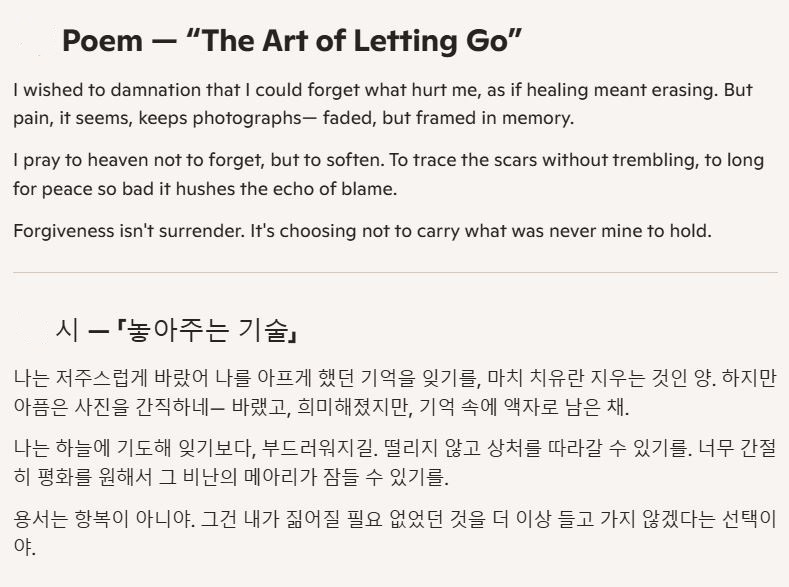
16.
What does the speaker wish to forget?
The scars they trace
The photographs in memory
The echo of blame
The pain that hurt them
17.
What does the speaker say about pain?
It is erased through forgiveness.
It fades away completely over time.
It keeps photographs, faded but framed in memory.
It is something that can be forgotten easily.
18.
What does the speaker pray for?
To surrender to forgiveness
To forget everything that hurt them
To erase all memories of pain
To soften and trace scars without trembling
19.
How does the speaker define forgiveness?
As surrendering to the pain
As erasing all memories of hurt
As choosing not to carry what was never theirs to hold
As forgetting the scars and moving on
20.
What does the speaker long for so badly
that it hushes the echo of blame?
Forgetfulness
Peace
Healing
Forgiveness
21.
What does the speaker mean by 'healing meant erasing'?
Healing is mistakenly thought to mean forgetting pain.
Healing involves removing all scars.
Healing is about surrendering to the hurt.
Healing requires forgetting everything.
22.
Why does the speaker describe pain as keeping photographs?
To emphasize that pain is easily forgotten.
To suggest that pain is like a physical photograph.
To show that pain is a vivid memory.
To illustrate that pain fades but remains framed in memory.
23.
What does the speaker wish to achieve by 'softening'?
To stop trembling when tracing scars.
To surrender to the echo of blame.
To forget the photographs of pain.
To erase all memories of pain.
24.
What does the speaker imply
by 'choosing not to carry what was never mine to hold'?
Erasing the echo of blame.
Surrendering to forgiveness.
Forgetting all painful memories.
Letting go of unnecessary burdens.
25.
What is the speaker's attitude toward blame?
They want to erase it completely.
They wish to quiet its echo through peace.
They believe it should be forgotten.
They think it is a necessary part of healing.
26.
What does the word 'damnation' most closely mean?
Salvation
Condemnation
Forgiveness
Healing
27.
What does 'faded' mean in the context of the poem?
Bright and clear
Framed and preserved
Completely erased
Diminished or less vivid
28.
What does 'soften' imply in the poem?
To forget completely
To surrender to pain
To make less harsh or intense
To erase scars
29.
What does 'echo' refer
to in the phrase 'hushes the echo of blame'?
A memory or lingering effect
A repeated sound
A loud noise
A direct accusation
30.
What does 'trace' mean
in the context of 'trace the scars'?
To erase or remove
To deepen or intensify
To follow or outline
To hide or cover
☞ [정답]
1. ㅡ 3) 2. ㅡ 2) 3. ㅡ 2)
4. ㅡ 2) 5. ㅡ 3) 6. ㅡ 1)
7. ㅡ 1) 8. ㅡ 2) 9. ㅡ 1)
10. ㅡ 1) 11. ㅡ 2) 12. ㅡ 4)
13. ㅡ 3) 14. ㅡ 3) 15. ㅡ 1)
16. ㅡ 4) 17. ㅡ 3) 18. ㅡ 4)
19. ㅡ 3) 20. ㅡ 2) 21. ㅡ 1)
22. ㅡ 4) 23. ㅡ 1) 24. ㅡ 4)
25. ㅡ 2) 26. ㅡ 2) 27. ㅡ 4)
28. ㅡ 3) 29. ㅡ 1) 30. ㅡ 3)
☞
4지선다에 번호가 없더라도 순서대로 1), 2,) 3,) 4).
'영어 어휘력 기르기' 카테고리의 다른 글
| 어휘력 [wish - (27)] - Ⅰ → [단어/숙어 1] → [테스트 2] (4) | 2025.08.04 |
|---|---|
| 어휘력 [wish - (27)] - Ⅰ → [단어/숙어 1] → [테스트 1] (0) | 2025.08.04 |
| 어휘력 [wish - (27)] - Ⅱ → [테스트 2] (0) | 2025.08.03 |
| 어휘력 [wish - (27)] - Ⅱ → [테스트 1] (2) | 2025.08.03 |
| 어휘력 [wish - (27)] - Ⅱ → [단어/숙어 3] (4) | 2025.08.02 |