★
테스트를 통해 어휘력 다지기!
☞ 어휘력 [wish - (28)] - Ⅰ → [단어/숙어 11]
★
"moor"의 '명사형' 동의어 (1).
1.
You are hiking in the Scottish Highlands.
The ground is covered
in purple heather and low shrubs,
but there are no trees in sight.
The soil is acidic and not suitable for farming.
Which term best describes this landscape?
A) Savanna
B) Heath
C) Swamp
D) Steppe
Answer: B
Explanation:
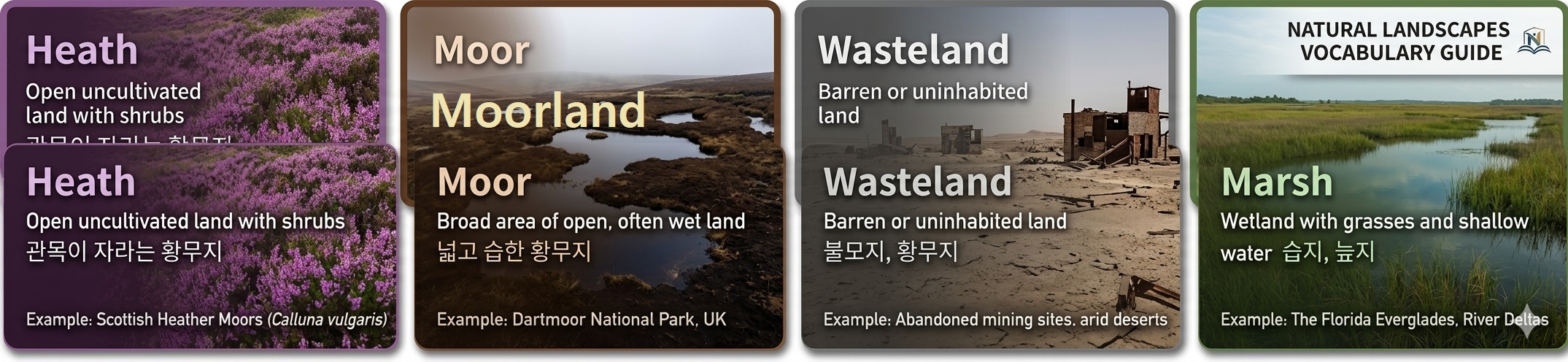
A Heath is characterized
by open, uncultivated land
dominated by low-growing shrubs
like heather,
often with acidic soil.
2.
A traveler is walking
through a vast,
open area in Northern England.
The ground is very wet and peaty,
often feeling like a soaked sponge underfoot.
Mist frequently covers this wide, desolate elevation.
What is this place?
A) Savanna
B) Tundra
C) Moor
D) Wasteland
Answer: C
Explanation:
A Moor (or Moorland) refers to
a broad area of open,
often high and wet land with peaty soil,
common in the British Isles.
3.
After a major industrial disaster and decades of neglect,
a specific region has become completely barren.
No plants grow there, no animals remain,
and humans can no longer live on this ruined land.
This area is now a:
A) Wasteland
B) Marsh
C) Fen
D) Steppe
Answer: A
Explanation:
A Wasteland is land
that is barren, uninhabited,
or has been devastated and rendered useless
for cultivation or living.
4.
You are birdwatching near a lake.
You see tall grasses and reeds
growing out of shallow,
standing water.
The ground is soft mud,
but there are no trees
growing in the water itself.
This ecosystem is a:
A) Tundra
B) Savanna
C) Bog
D) Marsh
Answer: D
Explanation:
A Marsh is
a type of wetland
characterized by grasses, reeds,
and herbaceous plants
rather than woody trees.
5.
While exploring a nature reserve,
you step on a patch of ground
that looks solid but sinks deeply
like a wet sponge.
It is composed of decaying moss
and very acidic water.
What have you encountered?
A) Steppe
B) Bog
C) Wasteland
D) Savanna
Answer: B
Explanation:
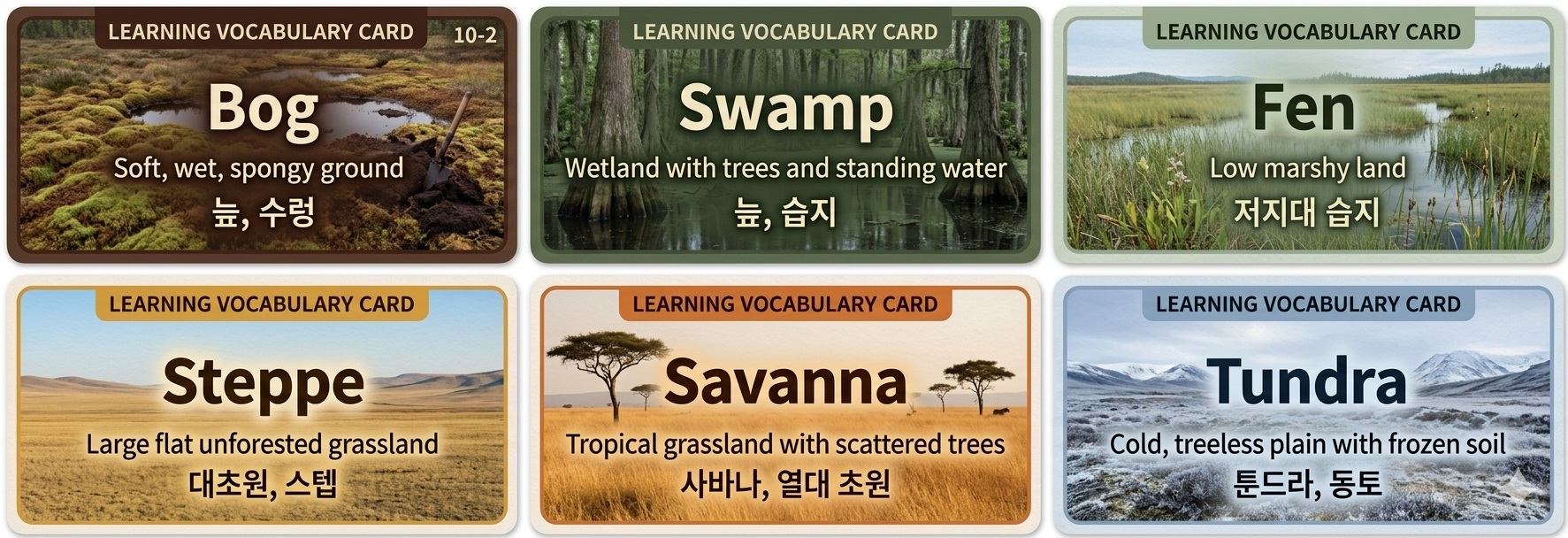
A Bog is known
for its soft, spongy ground
made of accumulating peat
and highly acidic conditions.
6.
A photographer is taking pictures
in the Everglades.
They are navigating a boat
through thick groups of cypress trees
that are growing directly out of the deep,
standing water.
This environment is a:
A) Heath
B) Moorland
C) Swamp
D) Fen
Answer: C
Explanation:
A Swamp is a wetland
specifically defined by the presence
of permanent standing water and woody trees.
7.
A researcher is studying
a low-lying wetland
that is fed by mineral-rich surface water.
Unlike an acidic bog,
this area is alkaline
and supports a unique variety of marshy plants.
This specific land is a:
A) Fen
B) Tundra
C) Steppe
D) Wasteland
Answer: A
Explanation:
A Fen is a low, marshy land
that, unlike a bog, is less acidic
and fed by mineral-rich groundwater or surface water.
8.
An explorer is traveling across Central Asia.
For hundreds of miles,
there is nothing but a vast, flat, and dry grassland.
There are no trees and very little rainfall,
but it isn't a desert.
They are crossing the:
A) Marsh
B) Bog
C) Steppe
D) Swamp
Answer: C
Explanation:
A Steppe is
a large, flat, and unforested grassland,
typical of regions
like Central Asia and parts of Eastern Europe.
9.
During a safari in East Africa,
a tourist sees a wide landscape of tall grass.
There are occasional acacia trees
scattered far apart,
and lions are hiding in the shade.
This tropical grassland is a:
A) Tundra
B) Savanna
C) Heath
D) Moorland
Answer: B
Explanation:
A Savanna is
a tropical or subtropical grassland
characterized by scattered trees and a seasonal climate.
10.
A scientist is visiting the Arctic Circle.
The ground is flat and treeless,
and even in the summer,
the deeper layers of soil remain permanently frozen.
This cold, harsh environment is the:
A) Fen
B) Marsh
C) Wasteland
D) Tundra
Answer: D
Explanation:
The Tundra is
a cold, treeless plain
found in Arctic regions
where the subsoil is permanently frozen
(permafrost).
11.
You are reading
a classic novel
where a character gets lost in a "broad area of open,
often wet land" in the countryside.
The author uses the term
for this specific type of high, wild terrain.
Which term is used?
A) Moorland
B) Steppe
C) Swamp
D) Savanna
Answer: A
Explanation:
Moorland (the noun form of moor) refers to
the broad, open,
and often damp upland areas
typical of the British countryside.
☞
[학습용 단어장]
'영어 어휘력 기르기' 카테고리의 다른 글
| 어휘력 [wish - (28)] - Ⅰ → [단어/숙어 11] → [테스트 3] (1) | 2026.04.11 |
|---|---|
| 어휘력 [wish - (28)] - Ⅰ → [단어/숙어 11] → [테스트 2] (2) | 2026.04.11 |
| 어휘력 [wish - (28)] - Ⅰ → [단어/숙어 10] → [테스트 3] (0) | 2026.04.09 |
| 어휘력 [wish - (28)] - Ⅰ → [단어/숙어 10] → [테스트 2] (1) | 2026.04.09 |
| 어휘력 [wish - (28)] - Ⅰ → [단어/숙어 10] → [테스트 1] (0) | 2026.04.09 |